 Society

Phú Quốc counts down to November 10 as Symphony of the Sea Season 3 prepares to light up a 3,000sq.m ocean stage
1.
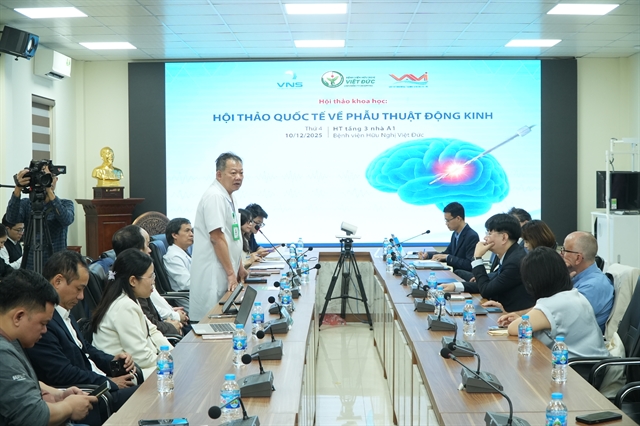 |
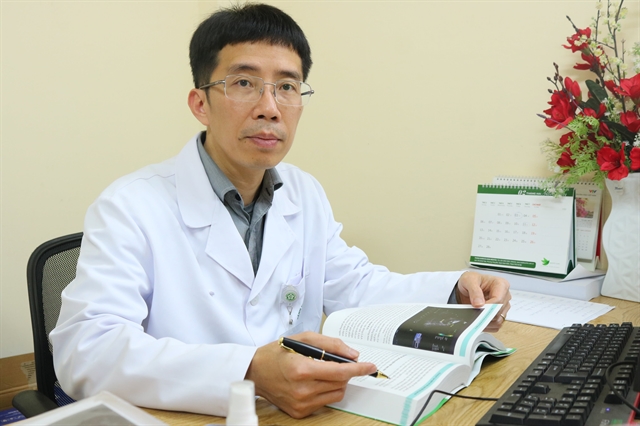
| Dr Dương Đức Hùng, director of Việt Đức General Hospital, speaks at the workshop in Hà Nội on December 10. — Photo courtesy of the hospital |
HÀ NỘI — Health experts shared the latest studies and experience in epilepsy surgery and treatment at an international workshop held by the Việt Đức General Hospital in Hà Nội on Wednesday.
Speaking at the event, Việt Đức General Hospital Director Dr Dương Đức Hùng said the event serves as an important bridge, helping Vietnamese doctors update their knowledge of advanced techniques, share clinical experiences and expand professional cooperation with leading neurological centres worldwide.
At the event, experts said that epilepsy surgery is increasingly becoming a life-saving solution for patients with drug-resistant epilepsy, noting that accurate identification of the seizure zone is a crucial factor in its success.
Drug-resistant epilepsy, which causes seizures that continue despite the use of at least two appropriate anti-epileptic drugs, affects approximately 30 per cent of epilepsy patients.
When medication fails to control the seizures, surgery is a crucial option for improving quality of life and reducing the risk of long-term complications.
Participants also focused their discussion on specialised topics, particularly the application of stimulation with stereoelectroencephalography (SEEG) to optimise epilepsy surgery.
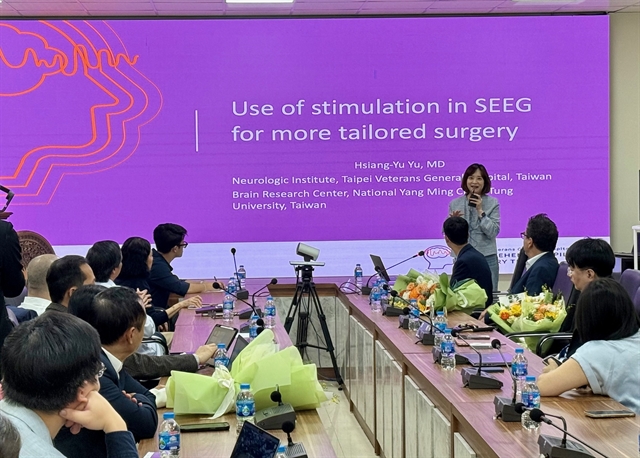 |
| Dr Hsiang-Yu Yu from the Taipei Veterans Hospital (Taiwan) shares her experience in establishing a SEEG monitoring unit at her hospital. — VNS Photo Thanh Hải |
SEEG is a minimally invasive surgical procedure used to identify deep areas in the brain where difficult-to-treat epileptic seizures begin. It may be used in patients with epilepsy not responding to medical treatment, and who are potential candidates to receive brain surgery to control seizures.
SEEG has proven to be a valuable tool, with a high success rate in identifying seizure areas and a low complication rate (approximately 1–2 per cent). The adoption of SEEG is increasing globally, particularly in specialised centres in the US, Europe, China and India.
Speakers also shared their experiences in establishing a SEEG monitoring unit at Taipei Veterans Hospital (Taiwan), including pre-epileptic seizure assessment, radio frequency coagulation under SEEG guidance in seizure treatment, SEEG procedure steps, SEEG design principles and pre-operative assessment of drug-resistant epilepsy.
In Việt Nam, with the development of neurosurgery and neuroelectrophysiology, SEEG is expected to become an important direction for improving the effectiveness of epilepsy surgery, helping many patients overcome seizures and improve their quality of life.
Currently, there are approximately 710,000 people with epilepsy in Việt Nam, of which about 213,000 are drug-resistant. The annual incidence of epilepsy ranges from four to 14 people per 1,000 population. Children with epilepsy account for 30-40 per cent of epilepsy patients in Việt Nam. — VNS
Society
 Society
 Society
 Society
 Society
 Society
 Society
 Society
 Society
 Society
 (1).JPG) Society
Society
 Society
 Society
 Society
 Society