 Society
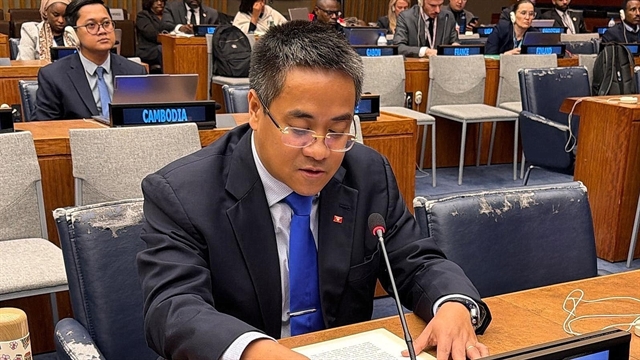
Việt Nam reaffirms ASEAN support for UN radiation scientific committee
1.
 (1).JPG)
|
| Doctors of the level-2 field hospital No.7 at a large-scale mass-casualty incident (MCI) exercise on Tuesday in Bentiu, South Sudan.— Photos courtersy of the Việt Nam Department of Peacekeeping Operations |
BENTIU — Level-2 Field Hospital Rotation 7 of Việt Nam’s peacekeeping force took part in a large-scale mass-casualty incident (MCI) exercise designed to assess the emergency response capacity of Level-1 hospitals across the sector on Tuesday in Bentiu, South Sudan.
The drill was based on a realistic scenario developed by the Sector Health Office and the Emergency Operations Centre of the United Nations Mission in South Sudan (UNMISS).
The exercise aimed to enhance the mission’s ability to respond rapidly to “accidents” involving high numbers of victims with varied and complex injuries.
MCI preparedness is regarded as a critical component of peacekeeping medical training, strengthening command and coordination in a multinational framework, standardising field-care procedures, and reaffirming the role of the field hospital as the sector’s higher-level medical facility.
Under the scenario, a UNPOL patrol travelling along Guit Road, which connects the UN base in Bentiu with a nearby camp for displaced people, encountered an explosive device, leaving 10 officers with injuries of differing severity.
Following the initial report, the Field Integrated Operations Centre (FIOC), together with UNDSS, UNMAS and the office, activated the mission’s MCI command mechanism and mobilised medical assets across the sector for casualty management and evacuation.
At the scene, level-1 hospitals from Mongolia, Pakistan, and Ghana, along with the Ghanaian Formed Police Unit, implemented rapid triage following the START protocol.
They carried out initial life-saving treatment before transporting patients to the hospital Rotation 7 the designated higher-level facility.
Vietnamese medical officers from the hospital acted as supervisors and clinical advisers, assessing the performance of level-1 units in a challenging field environment.
|
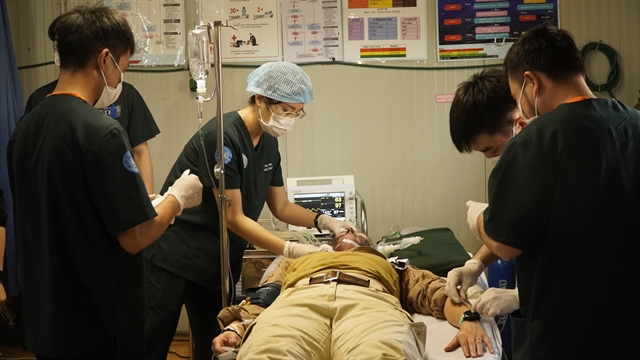
| Doctors of the level-2 field hospital No.7 treat a patient at the drill on Tuesday in Bentiu, South Sudan. |
MCI plan activated
Upon receiving instructions from the office, the hospital Rotation 7 activated its internal MCI response plan.
Personnel, equipment and treatment areas were organised into four priority groups of red, yellow, green and black, corresponding to UN emergency care guidelines.
Patients were triaged at the hospital entrance and moved to designated treatment zones, where Vietnamese clinicians conducted advanced triage under the SORT protocol, provided trauma resuscitation, and made surgical decisions in line with UN regulations.
Simulated injuries were designed to reflect real operational risks, including open chest wounds, compound leg fractures, facial and chest burns, multiple shrapnel injuries, traumatic brain injury, as well as one fatality recorded at the scene.
Head of the hospital said the drill clearly demonstrated the effectiveness of Việt Nam’s pre-deployment training.
Most MCI scenarios had already been rehearsed domestically under training programmes overseen by the Việt Nam Department of Peacekeeping Operations.
Experienced instructors from the Military Medical Academy, the Department of Military Medicine, Military Hospital 175 and Military Hospital 103 had developed mission-specific curricula, provided direct training and evaluated performance during both pre-deployment courses and field training exercises.
The preparation enabled Vietnamese medical teams to confidently apply the START–SORT protocols, coordinate with multinational partners and handle mass casualties under peacekeeping conditions.
.JPG)
|
| Doctors of the level-2 field hospital No.7 at a large-scale mass-casualty incident (MCI) exercise on Tuesday in Bentiu, South Sudan. |
Practical results
In the exercise, the hospital not only provided second-tier medical care but also assessed the clinical performance of level-1 units, contributing to capacity-building across the sector.
Its report to the post-exercise evaluation meeting noted that participating units performed well in triage, initial first aid and CASEVAC operations in accordance with UN MCI principles.
The results also indicated that the inter-hospital coordination model within UNMISS worked effectively, ensuring the safe evacuation and treatment of multi-trauma patients in a complex security environment.
One notable outcome was that 8 out of 10 triage cases were accurately categorised using the START-UN colour-code system.
Essential life-saving interventions such as airway control, tourniquet application, limb immobilisation and burn management, were carried out effectively.
Level-1 hospitals demonstrated good organisational discipline, rapid response and clinical practice aligned with established procedures.
Treatment zones at the scene were clearly demarcated, maintaining safety and preventing interference with the management of critical patients.
Alongside these strengths, Rotation 7 hospital recommended improvements in several areas, including more consistent cervical-spine immobilisation in head and facial trauma cases; standardising patient transfer from ground to stretcher to avoid secondary injury; strengthening the assessment of airway burns; reducing on-site treatment time for red-category patients; and directing green-category patients to move independently to safe areas to ease the load on evacuation teams.
The hospital will compile these recommendations for submission to the office and will support level-1 hospitals in developing internal training programmes on the START-SORT system in the coming months.— VNS
Society
 Society
 Society
 Society
 Society
 Society
 Society
 Society
 Society
 Society
 Society
.jpg) Society
Society
 Society
 Society
 Society