 Society

Việt Nam, Switzerland to turn education, sci-tech, innovation into cooperation focus
1.
|
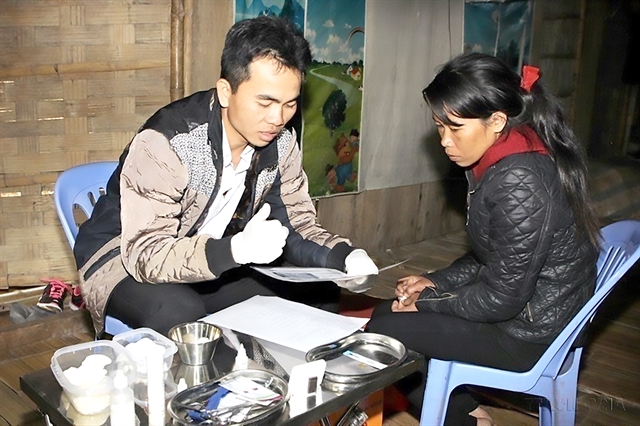
| A health worker offers free mobile HIV testing to a woman in the northern province of Thanh Hóa. — VNA/VNS Photo |
HÀ NỘI — More than three decades after Việt Nam recorded its first HIV case, the country’s fight against the epidemic has shifted from fear and exclusion to sustained public-health progress, driven by early political commitment, wider access to antiretroviral treatment and a slow but visible erosion of stigma.
When HIV first appeared in 1990, it brought a wave of panic that swept through families, workplaces and entire communities. The virus was quickly tied to social evils and thousands of people living with HIV were pushed into isolation.
Many recall hiding their diagnosis for fear of being shunned.
"We weren’t dying of AIDS; we were dying of stigma," one activist said.
That climate has changed markedly. Treatment is now widely available, thanks in part to consistent government policy and the gradual integration of HIV services into the national health-insurance system.
ARV therapy has become a cornerstone of care, with Việt Nam among a handful of countries where more than 95 per cent of people on treatment achieve viral suppression, meaning they cannot transmit HIV through sex.
In 2024, 96 per cent of treated patients reached that threshold.
Public attitudes have softened too. HIV is no longer widely seen as a death sentence but as a chronic, manageable condition. For many, the shift has been transformative: people living with HIV can work, marry and have children without passing on the virus, and remain active in their communities.
The legal framework has moved in the same direction. Việt Nam’s Law on HIV/AIDS Prevention and Control, first passed in 2006 and amended in 2020, explicitly bans discrimination and affirms the right to education, employment and social participation for people living with HIV.
Public-health experts regard it as one of the country’s most progressive health laws.
Community networks have become a defining feature of Việt Nam’s response. Beyond non-governmental organisations, hundreds of grassroots groups, including networks of people at high risk and those living with HIV, now provide counselling, outreach and support, working as an informal extension of the health care system.

|
| A workshop addressing stigma against people with HIV in 2022. — Photo vaac.gov.vn |
Their presence has helped people test earlier, start treatment sooner and stay in care.
The expansion of health insurance coverage has also filled a critical gap since foreign donors began withdrawing support in 2018. Today, 95 per cent of patients are insured and nearly 90 per cent of people on ARV treatment receive their medication through insurance.
For many families, this has eased what was once a crushing financial burden.
The results are visible in the numbers. New infections have fallen from about 30,000 a year in the early 2000s to roughly 11,000–13,000 today, a drop of around 60 per cent.
Screening and confirmatory testing are now available in 34 provinces and cities, and mother-to-child transmission has declined to just 2.8 per cent.
By mid-2025, Việt Nam had recorded 267,455 people living with HIV nationwide, with 5,120 new cases detected in the first half of the year.
Health officials say the next stage will be more complex. As treatment expands, the country must sustain financing, scale up pre-exposure prophylaxis (PrEP) and promote self-testing, especially among groups at high risk.
Communication – long the weak link – will also need a reset.
"We only defeat HIV when people understand it, when they’re no longer afraid to get tested, and when those living with HIV are welcomed rather than pushed away," said Hoàng Minh Đức, Director of Administration of Disease Prevention.
Experts argue that continued progress depends as much on social attitudes as on medical advances. They point to the gains made when stigma declines: earlier testing, stronger treatment adherence and healthier lives.
"Compassion and acceptance have broken down barriers that once felt immovable," said Phạm Đức Mạnh, a senior official at the Ministry of Health. "That is what has brought us closer to the goal of ending AIDS by 2030."
Việt Nam’s long fight against HIV/AIDS, once defined by fear and misunderstanding, is now characterised by steady advances and broader public acceptance.
The challenge for the next decade is to preserve those gains and to ensure that no one is left behind as the country pushes toward its goal of eliminating AIDS as a public health threat. — VNS
Society
 Society
 Society
 Society
 Society
 Society
 Society
 Society
 Society
 Society
.jpg) Society
Society
 Society
 Society
 Society
 Society