 Society

AIMCONNECT 2026 Held in Singapore, Bringing Global Automotive Leaders Together to Explore the Future of AI, Trust and Connected Mobility
1.
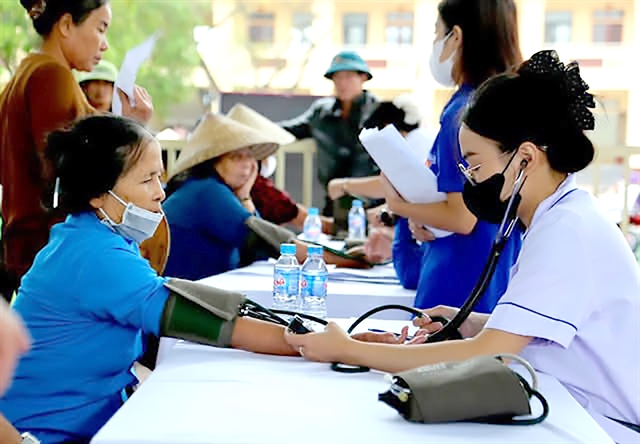 |
| Medical workers give overall health check for residents in Nghệ An Province. — Photo suckhoedoisong.vn |
NGHỆ AN — Facing chronic shortages of manpower, equipment and public trust in primary health care across the highland western districts, leaders of Nghệ An Province’s Department of Health have called for a complete operational overhaul, shifting fully to proactive, community-rooted services.
Communal health stations must reclaim their role as the frontline where people confidently entrust their daily care.
During a working session on Monday with communal health station leaders and directors of the Quỳ Châu, Quế Phong and Quỳ Hợp health care centres, officials discussed widespread challenges facing primary health care in the region.
Each locality has distinct conditions but shares constraints that prevent services from meeting community expectations. Human resources remain the most pressing issue. Health centres do not have enough doctors, particularly in specialities requiring extensive experience, including emergency resuscitation, obstetrics, anaesthesia and oral surgery. Some stations still have unfilled key positions and past mergers have stretched staff across multiple roles, leaving uneven professional capacity.
Equipment and infrastructure continue to limit services. Many stations operate with outdated or incomplete machinery, curtailing the introduction of new techniques. Quế Phong lacks essential diagnostic tools such as endoscopes and refractometers. Quỳ Châu faces funding shortfalls and limited backup systems. Quỳ Hợp is under repair, leaving cramped rooms and old equipment that drive patients to higher-level facilities.
Natural disasters further compound challenges, with some stations damaged and unrepaired, forcing staff to use village halls for examinations. Outdated facilities reduce on-site capacity, with some stations seeing only 15–20 patients per day. These limitations prevent primary health care from serving as a true gatekeeper, particularly in highlands where frontline flexibility, proactivity and resilience are critical.
Support strategies
Đặng Tân Minh, Director of the Quỳ Châu Health care Centre, said, "When manpower and equipment are fully supplemented, service quality will improve, better attracting and retaining patients."
Echoing the focus on strengthening lower-level facilities, Chu Trọng Trang, Director of the Nghệ An Centre for Disease Control, said the department would increase specialist staff, supervise operations, check vaccine storage, monitor immunisation and communicate risks, ensuring stations can handle multiple tasks simultaneously.
Provincial hospitals, such as Obstetrics-Pediatrics, General Friendship, Endocrinology and Oncology, have committed to expanding training and technique transfers through hands-on practice at local facilities. Provincial doctors will join cases, guiding local staff in difficult deliveries, obstetric emergencies, resuscitation, endoscopy, ultrasound and chronic disease management. Training on real patients is designed to build local doctors’ skills and confidence.
Parallel support measures include regular remote consultations, inter-hospital specialist groups and scheduled site visits. Needs-based, practical training is expected to boost treatment capacity, reduce referrals and allow highland residents to access quality care locally.
Community-centred approach
Amid these challenges, Director of the Nghệ An Health Department Lê Thị Hoài Chung called for a fundamental shift: primary health care must proactively screen and manage health in villages rather than wait for patients. She stressed professional discipline, service attitude and medical ethics.
"Serving the people means respecting them. Weak specialties like emergency resuscitation, internal medicine and obstetrics must be retrained hands-on to ensure frontline doctors handle basics, reducing referrals," Chung said.
Communal stations must work closely with the commune People’s Committees, supporting epidemic prevention, immunisation and non-communicable disease management tailored to local needs.
"Overcoming primary health care challenges is not just about adding staff or machines. Crucially, we must restore stations’ true role. Prevention precedes treatment. The frontline must be close to, near and care for the people," she added.
Doctors are now expected to proactively visit villages for screenings, chronic disease follow-up and routine non-communicable care. The approach moves facilities from passive centres to active community engagement, tracking households and risk groups for continuous highland health management.
Deputy Director Nguyễn Hữu Lê advocates reallocating manpower to prioritise communal levels, transferring and supplementing staff boldly, and redistributing positions to empower centre directors and station chiefs in professional management. Key focuses include basic techniques, essential supplies, emergency shifts and strict monitoring: stations report on prevention, immunisation and chronic care, while centres regularly visit communes for support and oversight.
"When communal levels lack manpower, equipment and mechanisms, the people suffer most. Only when primary health care strengthens can health equity be truly ensured," Lê said. — VNS
Society
 Society
 Society
 Society
 Society
 Society
 (1).JPG) Society
Society
 Society
 Society
 Society
 Society
 Society
.jpg) Society
Society
 Society
 Society