 Society
42 people hospitalised over suspected gas leak in Hà Nội
1.
|
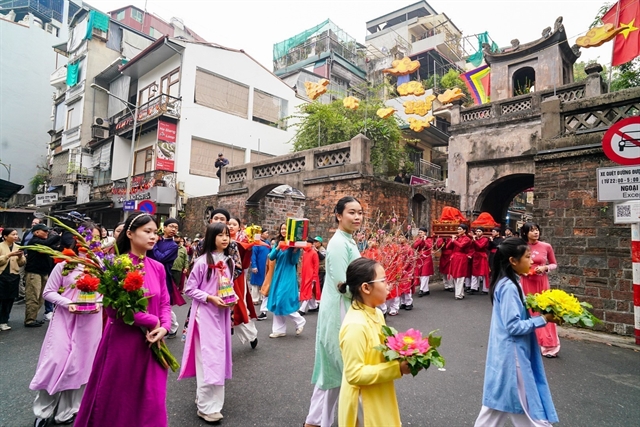
| More than 400 people dressed in traditional costumes paraded along 16 streets, passing historic sites and scenic spots in Hà Nội’s Old Quarter and around Hoàn Kiếm Lake earlier this year, as part of the 'Tết Việt – Tết Phố 2025' programme. — VNA/VNS Photo |
HÀ NỘI — Rapid urbanisation is transforming Việt Nam’s major cities, and expectations from residents and investors are climbing steadily. These pressures are prompting policymakers to search for more effective mechanisms to upgrade public spaces and commercial districts.
One concept gaining increasing attention is the Business Improvement District (BID) model. It encourages shared responsibility, long-term planning and closer collaboration between the public and private sectors.
Around the world, commercial and cultural districts have become powerful engines for economic activity and national branding. This global trend strengthens the case for developing similar zones in Hà Nội, a city with considerable untapped potential.
Yet despite these advantages, Việt Nam’s experience with BIDs remains limited. The model lacks an official legal framework, making it difficult to establish and operate. Its success also depends heavily on a strong consensus among businesses, which must both contribute financially and benefit directly.
According to Deputy Director of the Hà Nội Department of Finance Lê Trung Hiếu, a BID should not be understood simply as a physical area. It is a creative and forward-looking form of urban governance.
Within a BID, businesses and property owners agree to pay an additional fee to improve their immediate surroundings, from infrastructure and security to cultural activities and marketing. It is, in essence, a community-led effort to enhance and enrich its own living and working environment.
The fundamental objective of a BID is to create a district that is attractive to residents, workers and investors. BID activities typically span landscape upgrades, enhanced security, environmental sanitation, cultural programming and promotional campaigns designed to strengthen the area’s identity.
One of the BID model’s greatest strengths is its ability to respond quickly to issues that local authorities may struggle to address comprehensively, Hiếu said.
By creating a self-governance mechanism, BIDs allow stakeholders with direct interests to take part in decision-making and the implementation of initiatives. This not only builds shared responsibility, but also fosters closer ties between businesses and the surrounding community.
Crucially, a BID is not only about beautifying streets — it turns cultural and commercial values into long-term development drivers, he said.
Hà Nội, with its rich heritage, offers fertile ground. With the right approach, any street could evolve into its own version of Times Square.
In the US, New York City itself underwent a dramatic transformation in the 1980s thanks to the Times Square Alliance BID, which invested heavily in safety, cleanliness, lighting and events. Today, it stands as one of the world’s most recognisable urban success stories.

|
| Large crowds visit the dining area at AEON Long Biên during the National Day holiday on September 2. |
Interest in applying the BID model is growing in Việt Nam, especially in major cities like Hà Nội and HCM City.
Hiếu said that pilot programmes in the Old Quarter, pedestrian streets or busy commercial hubs could yield strong benefits, particularly by supporting tourism and the night economy. BIDs could help extend business hours, raise visitor spending and improve the overall urban experience, an approach many cities are now pursuing worldwide.
A BID also creates a framework for businesses to jointly invest in services that are more professional and appealing. Improvements can be funded through socialised resources, ranging from lighting and greenery to environmental sanitation. Security can be enhanced through CCTV systems or dedicated patrol teams, helping create a safer and more civilised urban environment.
Nguyễn Hưng Quang, Vice President of the Việt Nam Society of International Law, said Hà Nội has great potential to apply BID models in areas that combine commercial activity, cultural significance and environmental value.
This could include improving the operational model of existing pedestrian streets, such as the Hoàn Kiếm area, Trịnh Công Sơn Street, Thống Nhất Park, Đảo Ngọc – Ngũ Xã or the Sơn Tây ancient citadel, along with establishing new BIDs in culturally distinctive communities such as the Old Quarter, Đường Lâm ancient village and Vạn Phúc silk village.
Piloting BIDs in commercial and cultural hotspots could enable Hà Nội to better leverage its comparative advantages, especially in trade, services, tourism and heritage.
According to Hiếu, the model is fully workable. In the Old Quarter’s 36 guild streets, a BID could channel heritage value into new economic energy while protecting the area’s cultural identity.
If carried out well, a BID could upgrade urban aesthetics and boost the night economy. The key challenge is balancing preservation with commercial growth.
Agencies admit that rules for BIDs remain incomplete, existing efforts are ad hoc and planning and oversight are still fragmented. Incentives for social investment are limited, and, as Hiếu notes, the biggest barrier is the lack of a clear legal framework.
Businesses may also be cautious, as the model depends on voluntary contributions and strong trust. Without transparent governance, confidence can fade quickly, he said.
For a BID to succeed, businesses and property owners must share a common vision, supported by clear management and financial transparency.
Hiếu said that real progress will require firm legal groundwork, workable operational rules and committed stakeholders. With trust in place, a BID can evolve from a planning tool into a collaborative model that helps renew and enrich urban districts. — VNS
Society
 Society
 Society
 Society
 Society
 Society
 Society
 Society
 Society
 (1).JPG) Society
Society
 Society
 Society
 Society
 Society
 Society