 Society
Lotte, Phát Đạt combine strengths in Thu Thiem project
1.
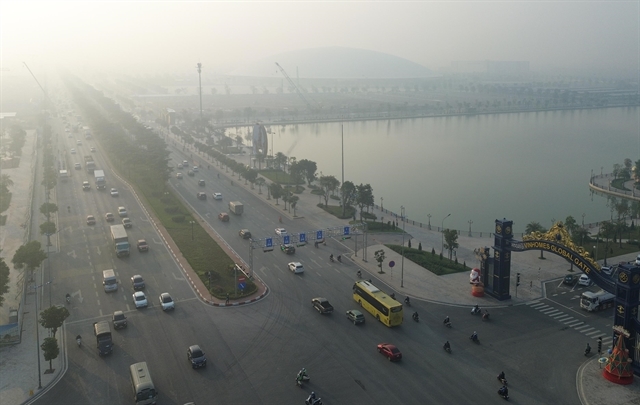 |
| A section near the National Exhibition and Convention Centre in Đông Anh District, Hà Nội, is shrouded in thick smog and fine dust on Wednesday. VNA/VNS Photo Phan Phương |
HÀ NỘI — Residents of Hà Nội are facing hazardous air pollution as Air Quality Index (AQI) levels entered the purple zone, a threshold considered very unhealthy, with data on Wednesday ranking the capital the third most polluted city in the world.
According to real-time measurements from the IQAir app on Wednesday morning, Hà Nội recorded an AQI of 223, placing it third worldwide for air pollution. On Tuesday, the city’s AQI was 188, ranking seventh globally.
Monitoring stations across the capital city on Wednesday all reported purple-level readings. Quảng Khánh recorded an AQI of 274; Ciputra 246; Lê Duẩn 240; Hoàng Quốc Việt 234; and Linh Đàm 220.
Data from the Ministry of Agriculture and Environment’s monitoring system also showed dangerously high AQI levels with many locations reaching the purple threshold.
Experts warn that when AQI reaches hazardous levels between 301–500, the public should minimise outdoor exposure, avoid all outdoor activities and remain indoors as much as possible. Recommendations for sensitive groups are even stricter in that they should not go outside at all and must ensure indoor spaces have safe, well-ventilated air.
 |
| Hà Nội remains among the world’s most polluted cities, posing serious risks to public health. VNA/VNS Photo Phan Phương |
Hà Nội has spent several days shrouded in thick smog laced with fine particulate matter, driving the air quality index from unhealthy red levels to very unhealthy purple.
Lê Thanh Thuỷ, Deputy Head of the Environmental Management Division under the Hà Nội Department of Agriculture and Environment, noted that the capital is under “tremendous pressure” from air pollution with PM2.5 concentrations remaining high and fluctuating sharply.
According to the department, air quality varies significantly between areas with central districts showing higher AQI levels partly due to heavier traffic, dense construction activity and congestion.
Thuỷ explained that year-end urban upgrading projects, frequent traffic jams, increased transportation of construction materials and open burning of waste and agricultural by-products all worsen air pollution.
“The weather conditions have not been favourable while many activities peak at the end of the year, placing enormous pressure on Hà Nội,” she said.
Hoàng Dương Tùng, Chairman of the Việt Nam Clean Air Network, stressed that Hà Nội’s air pollution problem does not originate solely within the city but also from neighbouring provinces such as Bắc Ninh, Ninh Bình and Hưng Yên.
To address this, he said, authorities must apply AI to validate, clean and synchronise air quality and pollution source data.
“Only with accurate, transparent, real-time data can we build appropriate scenarios and policies,” he said.
Also on Wednesday, the National Assembly approved a Resolution on the implementation of environmental protection policies and laws since the 2020 Law on Environmental Protection took effect.
The Resolution calls for urgent action to address and improve air quality in the country’s two largest cities of Hà Nội and HCM City during 2025–2026 while setting out a roadmap for emission reduction and stronger environmental monitoring in the following years.
By 2030, the Resolution sets a target that the average annual concentration of PM2.5 in Hà Nội must be reduced by around 20 per cent compared to the 2024 baseline at all monitoring stations in the national network.
Surrounding localities including Thái Nguyên, Phú Thọ, Bắc Ninh, Hưng Yên, Hải Phòng and Ninh Bình must achieve at least a 10 per cent reduction.
To reach these goals, lawmakers require strict control of emissions from vehicles, limits on highly polluting vehicles in major urban centres and the removal of vehicles that fail to meet minimum technical standards.
The Resolution also mandates tighter regulation of waste generated from construction and transport activities; curbs on the burning of agricultural by-products; and expanded collection and treatment of domestic wastewater to prevent further pollution in densely populated areas.
In addition, the National Assembly directs the swift completion and operation of a national environmental information and data system, including an integrated public map of environmental quality. This system will be applied in major cities such as Hà Nội and HCM City, connected to national databases, and provide real-time information to support management, monitoring and early warning efforts. — VNS
Society
 Society
 Society
 Society
 Society
 Society
 Society
 Society
 Society
 Society
 Society
 Society
 Society
 Society
 Society