 Society
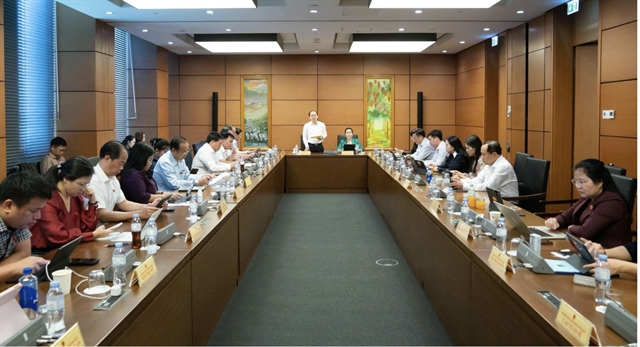
Draft law proposes to expand eligible tissue and organ donors
1.
 |
| Speakers discuss solutions to the 'impossible triangle' at the CONTECH+ 2025 conference on Wednesday. — VNS Photo Trần Như |
HÀ NỘI — Vietnamese architects and builders are grappling with what they call an 'impossible triangle': how to deliver social housing that is fast, affordable and built to last.
The dilemma sat at the centre of CONTECH+ 2025, a conference held in Hà Nội on Wednesday, as the government pushes ahead with an ambitious plan to build at least one million social housing apartments by 2030.
Hồ Chí Quang, director of the National Institute of Architecture, said the sector carries a heavy responsibility to challenge long-held assumptions that social housing is inevitably cramped and low-quality.
Meeting the national target, he said, demands more than reaching the unit count; it also requires building homes that are durable and liveable.
Nguyễn Tất Thắng, a senior researcher at the institute, said the 'impossible triangle' reflects structural weaknesses throughout the value chain.
Designs remain insufficiently standardised; many projects lack ventilation and natural light, driving up long-term living costs; and construction still relies heavily on manual, labour-intensive methods.
Digital tools such as Building Information Modelling are rarely used, he noted, slowing schedules and inflating budgets.
To break the stalemate, Thắng urged a decisive shift to industrialised construction, with technology embedded from design to operation.
Without that, he said, the scale of work ahead – dozens of millions of square metres of floor area within a decade – will outstrip the industry’s capacity.
CONTECH+ 2025, themed ‘Design – Technology – Materials – Interior Solutions for Architecture and Social Housing,’ was organised by the National Institute of Architecture (Ministry of Construction) in collaboration with Vietnam Architecture Magazine.
“In the context of rapidly increasing demand for social housing, while urban land reserves are shrinking, infrastructure remains inadequate, incentive mechanisms face many obstacles, and construction technology is slow to innovate, the organisation of a specialised forum like CONTECH+ 2025 is considered timely and necessary", said Editor-in-Chief of Vietnam Architecture Magazine, Phạm Thị Thanh Huyền.
She added that the conference was conceived as an annual forum to connect design consultants with technology and materials enterprises, investors, and regulatory agencies, thereby promoting applied research and disseminating feasible solutions. It also aims to link the social responsibility and humanistic values of professionals with the Government’s social housing programme
Đỗ Đức Thắng, recognised as Việt Nam’s top IPSTAR inventor in 2021, described a 5,000-apartment Samsung dormitory project delivered a decade ago.
Each 30-square-metre apartment cost roughly VNĐ100 million (around US$3,800) at the time, a result he said was achieved through disciplined design and technology-led construction.
But there are barriers that continue to stifle innovation, including a regulatory mechanism that does little to encourage new approaches and a persistent reluctance among investors and contractors to adopt new technologies.
Thắng called for wider pilot schemes for proven construction technologies and for those methods to be gradually written into national standards.
Vũ Hồng Cương of Hà Nội Architectural University said social-housing design should begin with actual user needs – compact but flexible apartments able to shift functions, maximise space and maintain basic comfort.
Interior design and spatial organisation, he added, must not be treated as afterthoughts, as they are central to the living experience of low-income households.
In a concluding discussion, experts agreed that Việt Nam must treat social housing as a form of large-scale industrial production, backed by digital technology and streamlined approvals to draw more private developers into the sector.
Recommendations from the conference will be submitted to the Ministry of Construction as it drafts upcoming policy revisions. — VNS
Society
 Society
 Society
 Society
 Society
 Society
 Society
 Society
 Society
 Society
 Society
 Society
 Society
 Society
 Society