 Society

Việt Nam, Suriname promote substantive cooperation across multiple fields
1.
 |
| The working delegation from the Hà Nội Department of Agriculture and Environment and Chuyen My Commune visits the Bat Trang Pottery Museum in Bat Trang Commune, Hanoi. Photos courtesy of Hà Nội Department of Agriculture and Environment |
To complete the application dossier for the World Crafts Council’s recognition of Chuyen My’s traditional mother-of-pearl inlay and lacquer craft village as a member of the World Crafts and Folk Art Cities Network in 2025, on September 12, the Hanoi Department of Agriculture and Environment, in coordination with the Chuyen My Commune People’s Committee, organised a study tour to Bat Trang Ceramic Village and Son Dong Wood Carving Village—two models of successful creative craft development closely linked with tourism and international integration.
Expanding the creative space of craft villages
At the meeting, Do Thanh Thuan, Vice Chairman of Bat Trang Commune People’s Committee, shared that after implementing the two-level local government model (since July 1, 2025), Bat Trang Commune now encompasses three ceramic-producing villages—Bat Trang, Giang Cao, and Kim Lan—with over 6,000 craft households. The commune is home to 173 artisans honored by the State and 49 OCOP-certified products, many of which have achieved 5-star or potential 5-star ratings.
Thanks to the development of creative ceramics, Bat Trang’s average per capita income now exceeds VND87 million per year. In 2025, the commune plans to evaluate and rank 16 new OCOP products, propose recognition for 15 additional artisans, and continue implementing its plan to integrate traditional craft development with experiential tourism.
According to Ha Thi Vinh, Vice President of the Vietnam Craft Villages Association and Chairwoman of the Hanoi Handicraft and Craft Villages Association, Bat Trang has become a symbol of Vietnamese ceramics by harmoniously blending heritage preservation with innovation. Many workshops have been upgraded to welcome visitors, allowing them to experience pottery-making firsthand.
The Center for Vietnamese Craft Quintessence (Bat Trang Ceramic Museum) offers visitors not only architectural and artistic experiences but also insights into the long history of the craft village. Beyond ceramics, the museum brings together other traditional art forms—such as light sculpture, conical hat making, and bamboo weaving—featuring artisans from across the country.
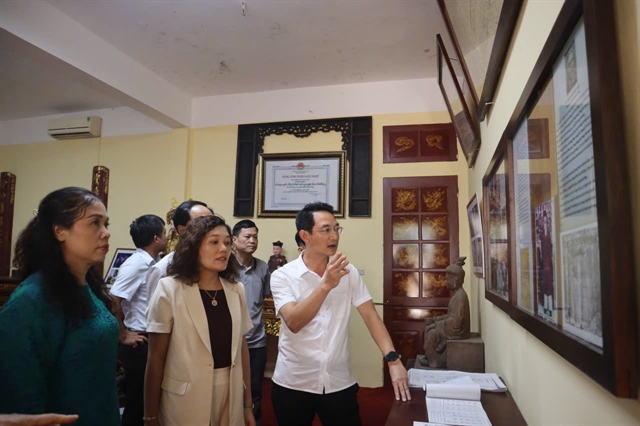 |
| Leaders of Son Dong Commune People’s Committee introduce the local traditional craft at the Design, Exhibition, and Promotion Center for OCOP and Son Dong Handicraft Products. |
Ms. Vinh emphasised that joining the World Crafts and Folk Art Cities Network requires meticulous preparation, strong local commitment, and community cooperation.
“In Bat Trang, every family and every clan contributes to telling the village’s story,” she noted. This model of craft production combined with cultural tourism has been highly appreciated by the World Crafts Council.
Similarly, Son Dong Village is striving to meet the criteria for recognition in 2025. According to Cao Van Tam, Vice Chairman of Son Dong Commune People’s Committee, the village is renowned for its intricate wooden statues, worship objects, and gold-gilded lacquer art, highly valued both domestically and internationally. The skillful hands of Son Dong artisans have left their mark on many iconic cultural landmarks in Hanoi, including the Temple of Literature, Ngoc Son Temple, The Huc Bridge, and the One-Pillar Pagoda.
In recent years, young villagers have opened sculpture and handicraft studios in major cities, contributing to the preservation and promotion of their heritage. To meet 2025 standards, the commune has established a Creative Design Center to showcase OCOP and fine art products and to serve as a hub for innovation and cultural promotion.
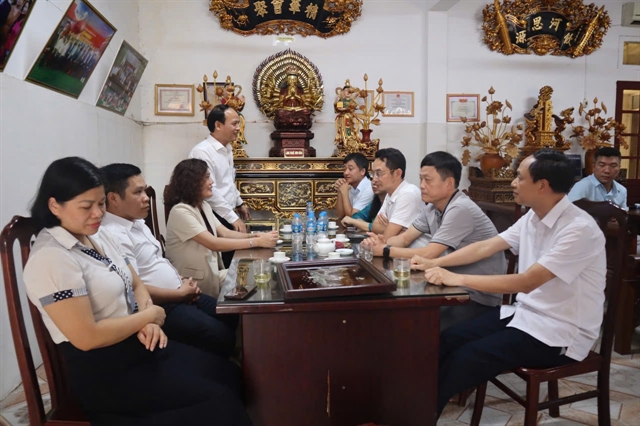 |
| Representatives of the Hanoi Department of Agriculture and Environment and Chuyen My Commune exchange experiences on craft village development with leaders of Son Dong Commune People’s Committee. |
Accelerating progress toward recognition
During the study trip, Nguyen Huu Chi, Chairman of Chuyen My Commune People’s Committee, shared that the commune is actively completing the required criteria for recognition as a member of the World Crafts and Folk Art Cities Network in 2025.
The commune has collected and exhibited valuable artifacts such as royal decrees recognizing the traditional craft, photos of artisans across generations, original design sketches, and materials used in mother-of-pearl inlay and lacquer production. It has also produced an album documenting the evolution of local craft products, launched a multilingual website and promotional videos, and published brochures introducing Chuyen My’s traditional crafts.
Exhibition spaces have been established to display certificates of recognition, awards, ancient tools, and representative artworks. A documentary video on the history of the mother-of-pearl inlay craft has also been produced to enhance cultural storytelling.
“Through learning from Bat Trang and Son Dong, we realise that combining preservation with innovation and production with tourism is the right approach. Chuyen My hopes to soon achieve recognition and bring its traditional mother-of-pearl and lacquer crafts to the global stage,” Mr. Chi expressed.
Toward a sustainable future
According to Hoang Thi Hoa, Head of the Rural Development Division under the Hanoi Department of Agriculture and Environment, Hanoi aims to restore at least five endangered traditional craft villages between 2025 and 2030; officially recognize 10 new crafts and 25 new villages; and develop 10 existing villages into traditional ones. The city also plans to invest in infrastructure, revive cultural spaces, and develop at least three craft villages linked to tourism, forming 10 experiential tourism routes to attract both domestic and international visitors.
Ms. Hoa emphasised that learning from successful models of craft development associated with tourism is essential. She expressed her hope that with the experience of being recognized by the World Crafts Council in 2024, Bat Trang Village and artisan-business leader Ha Thi Vinh will continue to mentor other Hanoi craft villages—particularly Chuyen My—in fulfilling the required criteria to join the global creative crafts network.
By proactively connecting and supporting exemplary craft villages, Hanoi not only advances its local economy but also reinforces its image as a “City for Peace” and a “Creative City” recognized by UNESCO. For Chuyen My, the journey toward becoming a member of the World Crafts and Folk Art Cities Network is more than a quest for a title—it is an opportunity to honor the legacy of its centuries-old crafts, preserve cultural identity, and inspire creativity and global integration within Vietnam’s craft village community. VNS
The article was produced in collaboration with the Hanoi Department of Agriculture and Environment.
Society
 Society
 Society
 Society
 Society
 Society
 Society
 Society
 Society
 Society
 Society
 Society
 Society
 Society
 Society