 Society

AITO Looks Ahead to Europe, Building a Thriving Automotive Ecosystem
1.

|
| Experts attend the national scientific conference themed “Modernising and Elevating Việt Nam’s Higher Education to Create Breakthroughs in High-Quality Human Resource Development and Talent, Driving Research and Innovation” in HCM City on October 24. — Photo Courtesy of VNU-HCM |
HCM CITY — A pilot mechanism allowing selected key universities to independently evaluate and recognise the titles of professor and associate professor, as well as determine the number of vice presidents, has been proposed at a national scientific conference on higher education reform held in HCM City on Friday (October 24).
The conference, titled “Modernising and Elevating Việt Nam’s Higher Education to Create Breakthroughs in High-Quality Human Resource Development and Talent, Driving Research and Innovation,” was co-organised by the Central Commission for Information, Education and Mass Mobilisation, the Party Committee of the Ministry of Education and Training, and Việt Nam National University-HCM City (VNU-HCM).
It aimed to concretise the Politburo’s Resolution No. 71-NQ/TW dated August 22, 2025, on breakthroughs in education and training, and to propose mechanisms that can elevate Việt Nam’s university system to meet national development needs.
Associate Professor Dr. Đỗ Phú Trần Tình, director of the Institute for Policy Development under VNU-HCM, proposed several key measures to strengthen decentralisation and autonomy for national universities in implementing Resolution 71.
He noted that current regulations on organisational structure and personnel management at financially autonomous public universities remain inadequate.
“For example, whether a university has 40,000 or 4,000 students, it is still limited to a maximum of three vice presidents — which is clearly inappropriate,” he said.
Tình proposed allowing key universities to pilot greater autonomy in determining their internal structure and number of vice presidents according to their scale and needs.
“Key universities should be allowed to decide their number of vice presidents and organisational model, tied to transparent supervision and performance evaluation mechanisms to ensure accountability,” he said.
He also called for a pilot mechanism enabling top universities to independently review and confer the titles of professor and associate professor, pointing out that the current four-tier review process is “too cumbersome and inefficient.”
“Four layers of councils are unnecessary. At just the institutional and sectoral levels, an applicant already has to submit up to 50 kilograms of documents,” he remarked.
Tình suggested that multidisciplinary universities with strong academic capacity should be allowed to self-assess, recognise, and appoint professors and associate professors in compliance with national standards set by the Prime Minister.
“The results of such evaluations should have nationwide legal validity, with greater flexibility for exceptionally talented scientists,” he said.
He proposed that the pilot programme run for three years, during which implementation would be closely monitored to refine the model before broader adoption.
|
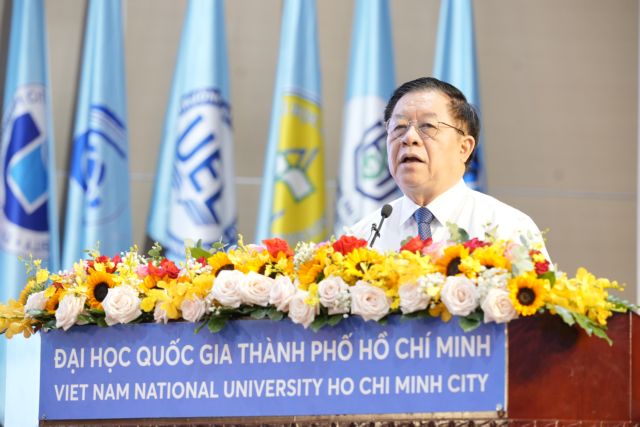
| Nguyễn Trọng Nghĩa, Politburo member, Secretary of the Party Central Committee, and head of the Commission for Information, Education and Mass Mobilisation, gives a speech at the conference held in HCM City on October 24.— Photo Courtesy of VNU-HCM |
From policy to action
Nguyễn Trọng Nghĩa, Politburo member, Secretary of the Party Central Committee, and head of the Commission for Information, Education and Mass Mobilisation, said Resolution No. 71-NQ/TW reflects the Party’s new, action-oriented mindset — shifting from “policy formulation” to “governance and implementation.”
“Modernising and elevating higher education is a key task to create breakthroughs in developing high-quality human resources and talents, while driving research and innovation,” he said.
He emphasised that decentralisation and delegation of authority must go hand in hand with resource allocation, ensuring full autonomy and accountability for higher education institutions.
“With new momentum, determination and the nation’s enduring tradition of learning and respect for teachers, we firmly believe that education and training will truly remain a top national priority — shaping the future of the nation,” he said.
Resolution 71 defines education and training as a central pillar for improving intellectual capacity, nurturing talent, and serving as a key driver for sustainable national development. It calls for innovation in thinking, perception, and institutions to create new motivation and development space while ensuring the State’s leading role and effective mobilisation of social resources.
Participants at the conference agreed that granting more autonomy to leading universities — including piloting their authority to appoint professors and associate professors and allowing flexibility in leadership structures — would align with international practices and foster a more competitive and innovative higher education system.
The event also highlighted VNU-HCM’s proactive role in advancing the goals of Resolution No.71.
Under its 2021–2030 development strategy, the university is focusing on nurturing talent, building elite research groups in semiconductor and artificial intelligence technologies, and expanding its innovation ecosystem — reaffirming its mission to become one of Asia’s leading research universities.
It pledged to act as a “policy laboratory,” pioneering and testing new models to modernise and elevate Việt Nam’s higher education nationwide.
The conference featured more than 40 presentations across four main topics: university policy and governance; human resource training and development; scientific research, technology and innovation; and international integration and sustainable development.
Speakers included representatives from central agencies, top domestic universities, the World Bank, Singapore Management University, and leading enterprises.
Discussions focused on strengthening institutional frameworks, modern university governance, and mobilising resources for building world-class universities.
The outcomes are expected to provide scientific and practical foundations for policymakers and university leaders to shape strategic roadmaps for higher education reform — contributing to the sustainable and innovative development of Việt Nam’s education sector. — VNS
Society
 Society
 Society
 Society
 Society
 Society
 Society
 Society
 Society
 Society
 Society
.jpg) Society
Society
 Society
 Society
 Society