 Society


Vietnamese fashion brand presents Fall-Winter collection at RUNWAY 7 in New York
1.
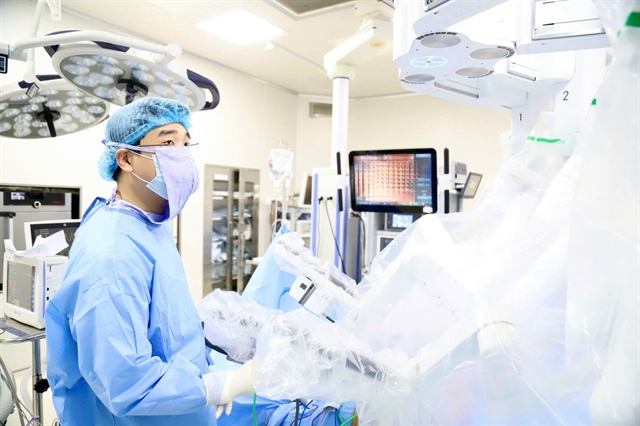 |
| Doctors from the Department of Gastrointestinal Surgery 2 at K Hospital perform a robotic endoscopic surgery to remove and reconstruct the oesophagus of an elderly cancer patient. — Photo courtesy of the hospital |
HÀ NỘI — Doctors from the Department of Gastrointestinal Surgery 2 at the national cancer hospital (K Hospital) have successfully performed a robotic endoscopic surgery to remove and reconstruct the oesophagus of an elderly cancer patient.
According to the hospital, it was a complex case requiring absolute precision due to severe fibrosis of the tissues surrounding the oesophagus following chemotherapy and radiotherapy, with several clinical challenges for the surgical team.
The patient, 66-year-old Nguyễn Hải B. from Thuần Trung Commune in the central province of Nghệ An, was admitted with dysphagia due to an oesophageal tumour. The patient has a history of smoking and heavy drinking for many years, factors that have long been known to be a high risk for gastrointestinal and respiratory diseases.
B. was diagnosed with oesophageal cancer in the lower third of the oesophagus, at a locally advanced stage. The tumour had invaded through the muscular layer of the oesophageal wall and metastasised to several nearby lymph nodes, but had not yet metastasised to distant sites.
Through endoscopic imaging of the patient's oesophagus, doctors discovered an infiltrative ulcerative tumour occupying up to half the circumference of the oesophagus. The tumour, located in the mid-thoracic mediastinum, was situated near vital organs, such as the trachea, bronchi and major blood vessels.
“The tumour has surrounded half of the oesophagus. This is the direct cause of the patient's symptoms, including difficulty swallowing, a feeling of something stuck in the throat, or pain behind the sternum when eating and drinking,” said Dr Đoàn Trọng Tú, head of the Department of Gastrointestinal Surgery 2 at K Hospital.
"CT and PET/CT scans revealed the tumour was in direct contact with the thoracic aorta and mediastinal lymph nodes were present."
Doctors advised and prescribed a concurrent chemoradiotherapy treatment regimen to shrink the tumour before surgical intervention. After completing chemoradiotherapy, the patient achieved a partial response, the disease stage progressed as predicted by the doctors, and the patient was eligible for reconstructive oesophagostomy.
After consultation, B. was prescribed robotic laparoscopic oesophagostomy with reconstruction after concurrent chemotherapy and radiotherapy. For a patient over 60 years old with a complex medical condition, this was a reasonable, safe and optimal treatment option, ensuring good results and a good recovery after surgery, according to Dr Tú.
To provide the best possible treatment options for patients, doctors decided to use the Da Vinci Xi robotic laparoscopic surgery system. With a system of sharp, high-definition 3D HD cameras and flexible robotic arms, surgeons can access and remove lymph nodes in difficult areas, such as near the recurrent laryngeal nerve and adjacent to the aorta, with precision, minimising the risk of missing metastatic lymph nodes after chemotherapy and radiotherapy.
In addition, the robotic arms provide stability for the surgeon, allowing for the safe removal of the tumour from the thoracic aorta and surrounding structures, minimising the risk of perforation or tearing of major blood vessels. The robotic-assisted endoscopic oesophagostomy and reconstruction surgery was performed successfully, ensuring radical treatment of cancer and maximum safety for the patient.
Dr Tú said that minimally invasive robotic surgery significantly reduces chest wall damage and postoperative pain, allowing patients to begin breathing exercises, cough and expectorate early, and quickly remove endotracheal tubes. This technique also reduces intraoperative blood loss, shortening recovery time and the overall hospital stay compared to traditional open surgery.
Doctors advise that early-stage oesophageal cancer often does not present with specific symptoms. Many patients only go to the hospital when they experience difficulty swallowing, chest pain or difficulty eating. This means that the disease has often progressed to a late stage, making treatment more complicated and the prognosis worse.
Quitting smoking and alcohol, adopting a healthy lifestyle, maintaining a balanced diet, getting adequate rest and undergoing early screening are keys to successful prevention, early detection and treatment of diseases, according to experts. — VNS
Society
 Society
 Society
 Society
 Society
 Society
 Society
 Society
 Society
 Society
 Society
 Society
 Society
 Society
 Society