 Politics & Law

Việt Nam, World Bank Group step up cooperation ahead of APEC 2027
1.
|
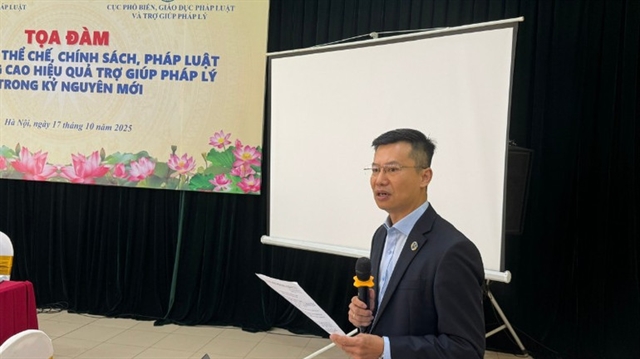
| Lawyer Nguyễn Minh Hiển, Head of the HHM Việt Nam Law Office – Hà Nội Bar Association, speaks at the seminar. — Photo nhandan.vn |
HÀ NỘI — Legal aid remains a cornerstone of the Party and State’s social policies, ensuring equal access to justice for all social strata, particularly vulnerable groups.
Lawyers play a central role in legal aid, providing consultation, representation and defence for those in need. Việt Nam currently has around 21,000 lawyers, thousands of whom have directly participated in legal aid cases, demonstrating that the work is increasingly substantive. Yet the sector still faces challenges in mechanisms, resources and implementation methods.
A recent seminar on 'Improving institutions, policies and laws to enhance the effectiveness of legal aid in the new era,' organised by Democracy and Law Magazine in coordination with the Law Dissemination, Education and Legal Aid Department under the Ministry of Justice, highlighted these issues.
Speaking at the event, lawyer Nguyễn Minh Hiển, Head of HHM Việt Nam Law Office – Hà Nội Bar Association, said public awareness of the right to free legal aid remains limited. Many people do not proactively seek legal assistance when facing difficulties or legal violations. At the same time, legal aid cases are increasingly complex, and recipients often lack legal knowledge or decline services offered by prosecuting agencies.
“Work pressure and social expectations make legal aid lawyers face difficulties. Some lawyers have not fulfilled their responsibilities fully or merely done it superficially due to workload pressure,” he said. He also noted a shortage of legal aid personnel in remote and mountainous areas, with some provinces having fewer than 15 lawyers.
Hiển highlighted the lack of professional support for specific cases, such as legal aid for people who are deaf, blind or have mobility disabilities, or defence of persons accused of crimes using computer networks, telecommunications and other electronic means. Some prosecuting agencies do not fully value the role of legal aid lawyers, training opportunities are limited, and recognition for exemplary lawyers is lacking.
Assessing achievements nationwide, lawyer Đào Ngọc Chuyền, Head of the Hà Nội Bar Association, outlined six key limitations: a limited number of participating lawyers compared with demand; uneven service quality between localities; lack of accountability mechanisms; absence of methods to evaluate case effectiveness; legal access barriers in remote and ethnic minority areas; and a legal aid scope confined to certain traditional fields.
To improve effectiveness, Hiển proposed compensating lawyers for activities required by prosecuting agencies beyond office hours, including nights, weekends and holidays. He also recommended increasing the state budget for legal aid targeting vulnerable groups, encouraging socialisation mechanisms, enhancing rewards for contributing lawyers, and strengthening skill training tailored to vulnerable groups such as at-risk individuals, people with mobility disabilities and minors.
Building a network of specialised legal aid lawyers, establishing data and experience-sharing mechanisms, and promoting technology through electronic legal aid portals, mobile applications and artificial intelligence to monitor and evaluate cases were also suggested.
Hiển stressed the importance of raising public awareness, including campaigns such as 'Never alone – Lawyer companion' targeting minors to prevent online luring and kidnapping. He said social responsibility towards vulnerable people must be recognised, adding: “Protecting the vulnerable is protecting social fairness and progress.”
To ensure sustainability, multi-level financial and supervisory mechanisms should be established to guarantee transparency and encourage lawyers and organisations to maximise capacity, responsibility and dedication to the community.
Lawyer Nguyễn Thị Thu Hà, Director of Vương Nguyễn Associates Law Company, recommended improving the legal framework and socialising legal aid activities, allowing independent lawyers, practising organisations and volunteer lawyer clubs to participate with supportive cost mechanisms, recognition, rewards and professional titles such as 'Legal Aid Lawyer for the Community.'
Lawyers participating in legal aid are also exempt from personal income tax under Article 49 of the Lawyers Law, while practising organisations may enjoy corporate income tax reductions.
Hà also proposed a system for periodic supervision and evaluation of legal aid effectiveness at community, provincial and central levels, including indicators such as number of cases resolved, average processing time, success rate, public satisfaction and socio-economic value generated.
Chuyền urged strengthening professional training, developing grassroots lawyer teams, linking legal aid with small and medium enterprises for legal compliance and dispute prevention, and accelerating digital transformation through integration of citizen identification data via VNeID to verify beneficiaries, avoid duplication and errors, and ensure proper support is delivered. — VNS
Politics & Law
 Politics & Law
 Politics & Law
 Politics & Law
 Politics & Law
 Politics & Law
 Politics & Law
 Politics & Law
.jpg) Politics & Law
Politics & Law
 Politics & Law
.jpg) Politics & Law
Politics & Law
.jpg) Politics & Law
Politics & Law
.jpg) Politics & Law
Politics & Law
 Politics & Law
 Politics & Law