 Politics & Law
Remains of 93 martyrs reburied in Tuyên Quang
1.
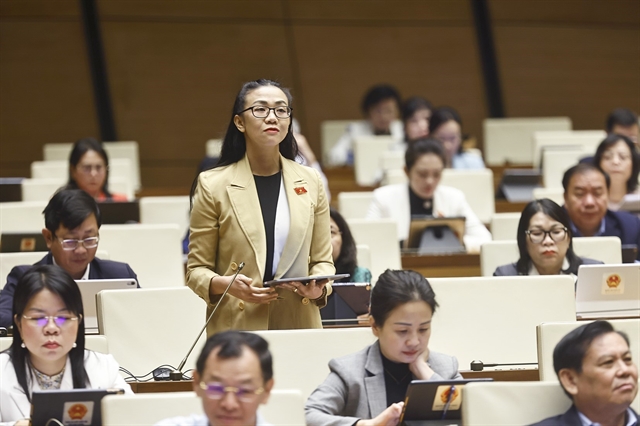 |
| Trịnh Thị Tú Anh, a delegate from Lâm Đồng Province at the discussion. — VNA/VNS Photos |
HÀ NỘI — The National Assembly (NA) yesterday reviewed a draft resolution on breakthrough public health policies, alongside the national target programme on health care, population and development for 2026–2035.
Delegates said the programme comes at a pivotal moment, as the health care system faces rising financial pressure, uneven infrastructure and a persistent shortage of medical staff.
Delegate Phạm Thị Kiều of Lâm Đồng Province described the draft resolution as a strategic long-term policy aligned with the Party’s direction on protecting public health.
She highlighted mounting challenges in the health sector, including limited investment, ageing facilities and the need for stronger incentives to attract and retain medical personnel.
Article 2 of the draft proposes widening health care benefits and lowering treatment costs, notably through a plan to exempt basic hospital fees under health insurance until 2030.
Kiều called this a historic step that would ease financial strain on households and reinforce social welfare, but emphasised that the exemption must be precisely defined to ensure long-term sustainability. She warned that expanding benefits for low-income and priority groups should not overstrain the health insurance fund or destabilise the broader system.
Delegate Hà Sỹ Huân from Thái Nguyên Province supported offering citizens at least one free annual health check or screening. He said this would especially benefit the elderly, workers in hazardous occupations and residents in disadvantaged or remote areas. To ensure effective implementation, he urged the Government to issue a standard framework governing the scope and quality of examinations. Huân also called for strict oversight of pilot schemes on supplementary health insurance to safeguard consumers and prevent excessive commercialisation.
From Lâm Đồng Province, delegate Trịnh Thị Tú Anh said high treatment costs remained the greatest concern for patients. She stressed the need to update the list of medicines covered by health insurance, with particular attention to cancer treatments and immunotherapy drugs, to reduce out-of-pocket spending and protect the more than 95.5 million people currently enrolled in health insurance. She also proposed waiving one year of voluntary health insurance fees for residents in provinces severely affected by storms and floods, arguing such support would strengthen social welfare in the same way that free textbooks help schoolchildren.
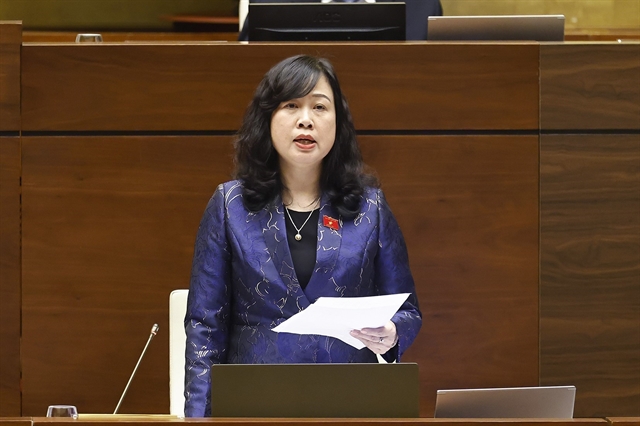 |
| Health Minister Đào Hồng Lan responds to questions raised by NA delegates. |
In Cần Thơ City, voters called for prompt action to improve health insurance procedures, strengthen primary care, and develop a sustainable medical workforce, particularly at the grassroots level.
Dr Trần Chí Cường, Director of S.I.S Cần Thơ International General Hospital, said the policy recommendations raised by National Assembly delegates were practical and focused on removing systemic bottlenecks.
He argued that eliminating the health insurance payment ceiling would be the most important first step towards universal free healthcare, as current limits prevent hospitals from investing in modern equipment and new services. Removing the ceiling would align reimbursements with actual costs, protect patient rights and improve the quality of care, he said.
To ensure financial sustainability, Dr Cường proposed maintaining or moderately increasing current health insurance contributions, taking into account citizens’ ability to pay while ensuring State support for vulnerable groups. He also called for prioritised investment in essential infrastructure, including upgrading facilities, building key hospitals and strengthening training programmes.
He cited the long-delayed Cần Thơ Oncology Hospital, begun in 2017, as an example of a project that would reduce pressure on HCM City hospitals and allow patients in the Mekong Delta to receive treatment closer to home and at lower cost.
Delegates also raised concerns that Việt Nam’s population is ageing rapidly while elderly care services lag far behind demand.
Delegate Nguyễn Văn Mạnh of Phú Thọ Province stressed the need to develop geriatric care in line with Politburo Resolution No 72, which requires every province and city to have at least one geriatric hospital or department. He noted that this priority is not yet clearly reflected in the 2026–2035 programme, which allocates no dedicated funding for geriatric services. He urged the Government to rebalance resources and consider piloting geriatric models in selected localities where capacity remains limited.
Health Minister Đào Hồng Lan told the National Assembly that the draft resolution aimed to implement Resolution 72 and reaffirm that caring for public health is a top political task.
She said measures on regular health checks and disease screening had been incorporated into the draft Preventive Medicine Law, while policies on land, tax and public–private partnerships to support health workers were being discussed across ministries.
She added that investment in geriatric facilities had been included in the public investment programme and that new incentives applied through Project 4 would help attract private investment in nursing homes. Decentralised budget allocation would give provinces greater flexibility, while updated criteria for commune health stations were expected in 2026. — VNS
Politics & Law
 Politics & Law
 Politics & Law
 Politics & Law
 Politics & Law
 Politics & Law
 Politics & Law
.jpg) Politics & Law
Politics & Law
 Politics & Law
.jpg) Politics & Law
Politics & Law
.jpg) Politics & Law
Politics & Law
.jpg) Politics & Law
Politics & Law
 Politics & Law
 Politics & Law
 Politics & Law