 Life & Style

Vietnamese scientist wins ASEAN-US Science Prize for Women
1.
Dr Cynthia Dacanay*
Jake (not his real name) was a typical 13-year-old boy – energetic, athletic and never one to complain. One evening after basketball practice, Jake told his dad he had a strange, sudden pain in his groin. At first, he thought he had strained something while jumping or running. But within an hour, the pain had become severe. He couldn’t stand up straight, and his face turned pale from discomfort.
Jake’s mom noticed that he was also sweating, looking nauseous and walking strangely. When he finally admitted that the pain was coming from his testicles, his parents rushed him to the emergency room. There, a doctor suspected a condition called testicular torsion – a twisting of the spermatic cord, which cuts off blood flow to the testicle.
Jake was taken to surgery within three hours of the pain starting. The doctors were able to untwist the cord and save the testicle. But they warned his parents: if they had waited much longer, the damage could have been permanent.
What is testicular torsion?
Testicular torsion happens when the spermatic cord – a rope-like structure that carries blood, oxygen and nutrients to the testicle – gets twisted. This twist acts like a kink in a garden hose, cutting off the blood flow to the testicle.
Without blood, the tissue in the testicle can start to die quickly. That’s why testicular torsion is a medical emergency. Time is critical – ideally, the testicle needs to be saved within six hours of the first sign of pain.
Testicular torsion symptoms
Here are some of the most common warning signs of testicular torsion:
Sudden, intense pain in one testicle or the scrotum
Scrotal swelling or redness
Nausea and vomiting
Testicle positioned higher than usual or at an unusual angle
Pain that doesn’t go away, or comes and goes
Fever in some cases (later on)
In some situations, especially during the early stages, the pain might seem mild or come in waves. This can confuse people into thinking it’s just a minor strain or muscle pull.
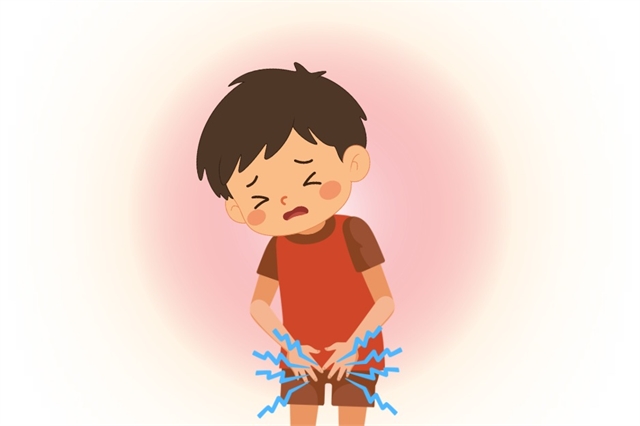
|
| Sudden severe testicle pain is the most common symptom of testicular torsion. — Image courtesy of Family Medical Practice |
Who is at risk of testicular torsion?
While testicular torsion can happen to males of any age, it is most common in boys and teens aged 12 to 18. This is likely due to the rapid growth during puberty, and sometimes because of a condition called the 'bell clapper deformity', which causes the testicles to move more freely and increases the risk of twisting.
Torsion can happen:
During sports or physical activity
While sleeping or turning in bed
After an injury to the groin
Without any obvious reason
Why time is everything?
If the spermatic cord remains twisted too long, the testicle may become permanently damaged and may have to be removed.
Within six hours: Over a 90 per cent chance of saving the testicle
After 12 hours: Only about a 50 per cent chance
After 24 hours: Less than a 10 per cent chance of saving it
How is it diagnosed and treated?
Doctors often make the diagnosis based on a physical exam and the patient’s description of symptoms. An ultrasound may be done to check blood flow to the testicle, but in emergencies, surgery is usually started right away without delay.
During surgery, the twisted cord is untwisted, and both testicles are stitched to the inside of the scrotum to prevent future torsion. If the testicle is already damaged, it may be removed.
What if one testicle is removed?
Even if one testicle is removed, the other testicle usually produces enough testosterone and sperm for a normal life. Most boys and men go on to have normal puberty, sexual function and the ability to father children.
However, in rare cases, complications can affect fertility or hormone levels, especially if the other testicle has problems too.
Breaking the silence
Many boys are shy or embarrassed to talk about their genitals. Some may try to hide symptoms out of fear or awkwardness. But as Jake’s story shows, speaking up can save a testicle.
Here are some tips for parents:
Teach your sons that any testicle pain is not normal and should be checked out.
Let them know it’s okay to feel embarrassed, but it’s better to be safe than sorry.
Remind them that doctors are professionals who handle these cases all the time.
When should you seek emergency care for testicle pain?
Testicular torsion is one of the few true emergencies in boys’ health where every minute counts. As a parent, your quick action can make all the difference. As a teen, listening to your body and telling someone about pain can prevent serious consequences.
If your son ever complains of sharp pain in the scrotum or testicles, don’t wait. Take him to a doctor or emergency room immediately. — Family Medical Practice

|
| Dr Cynthia Dacanay — Photo courtesy of Family Medical Practice |
*Dr Cynthia Dacanay is a General Paediatrician with over 20 years of clinical experience in the Philippines and Việt Nam. She specialises in the diagnosis and management of common childhood illnesses and preventive paediatric care, providing comprehensive healthcare for children from infancy through adolescence.
FMP Healthcare Group operates medical centres in major cities including HCM City, Hà Nội and Đà Nẵng, offering consultations with international doctors, check-up centres and emergency ambulance services.
Visit FMP Hà Nội 24/7 at 298I Kim Mã Street, Ngọc Hà Ward.
To book an appointment, please call us at (024).3843.0784, or contact us via WhatsApp, Viber or Zalo on +84.944.43.1919 or email hanoi@vietnammedicalpractice.com.
Life & Style
 Life & Style
 Life & Style
 Life & Style
 Life & Style
 Life & Style
 Life & Style
 Life & Style
 Life & Style
 Life & Style
 Life & Style
 Life & Style
 Life & Style
 Life & Style
 Life & Style