 Life & Style
EVNNPT seeks over $224 mln in bank loans for grid expansion
1.
|
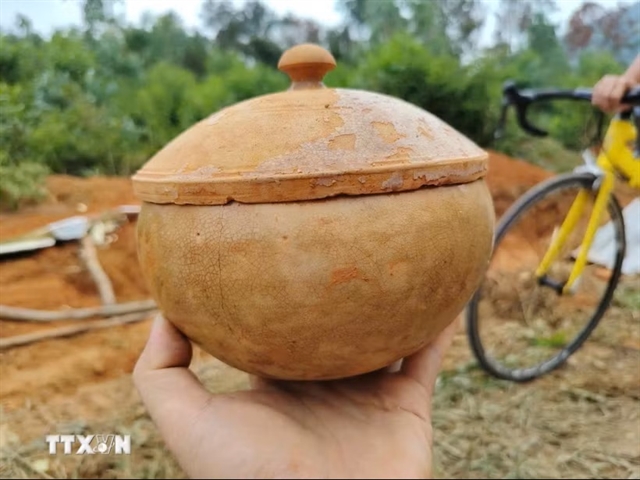
| Glazed ceramics, coins and metal objects were unearthed at the tomb site. —VNA/VNS Photo Hồ Hà |
NGHỆ AN — The excavation of an ancient brick tomb at the Rú Bụt site in Kim Liên Commune in the central province of Nghệ An has revealed numerous glazed ceramic and metal artefacts believed to be hundreds of years old, most notably two iron swords.
The excavation is ongoing and is set to continue through September, jointly conducted by the Nghệ An–Xô Viết Nghệ Tĩnh Museum and the University of Social Sciences and Humanities under Việt Nam National University Hà Nội.
According to Bùi Công Vinh, deputy director of the provincial Department of Culture, Sports and Tourism, the tomb was discovered in the garden of a local family in Kim Liên Commune (formerly Nam Giang Commune), Nam Đàn District, Nghệ An Province.
Preliminary findings based on the building materials and construction techniques reveal the tomb likely dates to between the 4th and 7th centuries CE.
|
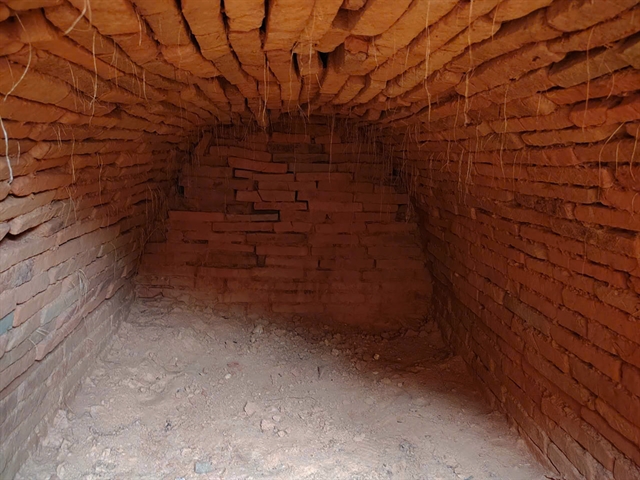
| Inside the brick tomb. — VNA/VNS Photo Hồ Hà |
Initial surveys revealed that around 1.5 metres of the tomb entrance had been exposed.
Archaeologists recorded several types of ancient bricks used in its construction, including rectangular and wedge-shaped bricks. Numerous glazed ceramic and metal artefacts were found inside the tomb.
In particular, two iron swords unearthed at the site have drawn considerable interest from experts.
According to a preliminary assessment by the Nghệ An–Sô Viết Nghệ Tĩnh Museum, archaeologists have not previously recorded similar swords in brick tombs of the corresponding period in Nghe An.
The two artefacts are expected to provide further material for study of the tomb, the life of contemporary inhabitants and potentially for identifying the identity and social status of the person buried there.
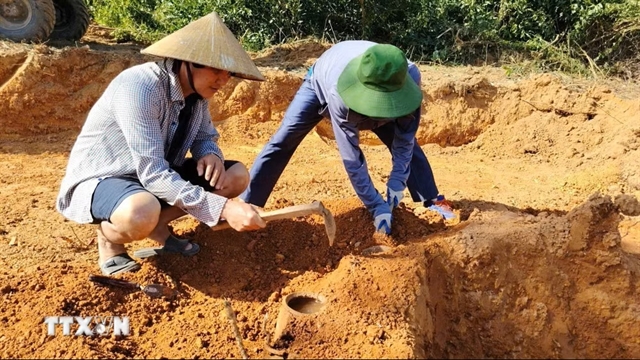
|
| The excavation is expected to shed new light on local history. — VNA/VNS Photo Hồ Hà |
The excavation began on August 10 and is being carried out urgently, as the site is located in a resident’s garden adjacent to a public road. Part of the tomb had already been exposed, so it was vulnerable to natural disasters, construction, urbanisation and illegal excavation.
Under an approved plan, the full excavation will cover an area of about 70sq.m and will be carried out over 40 days until September 18, including artefact processing and site restoration.
It aims to fully expose the parts of the tomb still covered by soil and mud, determine its scale, structure, date, burial practices and artefact assemblage, thus providing a more comprehensive assessment of the site’s value.
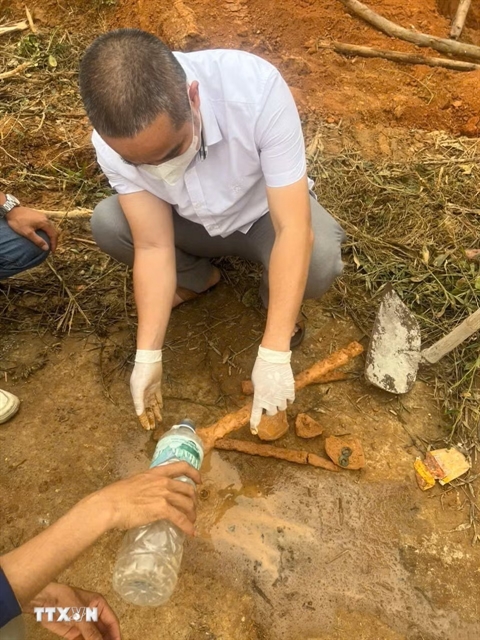
|
| The most notable result of the excavation thus far is the recovery of two iron swords. — VNA/VNS Photo Hồ Hà |
It is led by Dr Nguyễn Văn Anh, head of the Faculty of History and Culture at the University of Social Sciences and Humanities under Việt Nam National University Hà Nội.
After excavation, the artefacts will be studied, processed and handed over to the Nghệ An–Xô Viết Nghệ Tĩnh Museum for preservation, together with the scientific records. If human remains are discovered, they will be reburied at the site or in a local cemetery.
Findings will provide a basis for relevant authorities to consider expanding the excavation, delineating the site and developing plans to preserve it.
If found to have significant value, the tomb could be further studied for preservation and display, and may be linked with other heritage sites to create a historical and cultural tourism destination.
Determining the origins, date and characteristics of the two iron swords could also provide important data for research into the tomb’s occupant and the social context of Nghệ An at that time period.
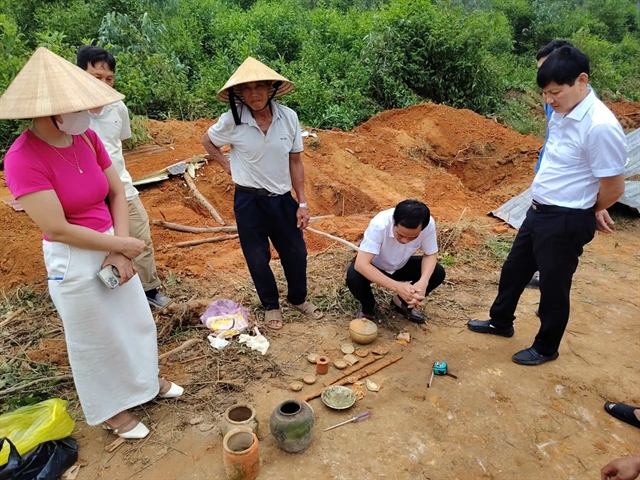
|
| The excavation has unearthed a number of artefacts. — VNA/VNS Photo Hồ Hà |
“A tomb buried deep underground can open a window onto an entire chapter of history,” said Lê Thu Hiền, director of the Nghệ An–Sô Viết Nghệ Tĩnh Museum.
“This emergency excavation is aimed not only at protecting an archaeological site at risk of damage, but also at clarifying the structure, characteristics, date and value of the brick tomb, while collecting essential materials and artefacts for research, conservation and the promotion of its heritage value.” — VNS
Life & Style
 Life & Style
 Life & Style
 Life & Style
 Life & Style
 Life & Style
 Life & Style
 Life & Style
 Life & Style
 Life & Style
 Life & Style
 Life & Style
 Life & Style
 Life & Style
 Life & Style