 Life & Style

Bắc Ninh expands industrial space to attract high-tech capital
1.
|
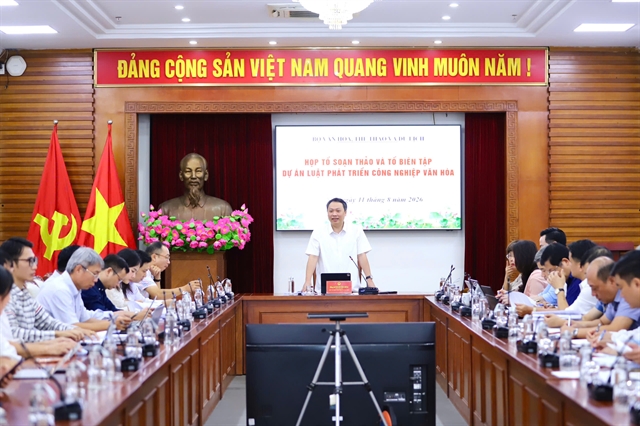
| MoCST Deputy Minister Nguyễn Huy Dũng speaks at a working session this week. — Photo bvhttdl.gov.vn |
HÀ NỘI — The Ministry of Culture, Sports and Tourism (MoCST) is striving to complete a draft Law on Cultural Industry Development, 'prioritising quality above all', according to MoCST Deputy Minister Nguyễn Huy Dũng.
Speaking to the Drafting Team and Editorial Team for the law at a ministerial meeting held in Hà Nội this week, Dũng emphasised that the law drafting is carried out with aims to concretise Politburo Resolution No. 80 dated January 7, 2026, develop culture and at the same time carry out directions that Party General Secretary and President Tô Lâm delivered at the second session of the Central Steering Committee on the development of Vietnamese culture.
The culture ministry is urgently drafting the Law on Cultural Industry Development under expedited procedures, with plans to submit it to the National Assembly session in October.
"Although the timeline is very tight, the Ministry of Culture, Sports and Tourism's lead drafting agency prioritises quality above all else," the deputy minister said.
"While the schedule must be met, quality will not be sacrificed for the sake of speed."
The draft law approaches cultural industries from the perspective of developing a strategic economic sector in the value chain, while ensuring no duplication of regulations already adjusted by specialised laws and avoiding the creation of unnecessary administrative procedures.
The law does not aim to resolve every issue within individual sectors, but instead focuses on key, cross-sectoral matters that are complete for action and capable of generating new drivers for development.
The guiding principle adopted during the drafting process is 'transforming cultural identity into intellectual property, and transforming intellectual property into cash flows to generate economic value'.
The law aims to achieve three major objectives of establishing the cultural industry's position within Việt Nam's economic structure; connecting value chains to boost economic value and exports while attracting strategic investment; and simultaneously promoting Vietnamese cultural identity, the national brand and Việt Nam's soft power on the international stage.
During the meeting, participants offered input aimed at solving bottlenecks and assessing policy feasibility, as well as the capacity to mobilise and utilise resources. Discussions also covered mechanisms for developing intellectual property, human resources, infrastructure, and markets, alongside financial and investment policies and preferable conditions for businesses and creators to participate more effectively in the cultural industry value chain.
In his concluding remarks, Dũng expressed his appreciation for the contributions and pledged that the Drafting Team and the Editorial Team would fully incorporate the feedback and finalise the dossier before submitting it to the Ministry of Justice for appraisal.
The draft law currently focuses on six major policy areas: the cultural industry ecosystem; intellectual property within cultural industries; workforce and talent development; infrastructure; market dynamics; and financial support and investment incentives.
All opinions said the draft law has shown a strong shift in mindset from 'cultural management and preservation" to "creative economic development', commercialisation of intellectual property and mobilisation of socialised resources.
In particular, it updates modern trends, integrating new concepts approaching the world such as cultural industry ecosystem, value chain, digital culture, cultural industry exchange, creative spaces.
According to opinions presented at the meeting, the draft law approaches the cultural industry through a value-chain perspective, extending beyond mere production support to encompass the entire process.
It places intellectual property at the core, addressing valuation, identification, and use as collateral, while implementing policies to train and attract talents. It creates breakthroughs by paving the way for new business models sịc as AI, gaming, the metaverse, and digital platforms.
Việt Nam boasts a rich cultural heritage, a young creative workforce, a market of over 100 million people and rapidly developing digital infrastructure – all favourable conditions for cultural industries to scale up.
The MoCST statistics show cultural industries’ average annual production value hit nearly VNĐ1.06 quadrillion Vietnamese (US$44 billion) between 2018 and 2022. The number of companies in these industries grew 7.2 per cent a year to 70,321 in 2022. The workforce expanded 7.4 per cent annually.
The numbers show a solid market foundation and pooled resources, but potential remains untapped. A major bottleneck lies in policy and legal frameworks. Current laws manage individual fields but don’t link resources into integrated value chains.
The second meeting of the Central Steering Committee for the Development of Vietnamese Culture identified turning cultural industries into a new growth driver as a key priority.
MoCST and other agencies have been ordered to finalise the bill for submission to the National Assembly’s October session under fast-track procedures. — VNS
Life & Style
 Life & Style
 Life & Style
 Life & Style
 Life & Style
 Life & Style
 Life & Style
 Life & Style
 Life & Style
 Life & Style
 Life & Style
 Life & Style
 Life & Style
 Life & Style
 Life & Style