 Life & Style
Phenikaa wins fifth consecutive Vietnam National Brand title
1.
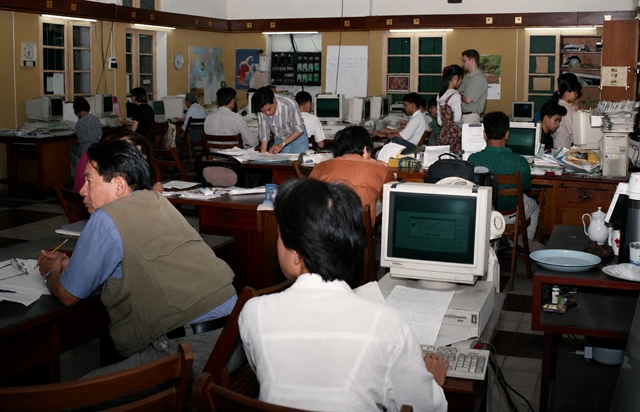 |
| The lone spirit:The busy newsroom back in 1996, when personal computers were newcomers yet the layout artist Trịnh Trí (left) still drew the pages every day starting from 5pm, sometimes late into the night. VNS Photo Duy Nghĩa |
by the Việt Nam News team
As we at Việt Nam News and Law prepared for our big day celebrating the newspaper's 35th anniversary, news struck us like a bolt of lightning.
The Colonel, a long-time layout artist, had suffered a serious stroke, his heart couldn't take it anymore and he passed away at 2.10am June 16, just one day before the birthday of the newspaper he spent 18 years of his life working for.
He was supposed to be coming to the Celebration, where he was expected to sing one of his many signature songs, "Que sera sera, what ever will be, will be, the future is not ours to see."
Words that ring very true as none of us can predict the future.
On Sunday he had called a colleague, saying that only he and his son would go to the party and he would sing the song, and others with his son.
Fixture of the old newsroom
He was a fixture of the non-digital newsroom. On his large table he had his pencils, erasers, rulers and triangles, his magnifying glass, and last, but not least, the sharp utility knife all old-style artists used.
For many of us who started out as fresh college graduates, he was always very kind, softly spoken and caring, unlike his rough appearance. Colleagues recalled the stress-free night shifts working with him, while he drew the pages with his young daughter hanging around to wait for him to take her home.
"He was always calm and gentle," recalled Nguyễn Hồng Thúy, a former Việt Nam News reporter, who worked with him.
"Each word he wrote, every photo box he drew showed his dedication, his diligence," she added.
"Even late into the night, he never showed any irritation nor agitation. Every time something needed changing, he just smiled and kept on working.
"For him, what made a good newspaper was the whole efforts of the team. His dedication, modesty and quiet sacrifice made us admire him more."
His younger brother Trịnh Lữ, a well-known writer and English-translator penned in his eulogy:
"Having mastered his craft so well, he was never pressured by any deadlines, nor late work. His love for the job, no matter how long or late it could get, never faltered.
"His life as a government employee was so easy-going. He never cared if he got a promotion or how much he got paid. We knew him by his nickname, The Colonel, that his colleagues gave him for his hobby wearing retro military clothing. He never had to fight with anyone, was always joyful and never drank nor smoked. He only liked good coffee, loved beautiful women and, of course, his large engine motorbikes.
"He lived well and enjoyed his life to the fullest, which for us is the greatest achievement we all wish for."
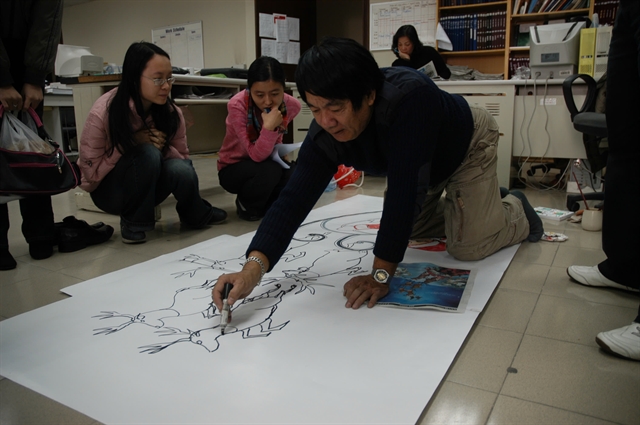 |
| Que sera sera: Layout artist Trịnh Trí crawls on the floor to draw year-end party decorations. VNS Photo Duy Nghĩa |
Nguyễn Thúy Bình, a long-time news reporter, said: "When he started work, usually at 5pm, when we were all tired from our shift since morning. He would pull out some treats, like a boiled or roasted corn cob, a sweet potato or manioc, and sliced them with his sharp knife to share with us all."
Trịnh Lữ said in his eulogy: "He was born with a natural kindness, caring only about his work and enjoying life."
A life worth living
Born in 1939 as the eldest son of artist Trịnh Hữu Ngọc, an award winning painter who graduated from the Indochina School of Fine Arts in the early 20th century, Trịnh Hữu Trí grew up with art all around himself.
In his early years, he already showed talent as a young athlete, actor, sculptor and footballer where he played in goal. He and his friends made a theatre group, performing in Hà Nội and playing football. He would also sculpt.
As they say in the art world, sculptors challenge, painters share their pains.
The youthful years ended when Trịnh Trí joined the army as the United States escalated war in the North of Việt Nam in the 1960s. He joined in 1965 and worked for an anti-aircraft group to protect Hàm Rồng Bridge in Thanh Hóa Province. During bombardments, he found himself often buried in the dirt and injured many times.
After four years, he left in 1969, heavily wounded and deaf in his left ear. For many years working at the newspaper, we never realised that he could hardly hear us.
At work he never talked about his time in the military. We had a few colleagues who also served and we would commemorate them on Martyrs and War Invalids Day on July 27. As his colleagues, we never knew he was on the frontline during the heaviest bombing of the bridge, had we known it, we would have honoured him.
Military men always valued their friendship and camaraderie during battles. When we asked them for interviews, they would always say, come to meet my comrades, let's hear them talk, too.
Colonel Trịnh Trí, not his real rank, but a nickname we gave him not only for his love of vintage military clothing and heavy silver jewellery, but also because he was an imposing man, well-built and taller than the average Vietnamese. He never talked about his military time, nor comrades and never about the war.
Everyone was his friend, and every lady, no matter how young, he treated with gentleness and called them 'little'. In today's environment, some may have opposed the way he addressed a female colleague, but the way he used the word was respectful and we never gave it a second thought.
"I remember he would address me gently as 'little'," said Tạ Thu Giang, a long-term colleague at the News.
"But this 'little' woman was already a mother of two. I would take my child to his home so both of us could learn painting. He was a great teacher. He trained us well and my daughter has now graduated from the College of Industrial Fine Arts. She's working as a graphic designer now. We owe him so much."
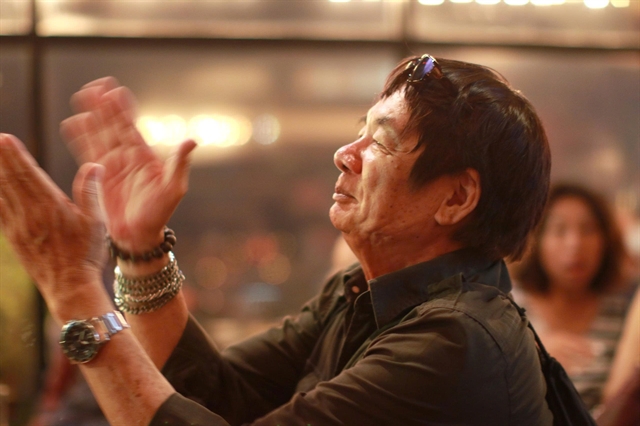 |
| Freedom spirit: The Colonel, as he has always been known for, claps in one of the office staff parties, where he's also known as a talented singer. VNS Photo Trương Vị |
In his later life after the military, Trịnh Hữu Trí did not do sculpture any more, only paint. Perhaps he has had enough of challenges during the war time. Now his subjects were mostly still life and daily objects of a peaceful life: a red gourd and some star fruit, papaya, some custard-apples, set against the morning rays of sunlight. He also painted peaceful landscapes, of course, and beautiful women.
He always treated women with respect and treasured them. A charismatic and good-looking man, rumour had it that some international copy editors had fallen for him. Former colleagues including Cao Thái Vân, Vũ Ngân Bình and Phạm Diễm Quỳnh remembered him as a big brother, respected colleague and trustworthy friend.
Well into his late years, he still rode a motorcycle, but opted for a design not as heavy, but he still wore the same heavy jewellery. At every staff party, he would sing, Returning to Sorriento or Qui sait qui sait qui sait (Quizas, quizas, quizas).
On his last day, he still took his wife out to coffee, then went home as he didn't feel well. Family rushed him to hospital but doctors could not do anything more.
As he could not make it to the last party and company trip this weekend, we all sang Que sera sera to honour him, his life and his art of living.
"Enjoy life for me," we would all imagine him telling us, speeding away on his big bike to eternal life.
Trịnh Hữu Trí, The Colonel, is survived by his wife Nguyễn Đoan Trang, their son and two daughters from a previous marriage. — VNS
Life & Style
 Life & Style
 Life & Style
 Life & Style
 Life & Style
 Life & Style
 Life & Style
 Life & Style
 Life & Style
 Life & Style
 Life & Style
.jpg) Life & Style
Life & Style
 Life & Style
 Life & Style
 Life & Style