 Life & Style
Hà Nội adorned in red ahead of Liberation Day
1.

|
| Director Lê Hoàng. — Photo courtesy of the director |
Gái Nhảy (Bar Girls) was directed by Lê Hoàng and produced by Giải Phóng Film Studio in 2003. The work ushered in the era of commercial films following the crisis period of Vietnamese film in the 1990s.
When Bar Girls premiered in 2003, few expected a film directly exploring the world of sex workers to generate such immense buzz. Not only did it become a box-office sensation at a time when theatre infrastructure was limited, but it also ignited fierce debates regarding the line between art and commercialism, and between social realism and sensationalist filmmaking.
Director Lê Hoàng spoke to the media about the return of his film to the theatre at the 4th Đà Nẵng Asian Film Festival (DANAFF IV).
After 23 years, many people still view Bar Girls as a movie that ushered in a new era. From the moment you began working on the film, did you ever think you were 'blazing a trail' for an entirely new genre?
Up to this point, I still do not consider Bar Girls to be a market film. When watching the work, the audience can see a world associated with social vices, but that does not mean the film can be categorised as commercial cinema. If one believes that commercial films are inherently separate from conventional subject matter clearly leads to certain misunderstandings.
With Bar Girls, despite choosing a sensitive topic, we never intentionally exploited shocking scenes or used sensationalist elements to attract an audience, so it is difficult to call it a commercial film, as many people think. Everything that appears in the film originates from the reality of life. If there is a difference, it lies only in the approach compared to other films of the same period.
Furthermore, the issues the film raises remain extremely serious, directly reflecting a heated social reality at that time.
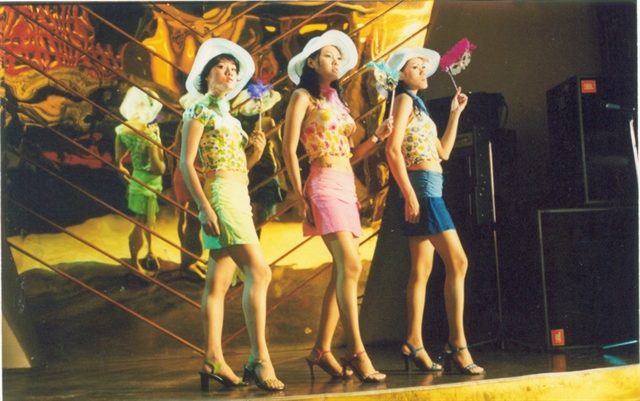
|
| A scene from Bar Girls. — Photo courtesy of Giải Phóng Film Studio |
Where did the initial idea come from? Was it social observation, a true story or a clear artistic intention?
At that time, we made the film without placing any weight on the revenue, we only focused on creating a work with depth in its story, powerful enough to make young people reflect on the dark side of society. The central character is a sex worker in an extremely tragic situation, and such fates, in any era, remain a burning issue.
The idea for the film was actually nothing too 'extraordinary'; it simply stemmed from very real fates and circumstances of life.
Social vices exist within a complex spectrum of perspectives. Beyond the surface negativity, they encompass the pain, tragedies and inner struggles of those facing misfortune. These are circumstances often difficult for outsiders to grasp, situations that the individuals themselves never wished to endure, nor did they ever intend to find themselves in such degrading work.
Within that sombre world, it is not only those in tragic circumstances who are vulnerable; even the privileged and the educated can fall. Ultimately, social vices spare no one.

|
| The main actors in Bar Girls. — Photo courtesy of Giải Phóng Film Studio |
When Bar Girls was released in 2003, it became a cinematic sensation. Do you still remember the most significant reactions from the public or industry professionals at the time?
At that time, HCM City had essentially only one major venue, the Thăng Long Cinema, where Bar Girls was released. The crowds were so overwhelming that residents began using their front yards as makeshift parking lots for moviegoers.
When I came, they even brought out sweets for me and said, 'Thanks to the director of Bar Girls, we’ve suddenly gained an extra source of income'. Street vendors in the area were equally thrilled, as the constant flow of customers lasted from morning until late at night.
The film earned approximately VNĐ13 billion (US$493,000), a staggering figure for that period. It is important to remember that theatres then were extremely limited, without the large-scale multiplexes we see today; as a result, almost no one imagined a Vietnamese film could ever achieve such box-office numbers.
Regarding the appraisals of the film, opinions were deeply divided. Personally, I don't view any perspective as strictly right or wrong. In cinema, especially theatrical releases, if a work fails to ignite debate or provoke discussion, then it’s better left unmade.
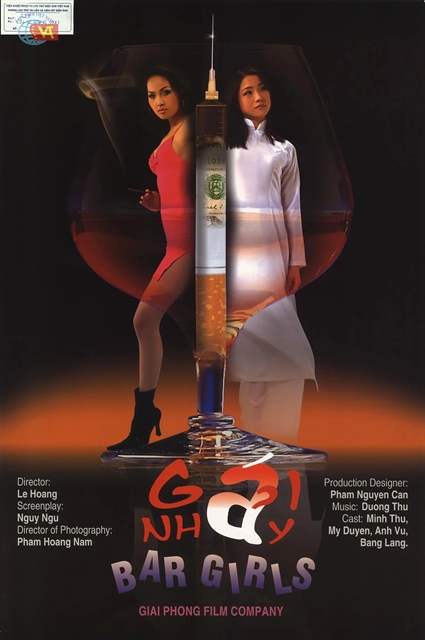
|
| The movie poster for Bar Girls. — Photo courtesy of Giải Phóng Film Studio |
Does the shock value of Bar Girls still carry the same weight for today's audience? If you were to remake the film now, what would you change?
I believe the film remains relevant to contemporary audiences, and I am confident it has not become obsolete, even for those who first saw it nearly thirty years ago. If I had the opportunity to remake it, there would certainly be many changes in its execution, but the core spirit would remain untouched: the story of the tragic fates of sex workers and the belief in the power to overcome adversity.
Filmmakers worldwide share a common goal: they desire to create works that nurture faith in humanity. No one creates art just to have the audience leave the theatre feeling that some lives are utterly hopeless or beyond redemption. That is not the ultimate purpose of cinema.
After 23 years, when Bar Girls has been chosen to be screened in the programme 'The face of Vietnamese Cinema after 40 Years of Renewal' at the 2026 DANAFF IV, how do you feel?
Organising a film festival like DANAFF on an annual basis is no small feat, especially when aiming for such vast scale, high professionalism, and a level of quality that rivals, or even surpasses, some of the international film festivals I have attended. It is clear that if an event like DANAFF can be sustained annually, much like the Cannes Film Festival in France, it will undoubtedly generate a profound impact on the industry.
For a filmmaker, having one's work screened and revisited within a retrospective spanning 40 years is a deeply emotional experience. It not only evokes personal memories but also sparks broader reflections on an entire era of cinema.
What is the most vital element that Vietnamese cinema should preserve from the past, and what needs to evolve for it to move further ahead?
I believe that in cinema, there are no boundaries of generation or age; there is no 'young' or 'old,' there is only 'good' or 'bad.' Every generation of filmmakers matures within different circumstances and contexts.
In reality, some young directors outperform their predecessors. Furthermore, we ourselves cannot always fully transmit our experiences to the next generation, as creative thinking constantly evolves with the times. — VNS
| After more than two decades, Lê Hoàng’s film has been selected for screening in the 'The face of Vietnamese Cinema after 40 Years of Renewal' programme at DANAFF IV. |
Life & Style
 Life & Style
 Life & Style
 Life & Style
 Life & Style
 Life & Style
 Life & Style
 Life & Style
 Life & Style
 Life & Style
 Life & Style
 Life & Style
 Life & Style
 Life & Style
 Life & Style



