 Politics & Law
Vietnamese Prime Minister meets Cambodian National Assembly President
1.
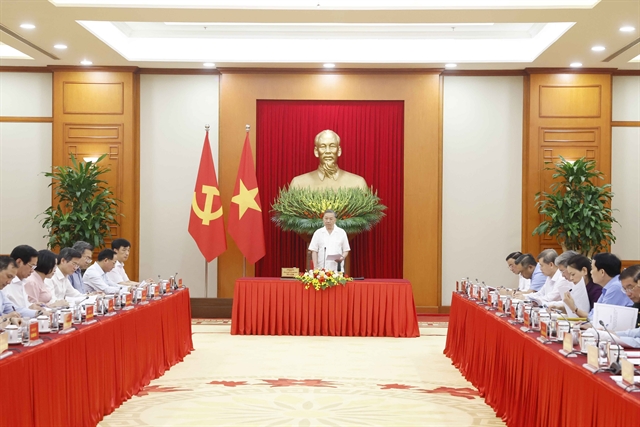 |
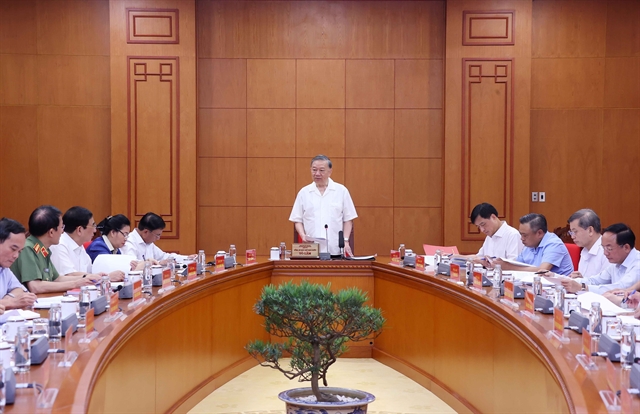
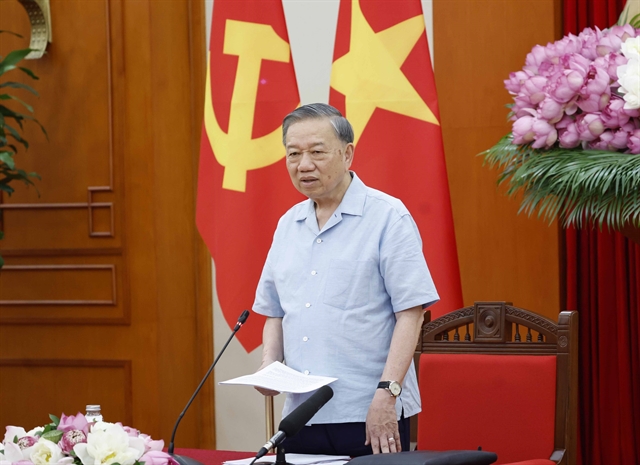
| Party General Secretary and State President Tô Lâm chaired a meeting with the Party Central Committee’s Organisation Commission on June 3. — VNA/VNS Photo |
HÀ NỘI — Party General Secretary and State President Tô Lâm on Wednesday chaired a working session in Hà Nội with the Party Central Committee’s Organisation Commission to review key tasks in Party building and organisational work in line with the Resolution of the 14th National Party Congress.
Also attending the meeting was Politburo member and Permanent member of the Party Central Committee's Secretariat Trần Cẩm Tú/
At the session, the commission's leader presented a report outlining priorities for Party building and organisational work under the 14th National Party Congress's Resolution.
Concluding the meeting, General Secretary and President Lâm highlighted several key priorities, stressing the need for a unified understanding that, in the new development phase, the Party building and personnel affairs are not merely internal matters of the Party but constitute the foundation of national governance. They are essential for translating policies into reality, resolutions into action, resources into development, and public trust into national strength.
He noted that the Resolution of the 14th National Party Congress sets out demanding requirements for renewing mindset, including reforms to the Party’s leadership methods to strengthen the country’s strategic autonomy and achieve rapid and sustainable development. These objectives require the Party to continuously renew, rectify, and improve itself, while enhancing its capacity for leadership, governance, forecasting, implementation, and supervision of power.
The top leader called for a fundamental overhaul of the Party’s leadership methods. Advisory work, he added, must shift from reacting to emerging issues towards forecasting trends and preparing in advance for major challenges relating to organisational structures and personnel.
Resolutions, he stressed, must be translated into practical action through concrete programmes that clearly identify responsibilities, tasks, resources, deadlines and expected outcomes. The top leader also described weak implementation capacity as a major bottleneck across many sectors, agencies and localities that must be addressed.
Regarding the effective operation of the new organisational model, General Secretary and President Lâm instructed the Organisation Commission to continue reviewing the functions, responsibilities, authority, organisational structures and working relations of agencies and units across the political system following recent restructuring efforts.
“The principle should be that one agency may handle multiple tasks, but each task should be assigned to only one lead agency mainly responsible for its implementation,” he stressed.
On personnel reform, the General Secretary and President underlined that officials in the new era must possess not only firm political mettle, sound ethics and exemplary conduct, but also strategic vision, modern governance capabilities, digital transformation skills, effective implementation capacity, problem-solving abilities, the capacity to engage with the public, and the courage to take responsibility for the common good.
He stressed the importance of building both strategic-level and grassroots-level cadres, while calling for stronger mechanisms to identify, attract and make effective use of talented individuals.
Việt Nam's top leader reaffirmed that efforts to combat corruption, wastefulness and negative phenomena must continue resolutely, persistently and without exception. At the same time, he said, it is equally important to tackle bureaucratic inertia, avoidance of responsibility, buck-passing and indifference to the legitimate concerns of the people.
He noted that power oversight is not intended to hinder reforms but to ensure that authority is exercised properly, within legal mandates and responsibilities, and in the interests of the nation and the people.
The top leader also urged accelerated digital transformation in the Party-building work, calling for a shift from simply digitising records to creating dynamic data systems that support strategic consultation, governance, inspection, supervision and personnel assessment.
He stressed the need to develop integrated, up-to-date, interconnected, secure and unified databases covering Party members, officials and organisational structures.
Digital transformation within the Party must be closely linked to the development of digital government, digital economy, digital society, and digital citizens, directly strengthening the Party’s leadership capacity, improving state governance, and enhancing public services, the top leader added. — VNA/VNS
Politics & Law
 Politics & Law
 Politics & Law
 Politics & Law
 Politics & Law
 Politics & Law
 Politics & Law
 Politics & Law
 Politics & Law
 Politics & Law
 Politics & Law
 Politics & Law
 Politics & Law
 Politics & Law
 Politics & Law