 Society

World Health Summit 2026: Berlin Becomes Global Meeting Point for the Future of Health
1.
|
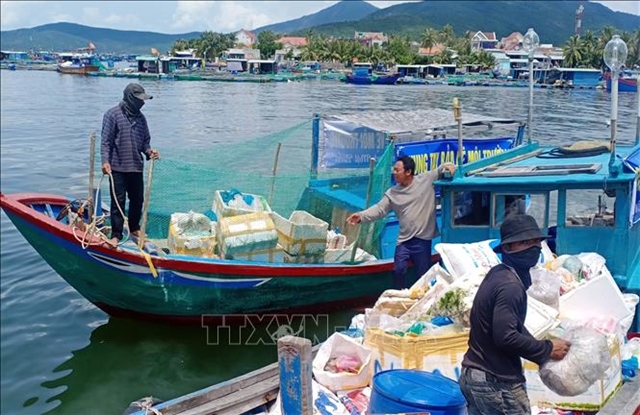
| Trần Thiện Toàn's four-member team collects waste from a local boat in Khánh Hòa Province. — VNA/VNS |
KHÁNH HÒA — A fisherman in the south-central coastal province of Khánh Hoà have been cleaning up marine waste in Vân Phong Bay for a decade, inspiring the local community to change their habits and helping restore the environment in the province's key aquaculture areas.
In the past, the beach in Đại Lãnh Commune used to be heavily polluted by waste. Fisherman Trần Thiện Toàn said that there was a period when the shoreline was covered with waste, and anyone wanting to go into the sea had to get through the litter along the shore.
Toàn said people used to believe that just throwing some rubbish into the water caused no harm, but eventually, it accumulated into a huge amount and became a serious problem, which is further exacerbated by local aquaculture activities.
Seeing the polluted environment in his hometown, in 2007, Toàn decided to start cleaning up the waste by the shore on his own.
He soon realised that waste coming from the sea was the main source of pollution, so he switched up his approach.
Toàn spent time convincing boat and floating house owners to change their habit of dumping rubbish into the ocean. At first, some of them disagreed with him, saying his efforts would not last long.
But over time, he successfully changed their perceptions and established a waste collection team comprising two boats and four members operating at sea. The team collects five to seven tonnes of waste per day from Khánh Hòa Province's key aquaculture areas, including Giếng (Well) Beach, Whale Island, and Cây Me (Tamarind Tree) Beach.
Trần Quốc Toàn, a lobster farmer in Đầm Môn fishing village, Đại Lãnh Commune, said the water surface around the floating aquaculture cage area was previously filled with rubbish. Thanks to the waste collection team, the water quality here has improved.
Meanwhile, locals now gather and sort their waste daily for the team to collect instead of throwing it directly into the ocean.
According to local fishermen, when water quality improves, aquaculture operations become much more favourable. Better water circulation helps reduce the risk of oxygen shortages and disease outbreaks among farmed seafood.
Currently, there are over 1,169 marine cage aquaculture households in Đại Lãnh Commune, generating a significant amount of daily waste.
To maintain the waste collection operations, Toàn implemented a voluntary funding model supported by local households.
Lê Đình Khiêm, Head of the Khánh Hòa Sub-Department of Fisheries and Islands, said Vân Phong Bay has potentials for developing high-tech marine aquaculture with high economic value species such as lobsters and marine fish.
However, he said that the environment in the bay’s concentrated farming areas will be negatively affected if the waste generated there is not effectively controlled.
Meanwhile, Nguyễn Văn Phương from the Economic Department of Đại Lãnh Commune noted that Trần Thiện Toàn's voluntary marine waste collection model not only cleans the marine environment but also helps prevent sunken rubbish from blocking the oxygen layer at the seabed, which can impact the ecosystem of the farming areas.
Phương said that most locals support the initiative because they see the direct benefits to water quality and aquaculture operations. — VNS
Society
 Society
 Society
 Society
 Society
 Society
 Society
 Society
 Society
 Society
 Society
 Society
 Society
 Society
 Society
 Rikkeisoft ký kết MOU với LAC.Co, LTD - thúc đẩy hợp tác kinh doanh toàn diện trong lĩnh vực an ninh mạng.jpg)