 Life & Style
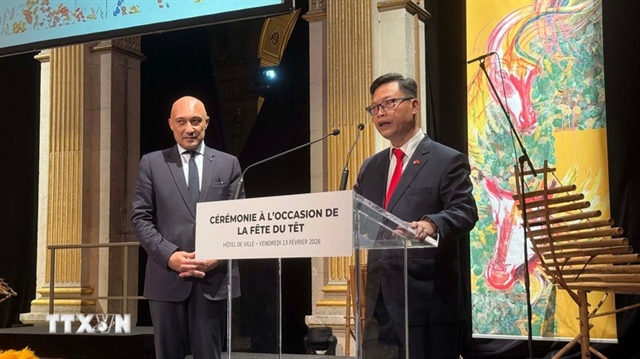
Việt Nam, EU and Belgium seek deeper, practical cooperation
1.
By Nguyễn Bình
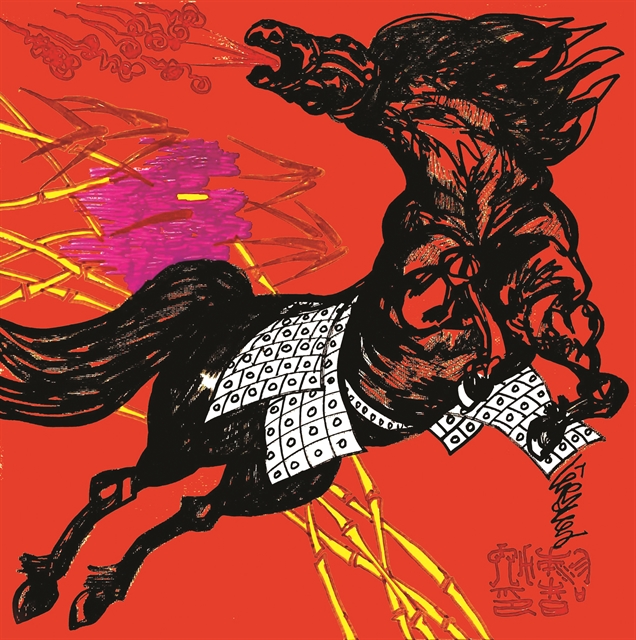 |
| GALLOP APPEAL: The horses in Lê Trí Dũng’s paintings are often shown galloping. |
As the Lunar New Year draws near, artists across Việt Nam once again turn to the animals of the lunar zodiac – a seasonal ritual that blends tradition with personal expression.
For painter Lê Trí Dũng, however, the arrival of the Year of the Horse holds a deeper resonance. The horse is not simply this year’s subject; it is the enduring centre of his artistic life, one he has pursued with unwavering devotion for more than four decades.
Under the light in his studio, Dũng sits quietly with his horse paintings, works that radiate vigour and freedom. The moment is more than a portrait of an artist at work. It is a convergence of memory, belief and a lifelong creative journey shaped almost entirely by the image of the horse.
About 100 horse paintings are currently on display at an exhibition, presented through a wide range of materials and visual languages such as lacquer and acrylic. Despite their diversity of medium, the works share a striking coherence: a spirit of creative freedom, a strong sense of individuality and an unmistakable personal imprint.
Within Việt Nam’s contemporary art landscape, Dũng stands apart as one of the few artists to have devoted nearly his entire creative output to the sustained exploration — and elevation — of a single motif: the horse.
A lifelong motif
The exhibition, entitled Thánh Mã (Holy Horse), is organised to pay tribute to Dũng, according to organiser Trần Thanh Tùng.
“In Vietnamese culture, the horse is associated with journeys of territorial expansion, with battlefields and with long expeditions across mountains and forests,” said Tùng.
“For him, however, the horse goes beyond the role of a sacred or decorative symbol. He refers to it simply — and deliberately — as the ‘Holy Horse’.”
Its origins trace back to the very first horse, the horse of Saint Gióng, which he heard about when he was a child. At the age of three, lying in his grandmother’s arms by the Chu River in the north-central province of Thanh Hóa, he listened to folk tales such as Sự Tích Trầu Cau (The Legend of Betel and Areca), Thạch Sanh, the tale of Sơn Tinh and Thủy Tinh and, of course, the legend of Saint Gióng.
The legend tells that Gióng helped the Hùng King defeat the foreign invasion that ravaged the country. When his iron rod broke in battle, Gióng uprooted a bamboo tree and continued fighting. After victory, he mounted his iron horse and ascended to heaven. In recognition of his deeds, the king built a temple in his honour and canonised him as a saint.
The Holy Horse
“The iron horse of holy hero in recognition of its great deeds, also came to be known as Thánh Mã,” said Dũng. “A holy horse must fly. If it stands still, it becomes an ordinary horse. Among the thousands of horse paintings I have made, most depict horses in flight. None of them are standing still.
“I have tried to create a distinctly Vietnamese horse, one that does not resemble the famous horses already known around the world. I want to transform the horse symbol found in Đông Hồ and Hàng Trống folk painting into a modern horse.
“My horses are always galloping forward, in pursuit of dreams.”
In this way, the horse in Dũng’s paintings consistently embodies the spirit of Saint Gióng – powerful, transcendent and forever striving upward.
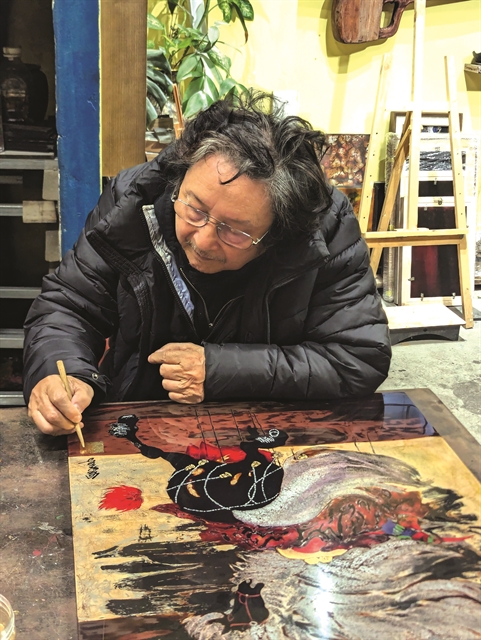 |
| HOOF FOCUS: The horse has been a central subject throughout the career of artist Lê Trí Dũng. Photos courtesy of Hội Quán Di Sản. |
Culture in motion
Moving beyond legend, Dũng also infuses the horse motif with layers of Vietnamese culture. He paints saddles using brocade patterns from ethnic minority groups such as the Thai, Dao and Mông, weaving their distinct identities and visual traditions into the body of the horse itself.
Recurring symbols – the sun, the moon and zodiac animals – also appear in his work. Through this accumulation of cultural signs, Dũng has shaped a horse that is unmistakably his own: a deeply Vietnamese horse, both ancient and contemporary.
According to Dũng, among the lunar zodiac animals, the horse possesses the most beautiful form. It also embodies benevolence, righteousness, propriety, wisdom and faithfulness, qualities he believes are essential to human character.
Horses are among the animals closest to humans. In ancient warfare, they stood beside soldiers on the battlefield in defence of the nation’s frontiers. In daily life, they likewise made significant contributions, including carrying goods.
It is both humorous and accurate when fine arts critic Phan Cẩm Thượng called him "Old Horse Herder", as Dũng has painted horses tirelessly and depicted them through every emotional moment across the stages of life.
Man and symbol
“Behind the galloping hooves lies the mindset of a seasoned artist,” said Thượng. “Dũng has witnessed the upheavals, when right and wrong blurred, and joy and sorrow intertwined.
“As a result, the horse in his paintings is no longer merely a literal animal, but an extension of his own character – free-spirited yet solitary.
“The horse becomes an extension of the artist himself – free-spirited yet solitary, brimming with vitality while carrying the quiet melancholy, the longing of someone who forever seeks release and renewal."
“In Vietnamese fine art history, horses have appeared in Đông Hồ and Hàng Trống folk paintings, in communal house sculptures and in court art. Yet Dũng does not replicate those traditions. He relocates the horse into a contemporary artistic space through bold brushwork, restrained detail and a strong emphasis on rhythm and movement.
"Some figures appear sinewy and charged with force; others are free and soaring. Some seem to neigh amid roaring winds, while others bow their heads in silence, gathering strength for the next surge forward.”
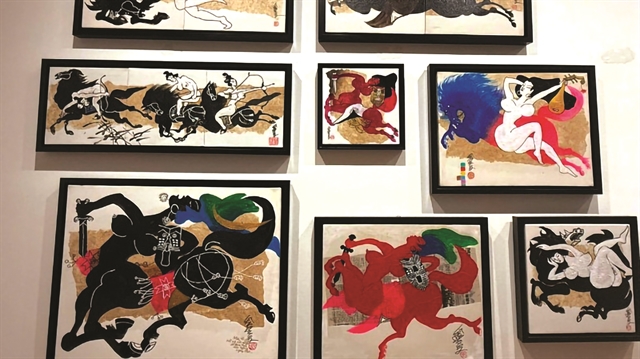 |
Dũng's breakthrough moment with the horse theme came when he painted Từ Công Army Camp. The large-scale work depicts the historic Từ Hải embracing Thúy Kiều, who holds a tỳ bà (traditional four-stringed lute), while a horse appears quietly in the background.
When an American collector asked to purchase the painting, Dũng initially thought the customer must have been deeply familiar with – and emotionally connected to – The Tale of Kiều. Only later did he learn that the collector’s attention had been drawn not to the central figures, but to the horse.
That moment marked a turning point. From then on, Dũng devoted himself to painting horses in various materials such as lacquer, oil on canvas and acrylic on traditional dó (poonah) and xuyến chỉ paper, as well as on wooden trays and even cardboard.
War, fate and devotion
One reason he has painted horses so extensively is closely tied to his own life story.
In 1972, while taking his graduation examination at the Hà Nội College of Fine Arts, he left the classroom to join the 338th Infantry Division. He later fought at the Quảng Trị Citadel and was subsequently stationed in A Sầu-A Lưới, a strategic gateway along the Trường Sơn supply route.
After the war, international surveys identified A Sầu-A Lưới as one of the areas in Việt Nam most heavily contaminated by Agent Orange. For years afterward, the fear of its lingering consequences followed him — quietly, relentlessly.
He later married but struggled for a long time to have children. Hope arrived late, and cautiously. In late 1978, joy finally arrived when he welcomed a healthy baby boy, unaffected by the lingering consequences of war. The child was born in the Year of the Horse.
According to artist Thành Chương, the horse is perhaps the animal most beloved by humankind.
“For thousands of years, from ancient times to the present, from East to West, people have drawn endless inspiration from the horse. Billions of artistic horses have been created ,” he said.
“For a long time, I believed there was little room left for Vietnamese artists to contribute something new.
“But I had to reconsider when I encountered the thousands of horse paintings by Dũng.
“His horses are striking in form, graceful in line, and rich and nuanced in colour. In his paintings, the horses appear at times majestic and proud, mysterious and romantic, sometimes contorted in pain, and at others radiant and exuberant.
“His horse paintings are, in essence, the man himself. They are the art of Dũng.”
Dũng was born into an artistic family. His father, painter Lê Quốc Lộc, was a renowned master of lacquer painting and a recipient of the Hồ Chí Minh Prize for Literature and the Arts.
Many of Dũng's works are held in the collections of the Việt Nam Fine Arts Museum, the Asia-Pacific Museum in Poland and in private collections both in Việt Nam and abroad. He has received numerous accolades, including top prizes at the National Fine Arts Exhibition in 1990, 2000 and 2009.
A legacy in motion
A small part of this artistic legacy is presented in the newly released publication Ngựa by the Hà Nội Publishing House to welcome the Year of the Horse. The book brings together 178 horse paintings, each carrying its own story and emotional register.
Together, they invite readers to wander through a world both majestic and introspective – a world shaped by movement, memory and belief.
It is essential reading not only for horse lovers and art enthusiasts, but also for anyone seeking to understand the life’s work of the Old Horse Herder, artist Lê Trí Dũng — a man who has spent decades painting not just horses, but the restless, resilient spirit of his time. — VNS
Life & Style
 Life & Style
 Life & Style
 Life & Style
 Life & Style
 Life & Style
 Life & Style
 Life & Style
 Life & Style
 Life & Style
 Life & Style
 Life & Style
 Life & Style
 Life & Style
 Life & Style