 Life & Style

Top leader hails friendship association's role in nurturing Việt Nam–Denmark ties
1.
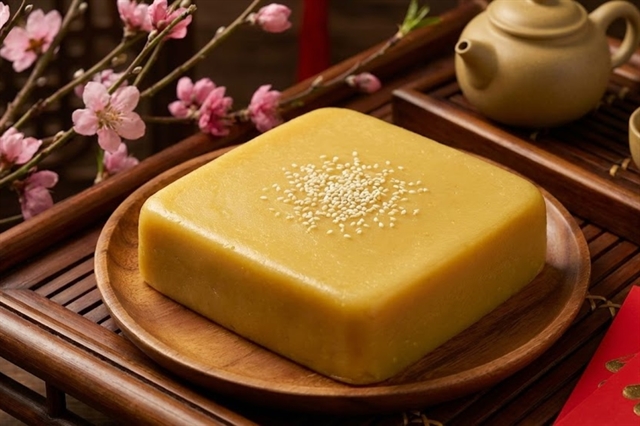 |
| A plate of golden 'chè kho', smooth and firm, topped with sesame seeds – a traditional Vietnamese mung bean cake often seen on Hà Nội family altars during Tết. — Photo cooponline.vn |
By Dương Ngân Hà
HÀ NỘI — For many people in Hà Nội, Tết (Lunar New Year) arrives not with fireworks or grand displays, but with a plate of chè kho (a humble-looking mung bean cake). The dense, golden mung bean sweet is modest in appearance, yet rich in memory, quietly linking generations through the warmth of family and the flavours of spring.
I am no exception.
Every time Tết approaches, my thoughts drift back to my mother, to her pot of chè kho, and to the warm, close-knit atmosphere of our family long ago.
In the small kitchen of my childhood, my mother would sit patiently beside the glowing charcoal stove, her hand moving in steady circles as she stirred the thickening mixture. The aroma of mung beans blending with the sweetness of sugar rose gently in the air, warm and comforting in a way that felt almost magical. It was the scent of memory itself – of peaceful reunions, of quiet joy, and of love that made even the simplest days feel full.
In our family, chè kho was a must every spring. Without fail, from the morning of the 30th day of the lunar year, my mother would begin preparing. The dish uses only a few familiar ingredients – mung beans, sugar, sesame seeds and cardamom – yet to cook a truly good pot requires immense effort and patience, most of it borne silently by her.
She used to say making chè kho was exhausting and painstaking, but it carried the flavour of family affection and the spirit of spring in the home, so she was determined to make it every year.
 |
| Mung beans — the key ingredient of chè kho — must be carefully selected for a fine, fragrant texture. — Photo phunuvagiadinh.vn |
The mung beans, she insisted, had to be small, whole and pale green inside. She would carefully pick through the beans, removing shrivelled or dark ones, then soak them for six to eight hours. When the skins loosened, she washed them thoroughly, a task that demanded patience to remove every damaged or discoloured grain.
After draining the beans well and sprinkling in a little salt, she steamed them until soft. Then came another labour-intensive step: pounding the cooked beans until fine, shaping them into small pomelo-sized balls, slicing them thinly, then chopping and pounding again – repeating the process several times until the beans turned into a fluffy, smooth mass.
 |
| The mung bean paste must be stirred continuously over low heat until thick and glossy — the most labour-intensive step in making 'chè kho'. — Photo cooponline.vn |
Sugar was dissolved in water, brought to a boil, then cooled into a syrup before being mixed with the mashed beans. My mother would then place the mixture over low heat and stir continuously with large chopsticks. Before beginning this process, she would simmer cardamom in water, strain it and add the fragrant liquid to the pot.
“The most important part is ‘kho’ – the slow cooking,” she would remind me. “You must stir constantly without stopping. The mixture is heavy and easily sticks to the pot.”
I once tried to take over for her. After barely ten minutes, my arm ached as the mixture grew thicker and heavier with each turn. She looked at me and smiled gently. “You’ll get used to it,” she said.
“When you’re too tired, think about how happy your loved ones will be when they taste what you’ve cooked. Then all the hardship will fade. That’s my secret.”
But I know that “getting used to it” was paid for with years of her quiet, tireless devotion.
She kept stirring until the sweet turned dense and glossy. “It’s ready when you lift the spoon and it doesn’t drip, when the surface is smooth, firm, golden, and doesn’t stick to your hands,” she explained. White sesame seeds, lightly toasted until fragrant, would then be sprinkled on top – the final touch that made the dish perfect in flavour, appearance and colour.
I remember that whenever she spooned the chè kho onto shallow plates, she always left a little in the pot – for her youngest daughter, me. Our family was poor back then. The sweet was made just enough to offer to grandparents, relatives, visiting guests and our own family. There was never much. Yet she always saved some for me to scrape from the pot, while casually saying, “There’s a bit stuck to the bottom – you eat it so it doesn’t go to waste.”
As a child, I ate happily, unaware of the quiet love hidden in that gesture. Now, grown up, with a more comfortable life and my parents no longer by my side, I think of those moments and feel how vast and boundless a parent’s love can be. How I wish I could return to those days, just once more, to scrape the last bits of chè kho from my mother’s pot.
 |
| 'Chè kho' shaped like a blooming flower, an elegant presentation reflecting the care behind this time-honoured sweet. — Photo visitvinhphuc.com |
My father loved chè kho too, especially with a cup of hot lotus tea. He would cut a small piece, take a sip of tea, and nod slightly. That, he said, was the proper way to enjoy it – to feel the soft sweetness of the beans mingling with the gentle bitterness and fragrance of tea.
On chilly early spring mornings, when the house still carried the fresh scent of coriander leaves – so typical of Tết – my father would sit quietly at the tea table, savouring a plate of the sweet my mother had made. In those moments, everything seemed to slow down. The flavour of Tết spread softly through the house, peaceful and complete in its own simple way.
This year, Tết is drawing near again. I miss my mother’s chè kho. I miss the bustling, love-filled atmosphere of our family in those days. And I want to step into the kitchen, cook a good pot of chè kho to place on the ancestral altar, to offer to my parents and forebears, and to make for my husband and children – the people I love most now.
Perhaps Tết does not lie in grand things after all, but in these quiet moments with family. — VNS
Life & Style
 Life & Style
 Life & Style
 Life & Style
 Life & Style
 Life & Style
 Life & Style
 Life & Style
 Life & Style
 Life & Style
 Life & Style
 Life & Style
 Life & Style
 Life & Style
 Life & Style