 Life & Style
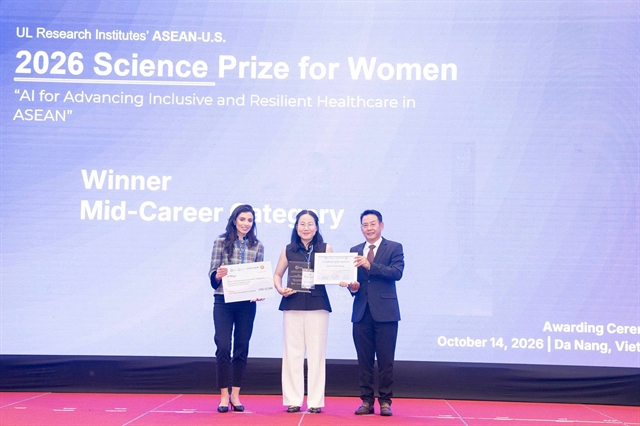
Vietnamese scientist wins ASEAN-US Science Prize for Women
1.

|
| The Thăng Long Imperial Citadel Heritage Site presents the show 'Thang Long Capital' using 3D mapping technology in a digital experience space. VNA/VNS Photo Thanh Tùng |
HÀ NỘI — The Politburo’s Resolution 57 is creating the chance to develop the cultural industry, seen as key to boosting economic growth and positioning Vietnamese culture on the global innovation map, experts have said.
Associate Professor Dr Bùi Hoài Sơn, a full-time member of the National Assembly (NA)’s Committee on Culture and Education, said the Politburo's Resolution 57-NQ/TW on breakthroughs in the development of science, technology, innovation and national digital transformation is a guiding principle for the development of a knowledge-based economy that also opens up enormous opportunities for cultural industries.
According to the NA official, in the digital age, the development of cultural industries is no longer just about art and tradition, but a harmonious combination of creativity, science, technology and innovation.
"Resolution 57 is not only a guiding principle for the development of the knowledge economy, but also opens up tremendous opportunities for cultural industries – a field with great potential in the country's sustainable development strategy," he said.
In the ever-evolving world of technology, culture also needs a profound transformation to adapt and develop.
While in the past, traditional cultural values existed only on the pages of books, in museums, on stage or through the stories of previous generations, now, thanks to the power of technology, we can bring this entire heritage into a new world – the digital world, according to Sơn.
From a strategic perspective, cultural industries including film, fine arts, music, design, advertising, fashion, video games, publishing, television, performing arts and handicrafts all share a common point: a deep dependence on creative power, an element that cannot be replaced by pure investment capital or simple production technology.
The cultural industry is seen as fertile ground for innovation, where emotions, identity, art and technology intersect to create new values, Sơn said.
Associate Professor Dr Vũ Thị Phương Hậu, director of the Institute of Culture and Development at Hồ Chí Minh National Academy of Politics said that amid digital transformation, developing cultural industries is needed to help build an advanced Vietnamese culture rich in national identity and is a driving force for economic development that will enhance the nation's position on the international stage.
With strong advances in information and communications technology and rapid changes in the market, Việt Nam has the chance to develop its cultural industries in the new era of the nation's rise.
Speaking at a recent workshop held by the Ministry of Culture, Sports and Tourism (MoCST) with the theme 'Digital Transformation in the Field of Culture', MoCST Deputy Minister Phan Tâm said that amid the rapid digital transformation taking place in Việt Nam and around the world, "the cultural sector cannot stand aside".
The deputy minister stressed the strategic importance of Resolution 57, saying that the Politburo has identified science and technology and digital transformation as a leading breakthrough and central driving force for the country's rapid and sustainable development in the digital age.
Tâm acknowledged the results in digital transformation of culture achieved in 2025 by the ministry's Centre for Digital Transformation of Culture, Sports and Tourism (CDTCST).
He said 2025 was the final year of the centre's 2020-2025 term and the year that the centre began a monumental shift under directions from the Party and Government on the digital transformation.
CDTCST has taken on the role of a key unit for implementation, management and operation of the culture sector's digital transformation.
As the cultural industry receives significant investment from the Party and the State, strengthening the industry's development with effective innovations and creativity are practical solutions to implement Resolution 57.

|
| A 3D interactive virtual exhibition recently opened at the National Museum of History in Hà Nội. — Screenshot photo. |
Since the 12th National Party Congress in 2016, development of the cultural industry has been set out as a key task, in parallel with building and perfecting the market for cultural services and products. It is also a crucial target to build Vietnamese culture in the new era and increase the nation's soft power.
The importance of this task was highlighted in policy outlining a strategy for the development of Việt Nam's cultural industries until 2020.
Decision 1909/QD-TTg issued by the Prime Minister and dated November 21, 2021, approved the Strategy for the Development of Vietnamese Culture until 2030. It clearly states: “Culture is the spiritual foundation of society, both a goal and a driving force for socio-economic development. Culture must be placed on par with and developed in harmony with the economy, politics and society; ensuring the cultural and human factors in economic development; adapting to the development trends of the Fourth Industrial Revolution, new and modern technologies, and socio-economic and human changes due to the impact of natural disasters, epidemics, crises, etc.”
Over the past several years, Việt Nam's cultural industries have made significant progress, gradually becoming an important service sector and contributing positively to socio-economic development. Between 2016 and 2018, 12 cultural industries contributed revenue of approximately US$8.08 billion (equivalent to 3.61 per cent of GDP); in 2021, this figure reached 3.92 per cent of GDP; in 2022 it increased to 4.04 per cent of GDP.
The production value of cultural industries from 2018 to 2022 was estimated at $44 billion.
From 2018 to 2022, the number of economic establishments operating in the cultural industries increased quite rapidly, at 7.2 per cent per year (with over 70,000 economic establishments currently present).
During this time, the labour force in the cultural industries also increased rapidly, at 7.4 per cent per year. The sector currently attracts about 2.3 million workers, accounting for 4.42 per cent of the total labour force of the whole economy. — VNS
Life & Style
 Life & Style
 Life & Style
 Life & Style
 Life & Style
 Life & Style
 Life & Style
 Life & Style
 Life & Style
 Life & Style
 Life & Style
.jpg) Life & Style
Life & Style
 Life & Style
 Life & Style
 Life & Style