 Life & Style
Hành Thiện's standing boat race
1.
Nguyễn Mỹ Hà
Most people don't really travel just for food, but any holiday will be more memorable and pleasant if you get to taste the local delicacies.
The true traveller's spirit can be found in these words: live like locals, eat like locals. For the New Year holiday, my family decided to take an unusual route for us by heading to Quy Nhơn, a beautiful seaside city on Việt Nam's south-central coast, located between two destination giants: Đà Nẵng and Nha Trang.
Quy Nhơn boasts spectacular natural landscapes, including beautiful beaches, crystal clear water and low-lying nearby mountain ranges. Kỳ Co - Eo Gió, Ghềnh ráng Tiên sa and the magnificent Champa Twin Towers are some of the must-see sites if you make it to the city.
|
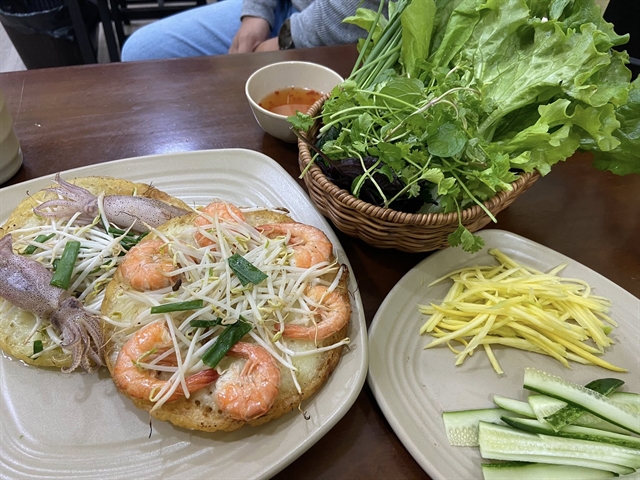
| Quy Nhơn's signature jumping shrimp and squid pancakes can also be enjoyed in Hà Nội or Hà Đông with the same fresh vegetables and dipping sauce. File photo |
Named Quy Nhơn by Nguyễn Hoàng in 1602 with a hope for the city to become a meeting point for talented individuals, it was a centre of intellectuals and poets in the early 20th century. Illustrious figures in the city's history include Chế Lan Viên, Bích Khê and Hàn Mặc Tử. But Quy Nhơn's main seaside road is named after Xuân Diệu, the king of early 20th century Romantic poetry.
Quy Nhơn has a lot to offer for the curious nature explorer, with Cù Lao Xanh (Evergreen Island) or Hòn Khô (Dry Island), Thị Nại Lagoon and the Phương Mai peninsula. Thị Nại Bridge connects the peninsula to Quy Nhơn city centre and boasts a length close to 2,500m.
Thị Nại Lagoon was a strategic seaport and has a long history of critical naval battles. Today, it looks peaceful, with spectacular views and a thriving mangrove forest ecosystem full of fish and birds for nature photographers.
|
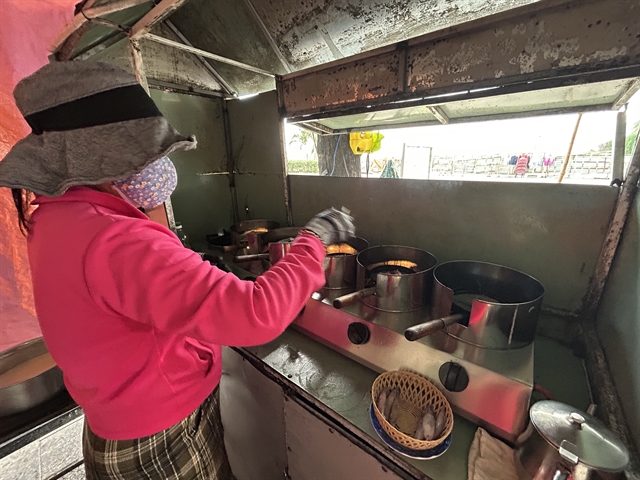
| A chef protects herself against the kitchen heat at a sidewalk bánh xèo food stall in Quy Nhơn. VNS Photo Mỹ Hà |
Quy Nhơn also boasts a rich history, including the now-lost Champa kingdom. The Champa towers are beloved by photographers and archaeologists alike, while the Champa museum at the foot of the Bánh Ít Tower gives visitors a great chance to learn more about this ancient culture.
The surrounding seas provide Quy Nhơn residents with ample seafood and some of the most expensive products in the culinary world. These include sea beetles, the rare, pyramid-shaped vú nàng snails, abalone, sea urchins, lobster and red frog crabs.
But the most famous dish that makes Quy Nhơn residents proud is bánh xèo, which often comes with a local seafood twist, including bánh xèo tôm nhảy (jumping shrimp fried pancake), bánh xèo mực (squid fried pancake) and bánh xèo bò trứng chảy (beef fried pancake with melting egg yolk).
|
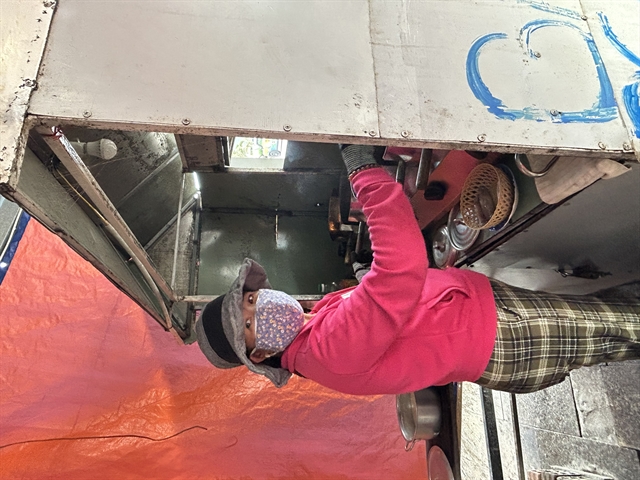
| SIZZLING SAFETY: A bánh xèo chef in Quy Nhơn protects herself from heat and oil with a thick cloth mask, a thick jacket and gloves. VNS Photo Mỹ Hà |
If you're used to the giant bánh xèo up north, then you might be surprised by the smaller size of the dish in the land where it originates.
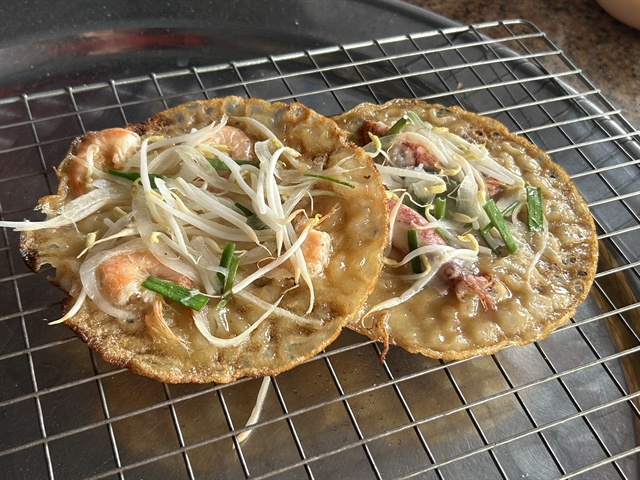
Quickly fried in a pan no bigger than a human hand, the dish is made by pouring fresh rice batter into the hot pan with oil, then topped with several fresh shrimp, two little squid about the size of a pinky finger, or fresh beef and an egg yolk in the middle. Fresh bean sprouts and spring onions are then sprinkled on top, and out on the plate it goes.
What makes the pancakes here stand out is the fish sauce-based dipping sauce and the green mango, julienned and served on the side. Fresh lettuce, coriander and cucumber slices are also added before the pancakes are folded and dipped into the sauce.
Unlike in other areas, where chefs add turmeric powder to make a yellow pancake, the rice batter in Quy Nhơn retains its original white colour.
|
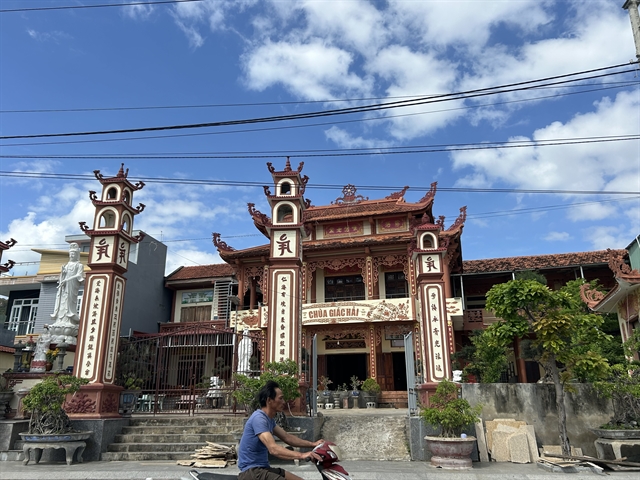
| SEASIDE SERENITY: Giác Hải Pagoda stands on a seaside road in Nhơn Hải Village. VNS Photo Mỹ Hà |
Before our trip, we searched the internet for places to try the pancakes. Many reviews and even a TVT video clip steered us to Nhơn Hải Village, where visitors can sit by the seaside, watch the fishing boats come back to shore and try the freshest possible pancakes with real jumping shrimp and squid.
We set off with high expectations. On holiday in a seaside village, it's not hard to have a good time.
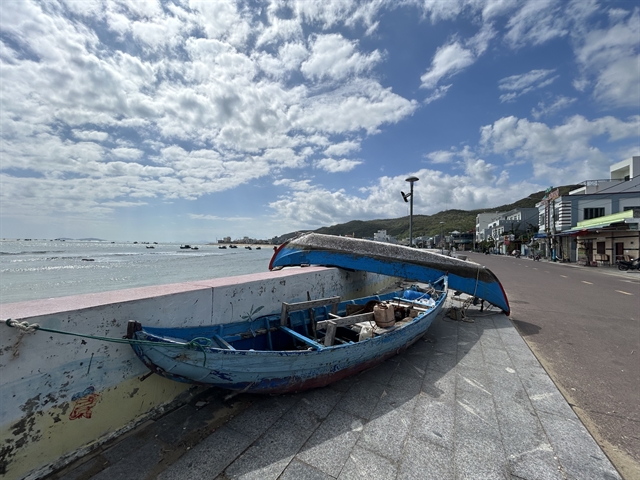
When we actually got there, however, reality struck. While the landscape was still beautiful, the whole village was shut down after Typhoon Kalmaegi came through on November 7, 2025. The storm wreaked havoc on the long stretch of land from Đà Nẵng to Gia Lai Province, where Quy Nhơn is located.
Everywhere we went, we saw broken coconut palms and destroyed buildings, with glass and aluminium still shattered and unrepaired.
|
| Along the main seaside road in Nhơn Hải, boats lie on shore as the village shut down all of its tourist activities to await the 2026 summer season. VNS Photo Mỹ Hà |
In Nhơn Hải Village, a once-beautiful seaside bar perched on top of the rocks at one end of the beach was destroyed, locked and now deserted. Along the main village road, we saw some bánh xèo signs for shops, but no food was being served.
We had to return to Quy Nhơn to actually taste the pancakes.
The weather was really nice, with mild temperatures at 20-22 degrees Celsius, a little cold for those of us who prefer warmer waters. The best time and weather for sea bathing in Quy Nhơn lasts from May through September or October.
However, take note: October and November is the storm season, as heavy rains and wind usually hit during these months.
The rainy season lasts from October until the following February, but check the weather forecast, because you can still get lucky and see some sun.
The first day of our trip was beautifully sunny, although locals told us it had rained the entire previous week.
|
| PAN-FRIED JOY: Fresh jumping shrimp and squid pancakes cool straight out of the frying pan. VNS Photo Mỹ Hà |
Dry season starts in March and lasts until September. It's the busiest time for locals, who welcome a large flow of tourists coming in for the sea, the beaches and the food. Summer is also when sea-inspired festivals take place, including the Great Whale Festival, during which residents pay tribute to the great whales that rescue fishermen lost at sea.
Other summer festivals include a traditional martial arts festival and a rowing festival.
Quy Nhơn was also the capital of the former Bình Định Province, which made a name for itself across the country as the home of ancient martial arts traditions.
|
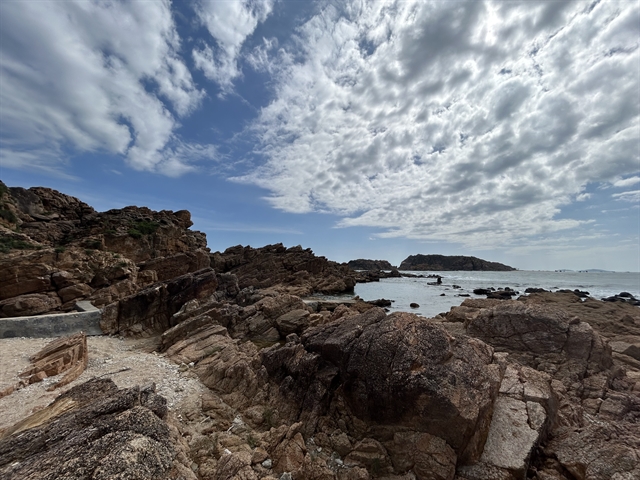
| ROCKY RETREAT: Rocks sit at one end of the Nhơn Hải fishing village, a popular tourist destination in summer near Quy Nhơn. VNS Photo Mỹ Hà |
As a popular saying goes: "Whoever comes to Bình Định will see the ladies of the land dance with rods and make great martial arts moves."
Variations of this saying also mention that the women of Bình Định dance with rods to teach their husbands, which may not be entirely true. But it does signify a certain degree of freedom and power for the women in the land of martial arts. VNS
Life & Style
.jpg) Life & Style
Life & Style
 Life & Style
 Life & Style
 Life & Style
 Life & Style
 Life & Style
 Life & Style
 Life & Style
 Life & Style
 Life & Style
 Life & Style
 Life & Style
 Life & Style
 Life & Style

.jpg)