 Life & Style

Lotte, Phát Đạt combine strengths in Thu Thiem project
1.
Dr Trương Hoàng Quý*
Ear infections in children, medically known as otitis media, are very common in young children, especially those under six years of age. Fortunately, most cases resolve quickly and are not usually serious.
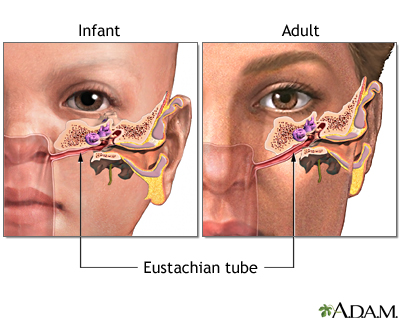
Several factors contribute to ear infections in children, including immature anatomy, physiology, genetic predisposition and living environment. The Eustachian tubes, which connect the middle ear to the throat, are smaller and more horizontal in infants and young children. This makes fluid drainage less effective and increases the risk of infection.
|
| Eustachian tube anatomy in infants and adults showing causes of ear infections in children. Photo courtesy of MedlinePlus |
Risk factors for ear infections in children
Other factors associated with ear infections in children include:
Age: most common between 6-18 months and preschool age
Some studies suggest that the risk of acute ear infections in children is associated with family history
Attendance at daycare, where infections spread more easily
Lack of breastfeeding
Exposure to tobacco smoke or air pollution
Higher occurrence during fall and winter months
Symptoms of ear infections in children
Common symptoms of ear infections in children include:
Ear pain is a common symptom of ear infections in children and often becomes worse when the child lies down. In younger children, signs may include irritability, disturbed sleep, frequent waking at night, or repeatedly touching or pulling at their ears. Older children may complain of hearing loss or ringing in the ears (tinnitus).
Children with ear infections in children often have accompanying upper respiratory symptoms such as fever, cough, and a runny nose.
Other possible symptoms include poor feeding, vomiting, or diarrhoea.
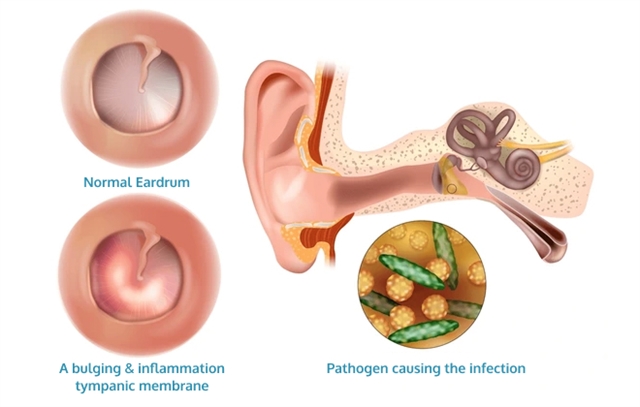
Ear infections in children are diagnosed when a doctor examines the ear and observes inflammation of the eardrum (tympanic membrane).
|
| Normal eardrum vs. inflamed tympanic membrane and infection. Photo courtesy of Avisena Women’s & Children’s Specialist Hospital |
What you can do at home
Pain control: Use medication for pain, such as giving Ibuprofen or acetaminophen to treat pain
Ear drops medication for pain, such as benzocaine or lidocaine preparation, may be used for children above 2 years of age
Symptom treatment medication should be used if the child has a cough or a runny nose
Avoid swimming until the symptoms resolved
When to see a doctor
Although many ear infections in children are caused by viral infections and may improve within 2-3 days, medical attention is recommended if:
The child is under 6 months of age
Symptoms do not improve after 48 hours in children over 2 years old
The child has a weakened immune system
There is swelling, redness, or pain behind the ear (possible complications such as eardrum perforation or mastoiditis)
Parents have any concerns about their child’s condition
Prevention for otitis media
To reduce the risk of ear infections in children, parents can:
Ensure children receive all routine vaccinations, especially pneumococcal conjugate (PCV) and Haemophilus influenzae type b (Hib) vaccines
Avoid exposure to cigarette smoke and air pollution
Treat upper respiratory infections promptly and maintain good nasal hygiene
Ear infections are a common part of childhood and, in most cases, can be managed safely with appropriate care and monitoring. Understanding the symptoms, knowing when home care is sufficient and recognising when to seek medical advice can help parents feel more confident. If there is any uncertainty, consulting a healthcare professional is recommended. — Family Medical Practice

|
| Dr Trương Hoàng Quý. — Photo courtesy of Family Medical Practice |
*Dr Trương Hoàng Quý is a paediatrician at Family Medical Practice in HCM City. He holds a medical degree from Hà Nội Medical University and a Master of Public Health Nutrition from Queensland University of Technology. He has experience managing a wide range of paediatric conditions, from routine care to more complex nutritional and developmental issues. Families value his careful and attentive approach to child healthcare.
FMP Healthcare Group operates medical centres in major cities, including HCM City, Hà Nội and Đà Nẵng, providing consultations with international doctors, health check-up centres and emergency ambulance services.
Appointments with Dr Trương Hoàng Quý can be made at the FMP clinic at 41 Đặng Đức Thuật Street, Tân Hưng Ward, HCM City, by telephone on +84 28 3622 4988 or by email at d7.reception@vietnammedicalpractice.com.
Family Medical Practice, part of FMP Healthcare Group, operates clinics in Districts 1, 2 and 7 in HCM City, as well as the Care 1 Executive Health Check-Up Centre and internationally accredited 9999 emergency ambulance services.
Life & Style
 Life & Style
 Life & Style
 Life & Style
 Life & Style
 Life & Style
 Life & Style
 Life & Style
 Life & Style
 Life & Style
 Life & Style
 Life & Style
 Life & Style
 Life & Style
 Life & Style