 Environment

Việt Nam, Denmark issue joint statement on establishment of Comprehensive Strategic Partnership
1.
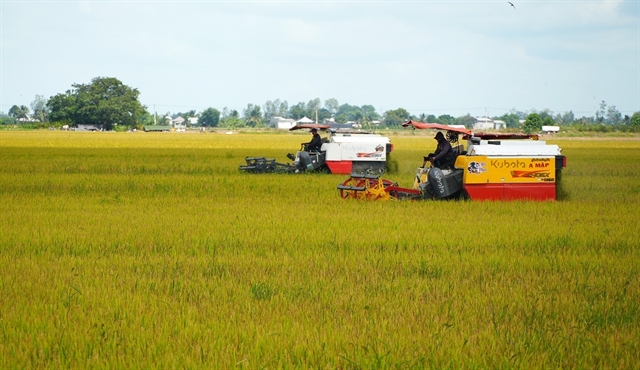 |
| Farmers harvest rice in Tân Hiệp Commune in An Giang Province. — VNA/VNS Photo Huy Hải |
Trần Như
HÀ NỘI — Việt Nam needs a “soil guardianship” model, under which the State, communities, land users, businesses, social organisations and scientists share responsibility for monitoring and protecting soil.
The recommendation was made by Phạm Tuấn Anh, former Director of the Đắk Nông Department of Agriculture and Rural Development, at an online workshop entitled “Finding the Rights of Soil”, organised by the Agroforestry Policy Research Network in Hà Nội on Friday afternoon.
Anh said maintaining productivity and output is increasingly dependent on higher levels of agricultural inputs, while organic matter, soil organisms, water-retention capacity and other essential soil functions are showing signs of decline.
The problem is particularly evident in the Central Highlands, where signs of soil degradation tend to accumulate over many years.
Soil compaction and declining water-retention capacity, chemical imbalances and acidification, as well as the deterioration of microbial and soil organisms, are all signs that soil health is being compromised.
This highlights a paradox that needs to be recognised: productivity and output may increase, but the foundation underpinning those “bumper harvests” risks becoming depleted.
Instead of asking only “What does the crop need?”, there is a need to ask “What does the soil need?” This means moving away from viewing soil simply as a means of production and recognising it as the ecological foundation of production, livelihoods and life itself.
From a management perspective, Anh said the current system still had significant gaps.
The ecological functions of soil had yet to be placed at the centre of policy; there was a lack of systems for monitoring soil health and providing early warnings; and mechanisms to protect the long-term interests of soil were inadequate.
Short-term land leases for large-scale commercial production provide one example. Land users may benefit for several years, but if overexploitation causes soil degradation, landowners, communities and future generations may ultimately bear the cost of restoration.
Anh also added that land policies therefore need to answer specific questions: How can farmers be supported? How can technology be transferred effectively? And how can the economic benefits of soil protection and restoration be demonstrated?
“Protecting soil, therefore, cannot be the sole responsibility of farmers,” he said.
It requires the participation of scientists, policymakers, businesses and society as a whole.
In Việt Nam, about one-third of the country’s total natural land area, equivalent to nearly 12 million hectares, is affected by degradation, with about 1.2 million hectares considered severely degraded.
Of the country’s agricultural land, about 5 million hectares, or roughly 40 per cent, are affected by degradation.
These figures show that soil degradation is not merely an environmental issue. It has direct implications for production, livelihoods, food security, water resources and sustainable development.
Also at the workshop, Tô Xuân Phúc, Executive Director of Forest Trends said: “Soil is not silent.”
It “speaks” through erosion, declining productivity, changes in soil structure and reduced water-retention capacity.
Phúc said soil was not merely a means of production but also the foundation that sustains life.
As people derive nutrients and many other benefits from soil, they also have a responsibility to restore what has been taken from it.
Soil can therefore be regarded as “capital for the future”. People use soil today but must simultaneously safeguard its benefits for generations to come, he said.
Regenerative agriculture
One approach highlighted by experts at the workshop is regenerative agriculture, which focuses not only on maintaining productivity but also on restoring the soil’s natural functions.
Nguyễn Thanh Tâm, CEO of TMT Consulting, said regenerative farming practices should begin with soil and nutrient management based on soil analysis, with fertiliser applied according to crop requirements.
Increasing ground cover, making use of branches and leaves, planting cover crops, increasing the use of organic fertilisers and applying microbial compost can help replenish organic matter and improve soil health.
Farming systems should also be diversified through the use of shade trees and fruit trees and the conservation of biodiversity, alongside integrated pest management, water-saving practices and biochar.
These measures can improve soil health, reduce input costs and strengthen resilience to climate change.
To help farmers make the transition, production needs to be supported by links between farmers, cooperatives and businesses, together with traceability systems and green financing mechanisms.
Tâm said sustainable production standards such as Rainforest Alliance and certifications for regenerative agriculture had made soil and biodiversity conservation important criteria.
A gradual roadmap for increasing ground cover would give farmers time to adapt.
These are very practical pathways that will allow farmers to adapt step by step.
“I hope scientists and policymakers will work together to support farmers in raising awareness and changing their farming practices before damage to the soil becomes difficult to reverse,” he said.
Today’s “bumper harvests” cannot become a sustainable success if the price is the exhaustion of the soil.
Restoring soil health, changing farming practices and sharing responsibility for soil protection are not only requirements for agricultural production.
They are also essential to safeguarding the foundations of livelihoods, food security, ecosystems and the future of generations to come. — VNS
Environment
 Environment
 Environment
 Environment
 Environment
 Environment
 Environment
 Environment
 Environment
 Environment
 Environment
 Environment
 Environment
 Environment
 Environment