 Environment
Việt Nam, New Zealand convene 14th political consultation
1.
|
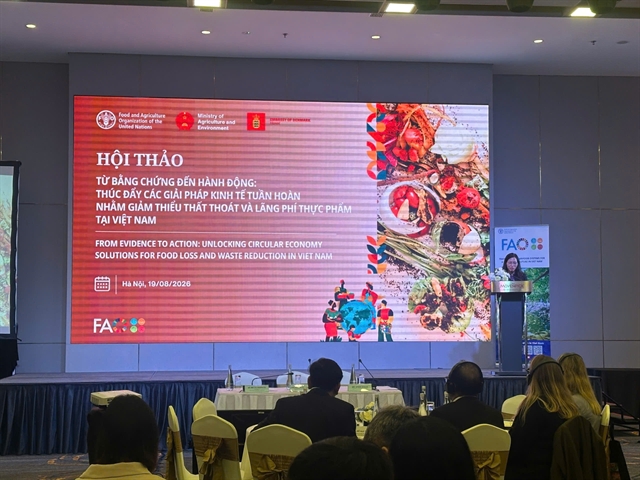
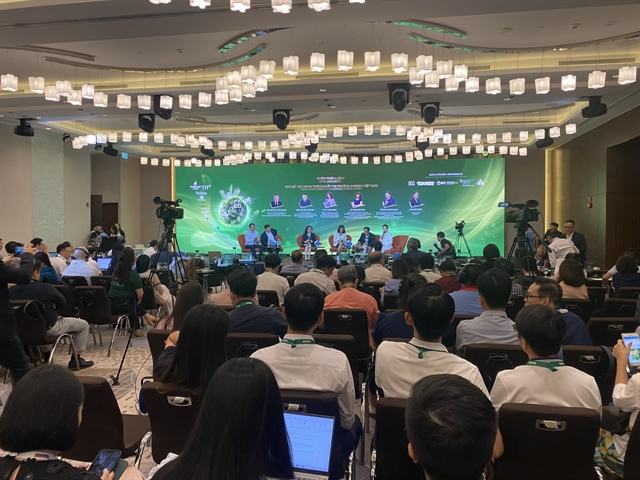
| Participants at the seminar 'From Evidence to Action: Unlocking circular economy solutions for food loss and waste reduction in Việt Nam', in Hà Nội on Wednesday. — VNS Photo Tố Như |
HÀ NỘI — The Ministry of Agriculture and Environment has said it will prioritise policies to promote high-tech agriculture, mechanisation, deep processing and higher value-added production, while strengthening innovation, ecological agriculture, the circular economy and emissions reduction.
Plans are also in place to promote digital transformation and the application of technology in logistics to reduce losses, according to the ministry.
It will also strengthen the processing and use of agricultural by-products to produce animal feed, fertiliser, renewable energy and industrial products, and attract private investment, strengthen value chain links and scale up initiatives developed by farmers, cooperatives and businesses.
Nguyễn Đỗ Anh Tuấn, director general of the Department of International Cooperation under the Ministry of Agriculture and Environment, made the remarks at a seminar titled 'From Evidence to Action: Unlocking circular economy solutions for food loss and waste reduction in Việt Nam', which took place in Hà Nội on Wednesday.
The seminar was held by the ministry in coordination with the Food and Agriculture Organization of the United Nations (FAO) and the Embassy of Denmark in Việt Nam.
A key focus of the event was the introduction of a draft White Paper on food loss and waste in Việt Nam, prepared by the Institute of Policy and Strategy for Agriculture and Environment in collaboration with the FAO. The draft provides a comprehensive foundation to support the development of a policy roadmap for Việt Nam.
Tuấn said food loss and waste is a major issue, involving billions of US dollars, billions of tonnes of agricultural products and vast amounts of water and other resources used throughout production, processing, distribution and consumption.
“Food loss and waste also account for around 8 per cent of global greenhouse gas emissions,” he said.
He noted that reducing food loss is not only important for the environment, but could also directly enhance the competitiveness of agricultural products.
Lower losses could reduce costs per unit of output and improve economic efficiency.
The use of by-products could also generate new products with higher added value, he said.
In Việt Nam, many agricultural by-products are already becoming valuable sources of raw materials, ranging from grapefruit, orange and lemon by-products to coconut-derived products such as coir and coconut leaves.
However, significant losses still occur during post-harvest handling, processing and distribution. Some surveys indicate that around 10-25 per cent of food products may be lost before reaching processors or being distributed to consumers.
He said that the Government’s Decision 300 on the National Action Plan for the transformation of the food system towards transparency, responsibility and sustainability by 2030 provides an important foundation for mobilising the participation and coordination of ministries, sectors, localities and domestic and international partners.
“What is important now is not simply to continue identifying the scale and causes of the problem, but to move from awareness to action; from isolated studies to an evidence base that can support decision-making; from pilot models to scalable solutions; and from the efforts of individual agencies and businesses to coordinated action across the entire system,” he said.
Also at the seminar, FAO Representative in Việt Nam Vinod Ahuja said the ambition is not simply to produce less waste, but to keep value circulating in the food system for as long as possible, and at the highest possible level. Scaling is not simply about doing more projects, it is about creating the conditions in which good solutions can grow on their own.
Deputy Head of Mission at the Embassy of Denmark in Việt Nam Mette Ekeroth said: “Waste is not always the end of a process – it can be the beginning of another.”
The challenge is to turn evidence into practical solutions. The value of initiatives is not only what they achieve individually, but what others can learn from them, adapt and take further.
Denmark is pleased to continue this cooperation with Việt Nam in the green transition of food systems, she added. — VNS
Environment
 Environment
 Environment
 Environment
 Environment
 Environment
 Environment
 Environment
 Environment
 Environment
 Environment
 Environment
 Environment
 Environment
 Environment
.jpg)