 Environment

Việt Nam, US seek to promote financial cooperation
1.

|
| Nguyễn Văn Tiến, deputy director of the Disaster and Dyke Management Authority, speaks during the working session on riverbank and coastline erosion on Tuesday. — VNA/VNS Photo |
CẦN THƠ — The Mekong Delta city of Cần Thơ has 207 riverbank erosion sites stretching nearly 18 kilometres that remain unfunded, with repairs estimated to cost about VNĐ1.6 trillion (US$60 million), city officials said.
The figures were presented during a working session between the Disaster and Dyke Management Authority, an agency under the Ministry of Agriculture and Environment, and the city's Department of Agriculture and Environment on Tuesday.
Since the start of 2026, Cần Thơ has recorded more than 272 erosion sites along its rivers and coastline, totaling over 34km, according to the department.
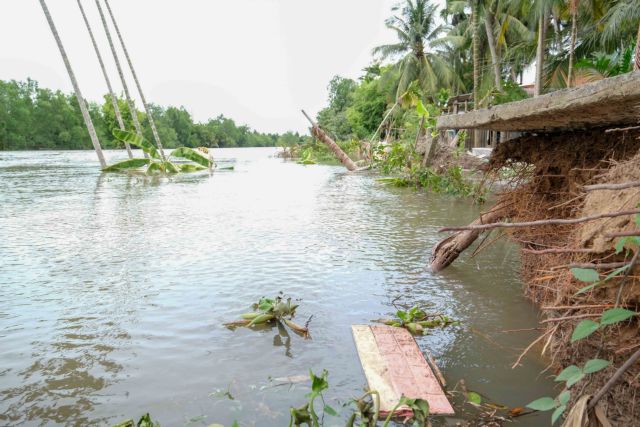
Ten homes have been swept entirely into the river, more than 70 others have been damaged, and erosion has severed rural roads in several areas, disrupting travel and the transport of goods.
The city has so far spent VNĐ47.3 billion ($1.8 million) to reinforce 65 sites covering nearly 12km, leaving 207 sites – requiring roughly 1.6 trillion ($60 million) – without funding.
Of those, eight sites covering about 9.5km have been declared emergencies and need urgent action, at a cost of around VNĐ1.3 trillion ($50 million), a Cần Thơ irrigation official said.
The city has proposed that the central government cover that amount for 2026-2027, plus an additional VNĐ274 billion ($10 million) to help 20 riverside communes and wards along the Hậu River tackle the remaining hazardous sites and restore local roads.
Nguyễn Văn Tiến, deputy director of the Disaster and Dyke Management Authority, credited local authorities and residents for proactive erosion-control efforts that have kept roads passable and daily life stable in affected areas.
|
| A concrete road collapses into the river in An Lạc Thôn Commune, Cần Thơ City. — VNA/VNS Photo |
He said high-risk areas without reinforcement funding need stricter management to keep risks from escalating, and that the city should move residents out of the most dangerous zones over time to safeguard lives and property.
Separately, he instructed the authority's disaster safety division to keep the erosion map updated with current site photos to strengthen monitoring and risk assessment.
Nguyễn Hoàng Anh, acting director of Cần Thơ's Department of Agriculture and Environment, urged the central government to fund emergency repairs at sites where erosion directly threatens residents and infrastructure.
He also called for funding to complete the Vĩnh Châu sea dyke, saying it would strengthen the city's defences against natural disasters and saltwater intrusion.
Rainfall this year has been below average, he added, and a possible emerging El Niño pattern raises the risk of severe saltwater intrusion during the 2027 dry season – a serious threat to agricultural production.
The Ministry of Agriculture and Environment is expected to allocate about VNĐ6.1 trillion ($233 million) for five embankment projects along the Cần Thơ, Trà Nóc, Bình Thủy and Ô Môn river sections, plus six road projects, to be built between 2026 and 2028 under the city's transport and agriculture project management board. — VNS
Environment
 Environment
 Environment
 Environment
 Environment
 Environment
 Environment
 Environment
 Environment
 Environment
 Environment
 Environment
 Environment
 Environment
 Environment