 Economy


Mutual trust, commitment to cooperation tie Việt Nam and Japan: expert
1.
|
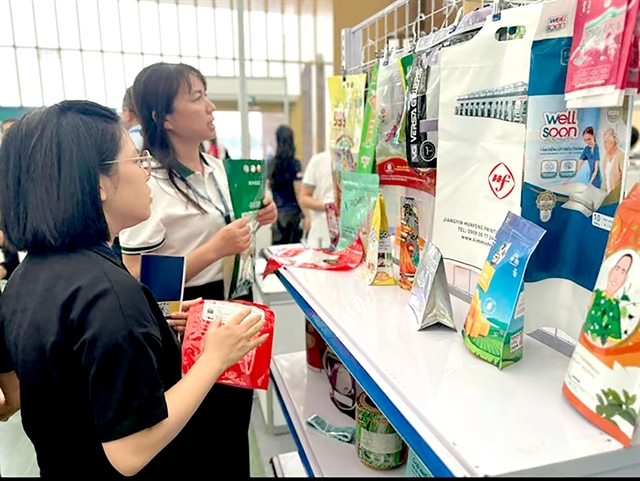
| A range of eco-friendly packaging products is showcased at an exhibition in Hà Nội.— Photo hanoimoi.vn |
HÀ NỘI — Green packaging, transparent labelling and product traceability are helping Vietnamese businesses add value to their products, meet environmental standards and expand into export markets, industry insiders said.
Nguyễn Thị Liễu, deputy chief of the office of the Vietnam Beer-Alcohol-Beverage Association, said packaging innovation has become a practical necessity amid significant shifts in policy, market conditions and consumer preferences.
Businesses must not only improve product quality but also boost productivity, operational efficiency and automation, strengthen quality control and advance sustainability, she said.
Many companies in the sector have proactively adopted measures to use materials more efficiently, reduce production costs and minimise waste, Liễu told a recent conference in HCM City.
Key priorities include using recycled plastics, reducing packaging weight while maintaining durability, safety and product quality, and improving packaging recovery, recycling and reuse. Businesses are also researching more environmentally friendly materials and upgrading packaging technology through automation and digitalisation.
Packaging innovation goes beyond changing a product's appearance and plays a vital role across the entire value chain, involving manufacturers, packaging suppliers, technology companies, research organisations and government regulators, Liễu said.
She added that technological innovation can help businesses increase productivity, optimise resource use, meet market demands and gradually transition towards more sustainable production models.
Trịnh Thị Hòa, co-founder of BUYO Solutions Co, said the company is researching ways to use spent grain from beer production and other agricultural residues to develop biomaterials.
Such materials could reduce reliance on conventional plastics and support circular-economy models in the food and beverage industry, she said.
Pressure to adopt greener packaging is also increasing as international markets tighten environmental requirements, experts said.
With an estimated 200 billion plastic bags consumed worldwide each year and recycling requirements for packaging sold in various international markets expected to become more stringent by 2030, businesses need to prepare for changes in regulations and supply-chain standards.
This requires companies to redesign packaging, improve lifecycle management and adjust supply chains proactively, rather than waiting for new trade barriers to emerge.
For Vietnamese businesses, investment in green packaging could therefore serve not only as a response to environmental requirements but also as a way to strengthen brand value and competitiveness in export markets, according to experts.
Standardised labelling strengthens market access
Standardised labelling and transparent traceability data are also becoming increasingly important for Vietnamese agricultural exporters as international markets tighten requirements on environmental sustainability, food safety and product origin.
Meeting these requirements can help businesses comply with regulations while increasing product value and improving access to higher-value markets.
Vũ Văn Hiệp, director of SS Corp Co, said the green transition and greater data transparency are essential to strengthening the competitiveness of agricultural products.
Regulations such as the European Union Deforestation Regulation (EUDR), the Carbon Border Adjustment Mechanism (CBAM) and importing markets' requirements for cultivation-area codes are placing greater demands on production processes, quality control and traceability.
To address these challenges, authorities, cooperatives, farmers and exporters need to strengthen coordination, Hiệp told hanoimoi.vn.
Cooperatives should play a key role in connecting small-scale producers, establishing centralised raw-material zones, maintaining production records and overseeing quality control. Farmers need to adopt sustainable practices, while businesses should invest in deeper processing, distribution networks and traceability technologies, he said.
Building a green agricultural brand also requires linking product labels to specific cultivation-area codes, developing compelling product stories and protecting intellectual property in target markets, he added.
Accurate labels and traceability build consumer trust
|
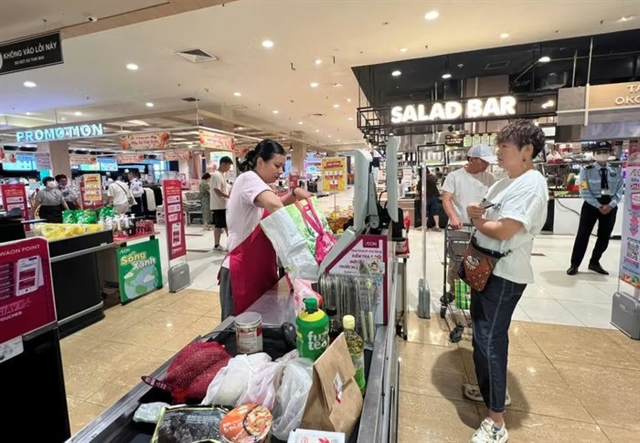
| Shoppers use packaging made from recycled materials at a supermarket in Hà Nội. |
Dương Văn Nam, general director of VietFarm, said labelling errors remain common, including missing ingredient lists, unclear expiry dates and the unauthorised use of One Commune, One Product (OCOP) or organic certification claims.
Businesses and cooperatives must ensure that product names, ingredients, expiry dates, nutritional information and origin details are accurate and consistent with official product declarations, laboratory test results and the actual quality of goods, he said.
QR codes and supplementary labels cannot replace mandatory information on product labels. Their value depends on whether they provide access to verifiable information about cultivation areas, production processes, farming records and test results, Nam said.
Up-to-date traceability data allows buyers to verify product origins and can strengthen confidence in brands, he added.
Businesses must also ensure that claims such as "organic", "OCOP" and "chemical-free", as well as health-related statements, meet applicable legal requirements.
Labels should be checked against official product declarations before large-scale printing to reduce errors and avoid costly revisions, Nam said. Packaging in direct contact with food must also meet safety and durability requirements appropriate to the product, while recyclability and recovery should be considered during material selection. — VNS
Economy
 Economy
 Economy
 Economy
 Economy
 Economy
 Economy
 Economy
 Economy
 Economy
 Economy
 Economy
 Economy
 Economy
 Economy