 Economy



84 individuals investigated for transnational online frauds
1.
|
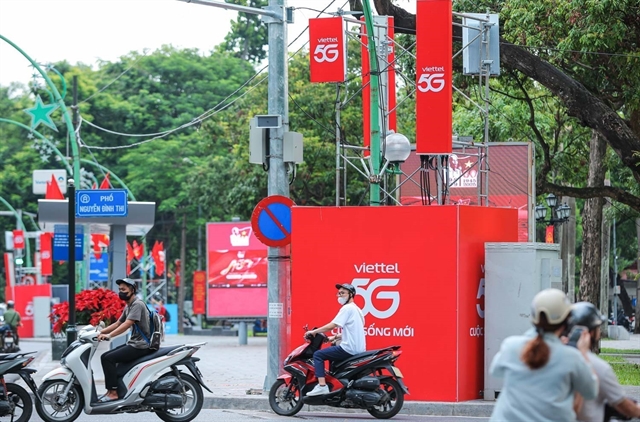
| 5G stations of Viettel. Digital infrastructure is identified as a foundation for developing a digital economy, digital society and digital government. — VNA/VNS Photo Hoàng Hiếu |
HÀ NỘI — More than a year after its commercial launch, Việt Nam’s 5G mobile network has expanded rapidly and now provides a broad digital infrastructure underpinning the country’s push towards a digital economy.
The rollout reflects the Government’s infrastructure-first approach to digital transformation, in line with the Politburo’s Resolution 57-NQ/TW, which identifies digital infrastructure as a foundation for developing a digital economy, digital society and digital government.
Within just 12 months of commercialisation, 5G coverage has been rapidly expanded nationwide, creating a new-generation connectivity backbone intended to prevent Việt Nam from falling behind in global digital transformation and to create a solid foundation for the development of digital economy models.
Nguyễn Hà Thành, deputy general director of military-run Viettel Telecom, said that by the end of 2025 Viettel had deployed 30,000 5G stations, achieving 90 per cent outdoor coverage and 70 per cent indoor coverage.
“Investing in 5G is investing in national digital infrastructure. When infrastructure goes first, economic and social value will follow,” Thành said.
In 2026, Viettel plans to develop an additional 15,000 5G stations to lift indoor coverage to nearly 85 per cent. New 5G subscriptions currently account for about 50 per cent of all new mobile subscriptions, while 5G data usage is rising by 15–20 per cent.
State-owned VNPT and MobiFone have also gradually expanded their 5G networks, prioritising major cities, industrial zones, ports and airports.
VNPT aims to achieve 5G coverage of 55–60 per cent of the population by the end of this year and is focusing on piloting private network models for universities and smart factories to lay the groundwork for new digital business models.
Nguyễn Tuấn Huy from MobiFone said 5G is expected to become a real growth driver from 2026, adding that the company is focusing on deploying 5G for business-to-government applications such as smart cities, smart traffic management, flood control and smart energy.
Reaching around 90 per cent population coverage in just one year has placed Việt Nam among the fastest countries in 5G deployment, Nguyễn Anh Cương, deputy director of the Vietnam Telecommunications Authority under the Ministry of Science and Technology, said. He added that in other countries it normally takes two to three years to reach similar coverage.
He noted that such rapid expansion helps narrow the digital gap between urban and rural areas.
As 5G is viewed not merely as a commercial activity but as a national-scale infrastructure mission, the Government has introduced policies to support faster deployment, including partial investment incentives for operators that meet rollout targets, he said.
How to monetise 5G
|
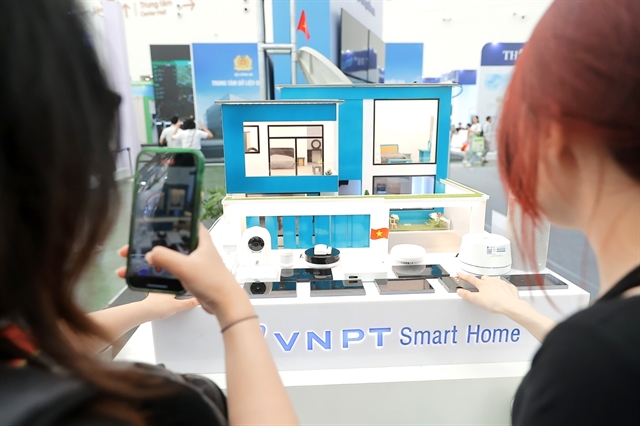
| Smart Home solution of VNPT. 5G is expected to usher in a deeper phase of digital economic development tied to automation, real-time data and smart production and governance models. — VNA/VNS Photo Minh Quyết |
While 4G created mass mobile internet and fundamentally reshaped social life and digital consumption habits, 5G is expected to usher in a deeper phase of digital economic development linked to automation, real-time data and smart production and governance models.
However, experts said 5G commercialisation is not merely a technological issue but a broader challenge involving infrastructure, business models, policy and societal readiness.
“5G is a long-term investment,” Nguyễn Quốc Khánh, deputy head of the Technology Department at VNPT, said.
He noted that the initial phase mainly improves individual user experience, while higher-value business models such as private networks or digital platforms require more time, ecosystem synchronisation and enterprise readiness.
Nguyễn Duy Lâm, senior telecommunications solutions expert at Huawei Việt Nam, recently recommended that Việt Nam initially focus on developing e-commerce applications, which are easier to deploy and allow users to livestream, buy and sell online more effectively.
More complex applications such as smart factories and smart cities require more time, stronger business participation and clear Government orientation, he said.
Mai Liêm Trực, a technology expert, said private networks had not developed as expected. He suggested telecom operators rethink how to monetise private networks, noting that they could become a major revenue source.
According to Vũ Hoàng Liên, chairman of the Việt Nam Internet Association, 5G is expected to drive the development of a national digital technology industry. “This is an opportunity for Việt Nam to develop its own equipment and technological solutions,” he said.
The Politburo’s Resolution 57 identifies 5G as strategic national infrastructure, with a goal of achieving nationwide coverage by 2030. — VNS
Economy
 Economy
 Economy
 Economy
 Economy
 Economy
 Economy
 Economy
 Economy
 Economy
 Economy
 Economy
 Economy
 Economy
 Economy