 Economy



Final section joins Saigon River pedestrian bridge
1.
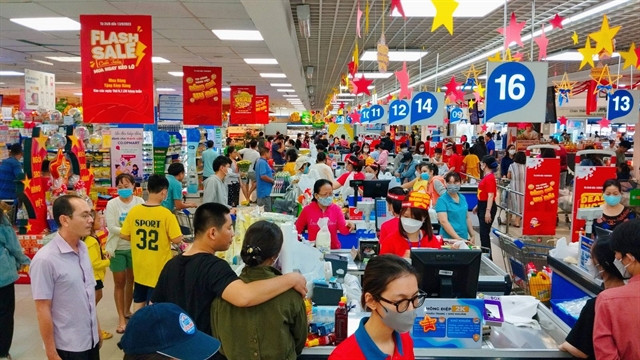 |
| Shoppers at a supermarket in HCM City. — VNA/VNS Photo |
HÀ NỘI — The recently approved National Strategy for Retail Market Development to 2030, with a vision to 2050, is laying a solid foundation for a new phase of growth in Việt Nam’s distribution sector, according to industry insiders and market analysts.
A key focus of the strategy is encouraging enterprises from all economic sectors to participate in retail development in forms and at scales suited to their capacity. It highlights the formation of a strong domestic distribution backbone through initial incentives in mechanisms, financial policies and land access, while gradually fostering large corporations and enterprises in the distribution sector.
Although domestic enterprises are identified as the core retail force, the strategy does not exclude foreign-invested firms. Private enterprises are seen as an important driver of retail market development, alongside policies to encourage and support small businesses, commercial co-operatives, household businesses and individual traders to engage in the market.
Another notable orientation is the strong emphasis on digital-based business models. E-commerce, online trading platforms and especially omni-channel retail, mobile commerce and social commerce are identified as inevitable trends to meet increasingly diverse consumer demand. These segments are also areas where many international retail groups possess strengths in technology, supply chain management and operational expertise.
Thanks to ongoing policy reforms, efforts to create a level playing field and improvements in commercial infrastructure, Việt Nam’s retail market is becoming more transparent, dynamic and open. These factors have helped establish a more attractive investment environment, drawing growing interest from global retail corporations.
Among the most prominent investors is Aeon Group, which has identified Việt Nam as its second most important market globally after Japan. The group is accelerating nationwide expansion, from major urban centres such as HCM City and Hà Nội to emerging markets in the central region, the Mekong Delta and the Red River Delta.
Thailand’s Central Retail has also outlined ambitious plans, targeting investment of 45–47 trillion baht, equivalent to around US$1.38–1.44 billion, through 2027. The group plans to develop an additional four to six large-scale GO! shopping centres and 12–15 new Mini GO! stores over the next three years, significantly expanding its nationwide presence.
MM Mega Market is likewise intensifying its expansion, reflecting long-term confidence in Việt Nam’s retail potential. The launch of the MM Mega Đà Nẵng Super Centre, with total investment of $20 million, marked the company’s first 'Super Centre' model in Việt Nam and underscored its long-term investment strategy in the domestic market.
Meanwhile, Lotte Shopping has announced plans to further expand its footprint by developing two to three additional mixed-use commercial complexes in major cities by 2030. The company aims to replicate the successful Lotte Mall West Lake Hanoi model in other key urban centres. Currently, Lotte operates three department stores and 16 supermarkets in Việt Nam.
According to Nguyễn Khắc Quyền, deputy director of the Institute of Strategy and Policy for Industry and Trade under the Ministry of Industry and Trade, retail development is a key objective and an important driver of domestic trade growth and the broader economy. He noted that retail is increasingly supporting domestic consumption at a time when exports remain under pressure. The entry of foreign retail groups presents challenges but also creates momentum for domestic enterprises to improve competitiveness.
SHS Research forecasts that the 2025–30 period will be a golden decade for Việt Nam’s retail sector, with a compound annual growth rate of up to 12.05 per cent, among the highest in the region. This outlook is underpinned by a large population, a young demographic structure and steadily rising per capita income, forming a strong foundation for sustainable consumption growth. — VNS
Economy
 Economy
 Economy
 Economy
 Economy
 Economy
 Economy
 Economy
 Economy
 Economy
.jpg) Economy
Economy
 Economy
.jpg) Economy
Economy
 Economy
 Economy