 Economy


AIMCONNECT 2026 Held in Singapore, Bringing Global Automotive Leaders Together to Explore the Future of AI, Trust and Connected Mobility
1.
 |
| Nguyễn Tuấn Anh, deputy director of ITAXA and concurrently Director of the Vietnam New Agency Printing House of ITAXA. — Photo courtesy of ITAXA |
HCM CITY — Việt Nam’s printing industry is undergoing a strong transformation amid the wave of digital transformation and growing requirements for green development. Domestic printing companies face both significant opportunities and challenges, requiring them to quickly keep pace with global trends, especially in applying advanced and environmentally friendly production technologies.
As the key printing unit of the Vietnam News Agency (VNA), ITAXA One-Member Liability Limited Company is responsible for printing publications that promote and publicise the image of Việt Nam. At the same time, it is taking the lead in technological innovation, investing in modern equipment and expanding production and service activities to meet the diverse needs of clients.
Nguyễn Tuấn Anh, deputy director of ITAXA and concurrently Director of the Vietnam New Agency Printing House of ITAXA, spoke with Việt Nam News and Law about opportunities and challenges facing Việt Nam’s printing industry and ITAXA’s sustainable development orientation in the new period.
How do you assess the overall picture of Việt Nam’s printing industry, especially amid digital transformation and green consumption trends?
Việt Nam’s printing industry has entered a completely new stage of development, with profound changes in technology, production standards and consumer behaviour in recent years. In the past, printing houses mainly focused on improving skills and optimising traditional processes. Today, digital transformation and green and sustainable requirements have become the two pillars reshaping the entire industry.
First, digital transformation is taking place strongly at every stage – from production and management to customer services. Technologies such as international-standard colour management, quality control systems using cameras integrated with artificial intelligence (AI), smart production scheduling software, and enterprise resource planning/manufacturing execution system (ERP/MES) solutions that allow real-time progress management are creating a “revolutionary” shift.
Enterprises with scale and financial capacity have quickly invested in modern machinery from Europe and Japan, while smaller firms are forced to adapt by optimising processes and boosting productivity to maintain their market position.
At the same time, green consumption trends are becoming mandatory, especially for printed products for export. Standards such as the Forest Stewardship Council Chain of Custody (FSC CoC), the use of recycled paper, environmentally friendly inks, and reduced operational emissions are no longer optional, but conditions for participating in major supply chains. This is an opportunity for Vietnamese printing companies to enhance their reputation, but also a challenge due to initial investment costs.
Overall, Việt Nam’s printing industry today is moving steadily towards modernisation, standardisation, and greening. Enterprises that seize this trend early will have opportunities to expand markets and enhance brand value. Those that slowly change will easily fall behind. I think this is a “golden” period for the industry to break through and approach global standards.
What opportunities and challenges are domestic printing enterprises, including ITAXA, facing in terms of technology, human resources and competition?
I believe printing enterprises today face four main groups of challenges, but each challenge also contains clear opportunities.
The first is technological challenges. Printing technology is changing very fast, especially in high-speed digital printing, automated offset printing, and intelligent quality control systems. Many new-generation machines can reduce set-up time by more than 30–40 per cent, save materials, and produce products that are almost perfectly accurate compared to the design.
This creates opportunities for enterprises to upgrade production lines, increase productivity, and expand markets, but also poses investment challenges, particularly for small enterprises.
The second challenge is human resources. The printing industry lacks high-quality workers, especially those capable of operating automated machinery, understanding information technology, and possessing management thinking.
However, this challenge also opens opportunities for enterprises to develop structured training policies, attract young talent and build a higher-quality workforce than before. At ITAXA, we place data and technology at the centre of training to ensure long-term adaptability.
The third challenge comes from market competition. Domestic competition has become increasingly fierce, especially in commercial printing and packaging segments.
However, this also provides opportunities for Vietnamese enterprises in recent years to restructure their processes, develop quality standards, and participate more deeply in the high-end market, where requirements for quality, traceability and environmental responsibility are top priorities.
The final group of challenges relates to green production requirements. Beyond FSC certification, many new standards on waste management, chemical safety, and energy efficiency are being applied by publishers and international clients.
If enterprises meet these requirements well, they can significantly expand export markets. At ITAXA, we see these challenges as drivers for innovation. An enterprise that wants to survive must be ready to enter the big league, and standardise its equipment portfolio, management standards, and human resource strategy to meet new requirements.
 |
| The finishing workshop of the Vietnam News Agency Printing House of ITAXA. — Photo courtesy of ITAXA |
What specific steps has ITAXA taken to keep pace with new technology trends and domestic – international market requirements?
ITAXA identifies digital transformation, modern technology investment, and sustainable development as the three most important pillars in its development strategy to 2030. On that basis, the company has implemented several key solutions.
First is strong investment in new-generation machinery and equipment. ITAXA has invested in modern offset printing machines and automated finishing lines from Europe and Japan in recent years. These new devices reduce set-up time from 30 minutes to just a few minutes, enable standardised colour control, operate stably at high-speed, and ensure consistent output quality across printing batches.
Alongside equipment investment, ITAXA is accelerating digital transformation in management and operations. The company is actively implementing an ERP/MES system for overall management, where all production data, warehouse management, printing schedules and material norms are digitised and monitored in real time. These steps help shorten order management processes, reduce errors and operating costs, and support faster and more effective decision-making. At the same time, we apply data analysis, connect equipment with management software, and optimise the entire internal workflow.
In addition, ITAXA is strongly expanding its markets and services. Beyond its political missions, the company is strengthening cooperation with units, enterprises, international organisations, publishers, and export clients. Investment in new technology and environmental standards such as FSC helps ITAXA enhance its competitiveness in the high-end printing segment, better meeting the growing demands of domestic and international clients.
Alongside technological factors, people have always been the key element. What policies has ITAXA implemented to enhance capabilities and attract a high-quality workforce?
ITAXA’s viewpoint is clear that technology can only reach its full potential when people can adapt to and master it. Therefore, ITAXA places special emphasis on building a high-quality workforce through four main orientations.
First, ITAXA regularly organises internal training courses and works with experts from major printing machine manufacturers to provide technical workers with guidance on machine operation, quality control, colour management and automated machinery management. Young technicians are given opportunities to study, practise and access new technologies, helping them master modern equipment.
At the same time, the company builds a transparent and professional working environment that values respect, responsibility and discipline, while encouraging creativity and improvement.
ITAXA also focuses on attracting young talent through clear career development policies, including transparent promotion pathways, competitive income, comprehensive benefits and encouragement of research and initiatives to improve productivity.
During the digital transformation process, ITAXA is streamlining its organisational structure by restructuring certain processes, reducing intermediate stages, and enhancing automation and flexibility. This approach helps the company operate more efficiently while creating opportunities for its workforce to improve professional capacity.
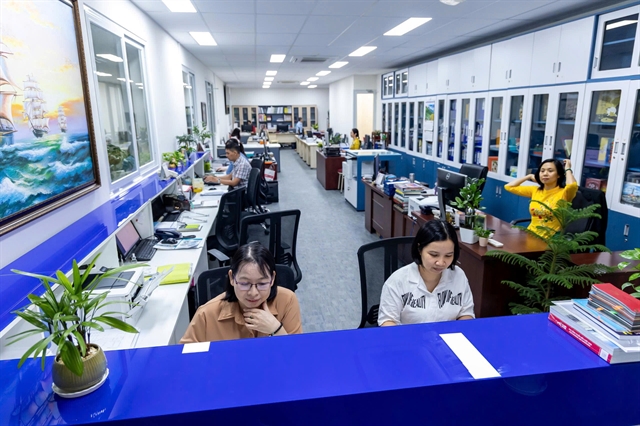 |
| ITAXA Business Department. — Photo courtesy of ITAXA |
As VNA’s key printing unit, what orientations and strategies has ITAXA set to keep pace with rapid changes in the printing market?
With the core task of serving VNA’s political mission while expanding production and services, ITAXA has built its strategy development on three main pillars.
First, ITAXA focuses on modern, high-technology development aligned with international standards. The company continues to invest in new-generation machinery, automate production lines, upgrade quality control systems and optimise all processes based on data platforms. The goal is to make ITAXA one of the leading printing houses in terms of technological capability.
Second, ITAXA pursues a green and sustainable production strategy as a long-term guiding principle. The company not only maintains FSC CoC certification but also aims to expand environmental standards, develop user-friendly products, apply energy-saving management model, and minimise waste release.
The third pillar is market expansion and stronger international cooperation. Beyond traditional markets, ITAXA seeks opportunities to work with foreign partners. It also develops the printing segment for book exports, high-end packaging and labels, and expand commercial services and distribution of printing materials.
Việt Nam’s printing industry is entering a period of profound change, where technology, digital transformation and green and sustainable requirements have become core development pillars. As VNA’s key printing unit, ITAXA is determined to build its development strategy based on modern technology, a high-quality workforce and a transparent management system.
The orientations and concrete actions that ITAXA is implementing will help enhance its competitiveness and contribute positively to the sustainable development of Việt Nam’s printing industry in the new integration period. — VNS
Economy
 Economy
 Economy
 Economy
 Economy
 Economy
 Economy
 Economy
 Economy
 Economy
 Economy
 Economy
 Economy
 Economy
 Economy