 Economy



AXA Global Healthcare Mind Health Report reveals global differences in how cost and stigma affect access to professional mental health care
1.
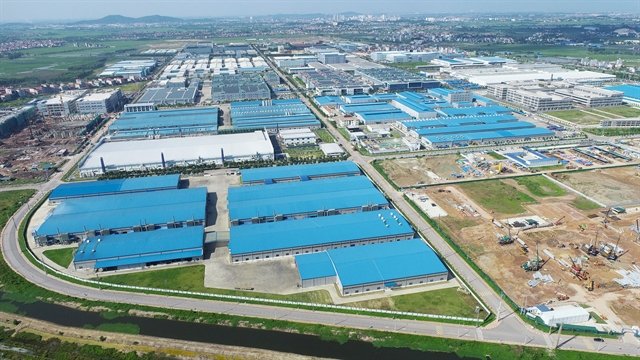 |
| Quang Châu Industrial Park in Bắc Ninh Province. Photo courtesy of Bắc Ninh Province |
BẮC NINH — Bắc Ninh Province continues to be one of the country’s leading centres for the production of hardware, electronic products, computers and optical products.
This group of products makes a major contribution to the province’s industrial output value this year, according to Deputy Director of the Bắc Ninh Department of Science and Technology, Nguyễn Gia Phong.
The scale of industrial production value is estimated at more than VNĐ2.4 quadrillion (US$92.3 billion), of which the manufacture of electronic products, computers and optical products plays a dominant role.
In 2025, Bắc Ninh had 165 new projects in electronics and IT investing for its industrial parks, with total registered capital of $1.95 billion, along with 128 projects in the same fields that have adjusted their investment to add more than $2 billion in capital.
To create breakthroughs in digital transformation, the development of the digital economy and the IT industry, the Bắc Ninh People’s Committee issued a plan to support enterprises in developing new digital applications and services under public–private partnership arrangements; a plan for developing the digital economy and digital society of Bắc Ninh Province for the 2026–2030 period; and a decision approving the investment policy and investors for a concentrated IT park.
Most enterprises in the province’s industrial parks, particularly foreign-invested enterprises and large companies, have deployed advanced management platforms such as ERP, MES, SCM, quality management systems and real-time production monitoring solutions to optimise production processes, reduce machine downtime, enhance productivity and improve data traceability.
For small and medium-sized enterprises (SMEs), the province has stepped up support to help them access popular digital platforms such as e-invoicing, digital signatures, accounting and finance software, sales software and e-commerce, contributing to improved operational skills, cost savings and expanded customer reach.
The use of cashless payment platforms and QR payments has also become increasingly common among service and commercial enterprises. Bắc Ninh has rolled out online public services, allowing businesses to carry out most administrative procedures in the digital environment, including business registration, investment, taxation and customs and land procedures.
This has promoted the use of digital platforms in business transactions, reduced time and compliance costs, and created a more friendly and transparent investment environment.
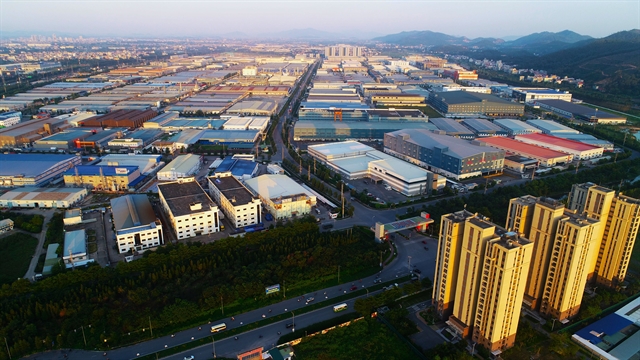 |
| A view of the Vân Trung Industrial Park in Bắc Ninh Province. Photo courtesy of Bắc Ninh Province |
As a result, Bắc Ninh’s digital transformation-based economy has recorded remarkable progress.
In 2025, the digital economy is forecast to account for more than 40 per cent of the province’s GRDP.
According to Bắc Ninh People’s Committee Vice Chairman Mai Sơn, the province aims for 60 per cent of local SMEs to apply digital technologies and for at least 40 per cent of enterprises to engage in innovation activities by 2030.
At the same time, Bắc Ninh will focus on developing the processing and manufacturing industry, viewing it as a key driver for improving productivity, quality and competitiveness, Sơn said.
The emphasis will be on transforming traditional factories into smart factories that apply advanced, environmentally friendly technologies in line with global green and sustainable development trends, he added.
In the next few years, the province will implement programmes to support enterprises and industrial clusters in digital transformation, focusing on strategic industries such as high-tech electronics, mechanical engineering, automobiles, textiles and footwear, steel and construction materials, food processing and renewable energy.
The province will promote the use of specialised manufacturing digital transformation platforms (MES) tailored to the characteristics of each sector.
In addition, the province is paying attention to training skilled workers with expertise in smart manufacturing and digital industrial management at colleges and universities.
Priority is given to training in the use of production simulation and management software such as ERP, MES and SCADA, forming a workforce of engineers and experts capable of operating, designing, consulting on and evaluating smart factories.
Bắc Ninh is also focusing on research and developing a number of specialised industrial park and cluster models.
These include high-tech parks for private enterprises in science, technology and digital transformation; accelerating the development of infrastructure for the province’s concentrated IT park; concentrated science and technology research and development zones; regional high-level science and technology research institutes; and high-tech agricultural processing industrial parks combined with centres for research and production of high-tech equipment and machinery for agriculture.
The province aims to establish an intelligent computing centre and deploy artificial intelligence, big data and the Internet of Things in key sectors.
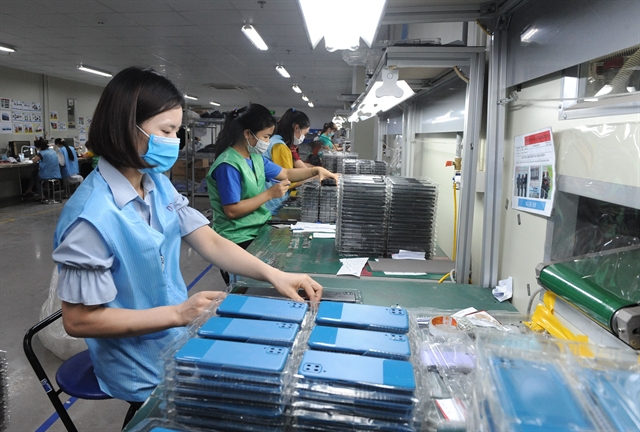 |
| Electronic component production at Alpha Green Tech Vina Co., Ltd. in Hòa Phú Industrial Park, Bắc Ninh Province. Photo courtesy of Bắc Ninh Province |
Canon Việt Nam is one of the most prominent Japanese enterprises, playing an important role in office equipment manufacturing in Việt Nam. Officially operating since 2002, Canon Việt Nam currently owns three large factories in Bắc Ninh’s Quế Võ and Tiên Sơn as well as Hà Nội’s Thăng Long.
With total initial investment capital of more than $306 million, the Quế Võ factory was once recognised as the world’s largest laser printer manufacturing plant, with an annual capacity of millions of units, meeting around 35 per cent of global demand.
Canon Việt Nam employs more than 21,000 workers, including around 3,000 in Bắc Ninh, and strictly complies with ISO 9001 and ISO 14001 quality and environmental management standards.
Canon Việt Nam General Director Shigeyuki Okamoto said: “We chose Bắc Ninh because of three outstanding advantages: its strategic geographical location, situated in the Hà Nội–Hải Phòng–Quảng Ninh triangle, with fast connections to airports and seaports and other transport, power and logistics infrastructure; an abundant supplier ecosystem; and a government that always accompanies and promptly supports enterprises.”
“Any difficulties are discussed and resolved immediately, such as Canon’s proposal to address congestion at the junction of National Highway 18 and National Highway 1, where Bắc Ninh proactively built two service roads using local budget funds to reduce congestion and ensure traffic safety for workers and local residents,” he added.
Roh Tae Moon, president and CEO of Samsung Electronics, said: “Samsung accounts for 14 per cent of the country’s total export turnover, with Bắc Ninh being a core production centre. The factories in Bắc Ninh and Thái Nguyên provinces have produced two billion mobile phones, accounting for 50 per cent of the group’s global output.”
“Active support from the provincial authorities has helped us maintain and effectively expand production,” he added. VNS
Economy
 Economy
 Economy
 Economy
 Economy
 Economy
 Economy
 Economy
 Economy
 Economy
 Economy
 Economy
 Economy
 Economy
 Economy