 Society

Z Hoạ announces events celebrating caricature art, social commentary
1.
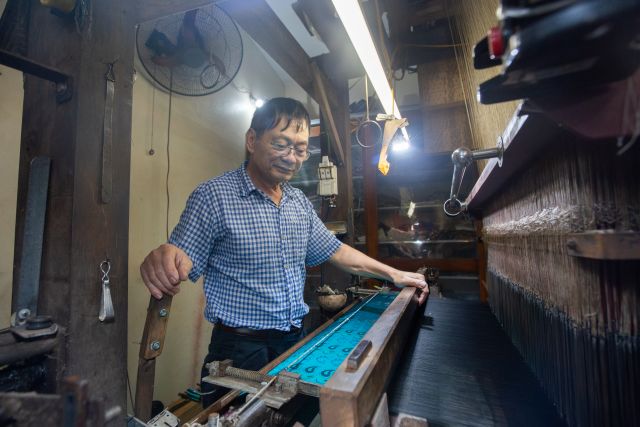 |
| Vạn Phúc silk is woven entirely from natural silk threads under wet conditions, a process requiring the skills and experience of artisans that industrial machinery cannot fully replace. Photos courtesy of the Hà Nội Department of Agriculture and Environment |
From the intricate patterns of Bát Tràng ceramics and the delicate textures of Vạn Phúc silk to the exquisite carvings of Sơn Đồng and Chuyên Mỹ, Hà Nội’s artisans are working tirelessly to preserve traditional techniques passed down through generations. With skilled hands and years of accumulated experience, they are not only keeping craft villages alive but also bringing the finest expressions of Vietnamese craftsmanship to international audiences.
Passing down the craft through skilled hands
In the workshops of Bát Tràng pottery village, artisans continue to work diligently at their potter’s wheels, carefully shaping and decorating each piece. Although machinery now assists with certain stages of production, skilled hands and years of experience remain indispensable in shaping, treating surfaces and finishing products that require a high level of craftsmanship.
Having spent many years in the pottery trade, artisan Hà Mạnh Tiến understands that even seemingly simple techniques take a long time to master. He believes that beginners should start with basic tasks, observe experienced craftspeople and practise patiently. Sharing this view, artisan Nguyễn Trọng Nghĩa says that learning a craft cannot be rushed. Trainees need to be observant, willing to learn and unafraid to redo work that does not meet the required standards.
From Bát Tràng to Sơn Đồng, a village renowned for its wood carving, the tradition of passing down skills continues through hands-on practice in workshops. While pottery requires a thorough understanding of materials and the ability to shape clay, wood carving challenges artisans to achieve precision in every cut and engraved detail.
Meritorious Artisan Nguyễn Danh Sơn of Sơn Đồng says that teaching a craft involves more than showing learners how to use tools or complete individual tasks. More importantly, it means helping them understand product requirements and develop patience and a sense of responsibility. Imperfect carvings must be corrected, while inaccurate details often have to be redone several times. Instructors need to provide close guidance so that learners can gradually improve their skills.
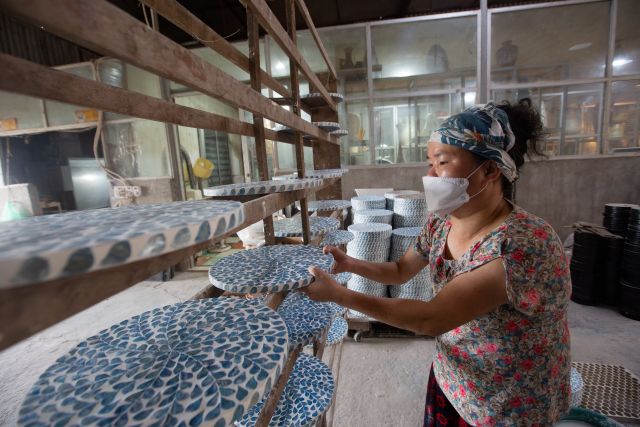 |
| A handcrafted mother-of-pearl inlaid lacquerware display shelf from Chuyên Mỹ craft village, highly favoured by international customers. |
In Sơn Đồng, Phạm Danh Nam is gradually learning the wood-carving trade. From observing experienced artisans to practising basic techniques, he is learning how to handle tools, recognise shapes and maintain concentration in every carving stroke. The image of a young apprentice working alongside an experienced artisan reflects a fundamental truth: preserving traditional crafts requires young people who are willing to learn and pursue work that demands considerable time and effort.
The experience of veteran artisans is passed on through practical demonstrations, corrections and guidance given directly in the workshop. However, a passion for the craft alone is not enough to keep younger generations in the profession. They also need an environment in which to develop their skills, employment opportunities and stable conditions for their future. For this reason, skills training must be closely linked to actual production rather than limited to short-term instruction.
Traditional craftsmanship reaching the world
Beyond Bát Tràng and Sơn Đồng, skills and techniques preserved through generations can also be found in every length of Vạn Phúc silk and every mother-of-pearl inlay product from Chuyên Mỹ.
In Vạn Phúc Ward, silk threads are woven into fine fabrics that reflect the distinctive character of a craft village with a history of more than 1,000 years. One of its signature techniques is brocade weaving, which creates raised floral patterns on silk and dates back to the late 17th century. Nguyễn Xuân Khiêm, who has devoted 40 years to the trade, explains that silk made entirely from natural silk fibres is woven under wet conditions, a process that industrial machinery cannot yet fully replace. Dyeing the threads before weaving is another traditional practice, producing distinctive colours and raised patterns.
In Chuyên Mỹ Commune, artisans express their skills through tiny pieces of mother-of-pearl and seashell. Through a series of processes involving selection, cutting, fitting and shaping, these natural materials are transformed into intricately decorated objects such as horizontal lacquered boards, parallel sentences, wooden daybeds, cabinets and inlaid paintings. More than 1,000 households are currently engaged in the mother-of-pearl inlay and lacquerware trade.
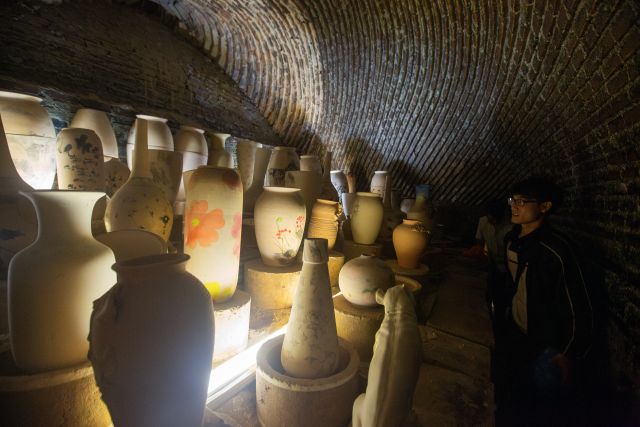 |
| Visitors explore a nearly 100-year-old traditional beehive kiln in Bát Tràng pottery village, where traditional ceramic-making techniques are still preserved. |
Phạm Văn Khỏe, who has spent 40 years in the craft, believes that the combination of intricate manual techniques, durability and cultural identity has enabled Chuyên Mỹ’s mother-of-pearl inlay craft to endure through generations. Each product serves not only a practical purpose but also embodies Vietnamese aesthetic and cultural values.
Meanwhile, in Sơn Đồng, wood carving, statue making and the application of gold leaf to lacquered objects continue to thrive in local workshops. Traditional son ta lacquer techniques, valued for their durability, colour retention and lasting lustre, are among the secrets behind the village’s reputation. Sơn Đồng Commune is now home to nearly 700 households and numerous businesses engaged in handicraft production, providing jobs for thousands of workers. Its products are exported to many countries.
The four craft villages of Bát Tràng, Vạn Phúc, Chuyên Mỹ and Sơn Đồng, each known for distinctive products and techniques, have all been recognised by the World Crafts Council (WCC) as part of its World Crafts Cities network. Bát Tràng and Vạn Phúc received the recognition in 2024, followed by Chuyên Mỹ and Sơn Đồng in 2026.
According to Dr. Darlie Oommen Koshy, Vice President of the World Crafts Council, field visits, meetings with local communities and direct observation of artisans and skilled craftspeople at work helped highlight the villages’ outstanding historical, cultural, economic and social values. He noted that Việt Nam is playing a strong role in preserving and promoting traditional craftsmanship. The inclusion of four Hà Nội craft villages in the WCC network further affirms the standing of Vietnamese handicrafts within the global heritage landscape.
Hà Nội currently has around 1,350 craft villages and villages with traditional trades, of which 337 have been officially recognised by the municipal authorities. The capital is home to 351 recognised artisans, including 19 People’s Artisans, 72 Meritorious Artisans and 260 Hanoi Artisans. They play a central role in preserving techniques, passing down production skills and creating new products. The city has also introduced various policies to honour and support artisans and skilled craftspeople, including Resolution No 49/2025/NQ-HDND, which stipulates support for artisans upon receiving honorary titles and for those engaged in vocational training.
To date, 100 craft villages and villages with traditional trades in Hà \Nội have products certified under the One Commune One Product (OCOP) programme, with 929 products rated three stars or higher. Handicraft products from the capital’s craft villages are now exported to 89 countries and territories.
From hands shaping pottery and weaving silk to those inlaying mother-of-pearl and carving intricate patterns in wood, each artisan helps preserve a part of the capital’s cultural heritage. Artisans such as Hà Mạnh Tiến, Nguyễn Trọng Nghĩa, Nguyễn Danh Sơn, Nguyễn Xuân Khiêm and Phạm Văn Khỏe not only create exquisite handicrafts but also pass their knowledge and experience on to the next generation. This continuity keeps Hà Nội’s traditional craftsmanship relevant in contemporary life and enables its finest values to reach the wider world. VNS
* This article was produced in collaboration with the Hanoi Department of Agriculture and Environment.
Society
 Society
 Society
 Society
 Society
 Society
 Society
 Society
 Society
 Society
 Society
 Society
 Society
 Society
 Society