 Society

Manchester United, AC Milan and Inter Milan to play friendlies in Việt Nam in 2027
1.
 |
| Electric motorbike assembly line at Yadea Vietnam's plant in Tân Hưng Industrial Park in Lạng Giang Ward, Bắc Ninh Province. — Photos courtesy of Bắc Ninh's Department of Science and Technology |
BẮC NINH — Bắc Ninh, a northern province on the outskirts of Hà Nội, has set a goal of ranking among the world's top 50 smart cities by 2030, an ambition officials say is central to its broader push to become a centrally governed municipality.
Provincial Chairman Phạm Hoàng Sơn said the smart-city drive would rely on data and digital transformation as its foundation, with residents placed at the centre. The province aims to be listed in recognised global indices such as the IMD Smart City Index, he said.
By 2030, Bắc Ninh plans to have a provincial coordination mechanism and a data-driven urban governance model fully in place, along with real-time monitoring and management systems operating both province-wide and in key urban centres.
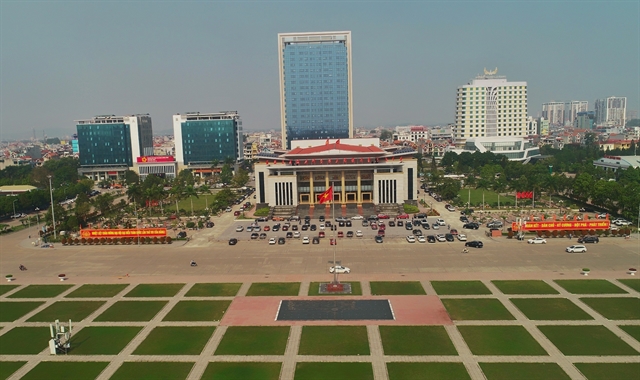 |
| A view of central Bắc Giang Ward, Bắc Ninh Province. |
Smart-city planning will be woven into all levels of urban development, with officials working toward a City Information Model that can eventually feed into a full digital twin of the province.
Health care, environmental management, water and waste services, and transportation are listed as priority areas, alongside investment in telecommunications, cloud and data-centre capacity, the Internet of Things and artificial intelligence.
The province is also drafting a formal ICT architecture for smart-city development, aligned with national standards, and rules for a regulatory sandbox that would let companies trial new technologies under controlled conditions – part of an effort to foster innovation while keeping data security requirements built into projects from the design stage.
Officials have grouped the effort into four workstreams. The first sets up a provincial coordination council and a smart-city master plan running from the province down to the commune level.
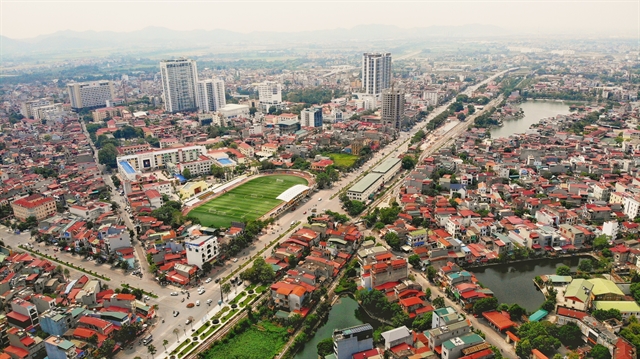 |
| A densely populated area of Bắc Giang Ward, Bắc Ninh Province. |
The second builds the ICT architecture. The third upgrades technical infrastructure such as smart transport, lighting and water systems. The fourth rolls out smart services in health care, education, agriculture and tourism.
Bắc Ninh is currently regarded as one of Việt Nam's leading provinces in smart-city development, having built out its digital government, digital economy and digital society in recent years.
Its Intelligent Operations Centre now pulls together public administration, transportation, health care, education, tourism, security and citizen-reporting functions in one system.
Similar tools – surveillance cameras, smart traffic management, public lighting, and environmental monitoring – have been rolled out in urban wards, including Bắc Giang, Kinh Bắc, and Việt Yên.
The province has also expanded electronic health records, online learning, digital tourism maps and cashless payments.
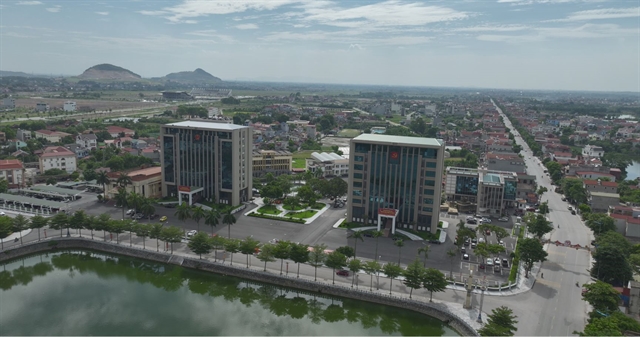 |
| A view of central Việt Yên Ward, Bắc Ninh Province. |
Under a directive from the provincial government, authorities are piloting 15 operating scenarios on the provincial command-centre system through August 31, covering areas such as economic management, public investment disbursement, administrative-procedure tracking, population data, health care, education and traffic – an effort led by the Department of Science and Technology that officials say is beginning to support real-time decision-making by provincial leaders.
Separately, the province is in the second phase, running from this October through December 2027, of a national programme ordered by the Prime Minister to integrate camera networks, population databases and the command-centre system, with the provincial police in charge of implementation.
On infrastructure, all communes in Bắc Ninh are now connected to a dedicated data-transmission network and mobile coverage reaches the entire population.
The province has installed roughly 849 5G base stations, covering more than 92 per cent of residents, and fiber-optic broadband now reaches every village and residential cluster.
Two provincial data-integration centres are being steadily upgraded for security, and 495 dedicated data lines link party and government offices from the provincial down to the commune level, supporting shared software platforms and video conferencing under the province's two-tier local government system.
 |
| The Public Administrative Centre in Kinh Bắc Ward, Bắc Ninh Province. |
Kinh Bắc, one of the province's central wards, illustrates the shift on the ground. Nguyễn Thị Hiền, the ward's vice chairwoman, said local authorities have made residents the focus of a broader push to modernise service delivery, in line with the Communist Party's Resolution 57 on science and technology.
"We've focused on changing how we operate and deliver public services so they're more modern, transparent and convenient for people," she said, adding that all administrative procedures in the ward are now handled digitally, with more than 99 per cent completed on time or early.
Residents say they've noticed the difference. Vũ Thị Thủy, who recently visited the ward's public administrative centre, said staff resolved her request immediately and never made her wait or navigate a drawn-out process.
Nguyễn Thị Thu Hường, a small trader in the ward, said cashless payments have simplified her bookkeeping and that selling through digital platforms has widened her customer base and boosted business. — VNS
Society
 Society
 Society
 Society
 Society
 Society
 Society
 Society
 Society
 Society
 Society
 Society
 Society
 Society
 Society