 Society

Exotic Food Showcases Its Position as a Leading Global Sriracha Producer and Exporter at SIAL Paris 2026
1.
|
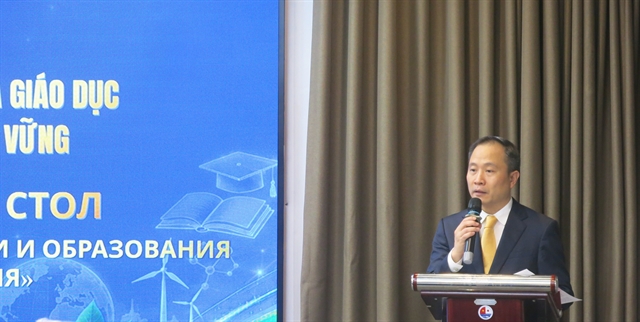
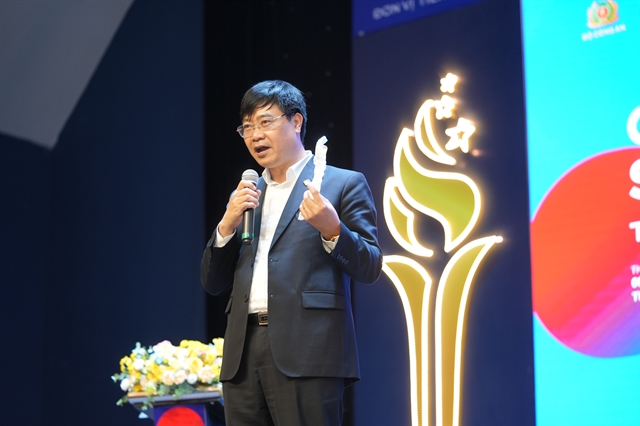
| Associate Professor Lê Trung Thành, Vice Principal of the University of Economics under Vietnam National University, Hanoi, delivers his speech at a discussion in Hà Nội on Wednesday. — VNS Photo Nguyễn Hằng |
By Nguyễn Hằng
HÀ NỘI — International cooperation in science and education not only provides funding, technology and modern equipment, but also opens the door to knowledge, giving Vietnamese scientists opportunities to join global research networks, gain access to internationally recognised laboratory management practices and learn how to commercialise scientific products.
Associate Professor Dr Hoàng Anh Sơn, Director of the Graduate University of Science and Technology under the Việt Nam Academy of Science and Technology, made the remarks at a discussion on “International cooperation in science and education as a driver of sustainable development”, held in Hà Nội on Wednesday afternoon as part of the “World Peoples Assembly Days in Việt Nam” event.
The successful experience of developed countries offers valuable lessons for Việt Nam, particularly as the country is stepping up implementation of Politburo’s Resolution No 57 on breakthroughs in the development of science and technology, innovation and digital transformation.
Sơn added that to make cooperation between Việt Nam and other countries, including Russia, more effective, several specific measures should be pursued.
First, strategic cooperation and the training of highly skilled human resources should be strengthened, with a focus on research and technology development and the training of high-level talent in partnership with advanced countries, including the Russian Federation.
“Priority should be given to artificial intelligence, semiconductors, biotechnology, quantum technology and new energy,” he said.
Another priority is technology transfer and mastery. Việt Nam should develop appropriate policies on technology procurement, technology decoding and transfer, taking into account the country’s domestic capabilities and actual conditions.
The legal framework should also be improved, while special mechanisms should be used to promote public-private partnerships and enhance the role of science and technology development funds at research institutes.
“Technology diplomacy” should also be strengthened by making better use of overseas diplomatic and trade networks to connect experts and attract intellectual and financial resources from around the world.
He also said forums such as the World Peoples Assembly could serve as a bridge and platform connecting research institutes, universities and other organisations, helping promote cooperation in science and technology, strategic technologies and digital transformation.
Speaking at the discussion, Andrey Belyaninov, Secretary-General of the World Peoples Assembly, said education was the future of a country, highlighting the importance of international cooperation in science and education as a driver of sustainable development.
Alexandra Ochirova, UNESCO Goodwill Ambassador, said that working together meant developing together.
She also stressed the importance of culture in international cooperation in education and science.
Nguyễn Thùy Anh, from the Faculty of Political Economy at the University of Economics under Vietnam National University, Hanoi, said international cooperation could be regarded as a key factor in the internationalisation of higher education in Việt Nam.
Anh also shared the UNESCO Goodwill Ambassador’s view on the importance of culture.
“When students go abroad or interact with international peers, they experience a multicultural environment. This is an important factor in promoting sustainable development, helping people cooperate, understand one another and live together.”
Anh said international cooperation could become a driver of sustainable development only when its benefits were integrated into the development and operation of universities.
“This required stronger human resources and knowledge capacity, strengthened institutions and policies that could contribute to development at both national and international levels,” she said.
Foundation for sustainable development
Associate Professor Lê Trung Thành, Vice Principal of the University of Economics under Vietnam National University, Hanoi, said the world was entering a period of profound transformation, with artificial intelligence, digital transformation, the green economy and climate change reshaping the way people learned, conducted research, worked and cooperated.
In reality, sustainable development goals could not be achieved by any single country or organisation, but required international cooperation networks, he said.
“These are spaces where knowledge is shared, experience exchanged, connections established and resources mobilised to create shared value. International cooperation in science and education will therefore provide the foundation for promoting sustainable development step by step.”
Against this backdrop, the choice of the discussion’s theme was both timely and practical, Thành said.
The discussion was not merely an academic forum for exchanging research findings, but also provided a space for dialogue and for exploring new cooperation models among universities, international organisations, research institutes and management agencies amid rapidly changing global development trends.
Thành said participants of the event would discuss several key areas that he believed to have strategic significance for the development of higher education and science in the current period.
The first area is cooperation in education and the role of universities in the knowledge era.
Universities no longer only fulfil their traditional role of providing education and training. They are also centres of innovation and research, as well as hubs for international connectivity.
Cooperation among universities today needs to go beyond traditional exchange programmes towards jointly developing curricula, conducting interdisciplinary research, developing academic staff and building cross-border academic networks, thereby creating new momentum for socio-economic development.
The second area is cooperation in science, research and technology applications.
Education develops people and builds the capacity to conduct scientific research and generate knowledge, while technology is an important means of turning that knowledge into practical solutions.
“Therefore, in a knowledge-based economy, scientific research should be more closely connected with innovation and society’s development needs.”
The third area is the role of international organisations in promoting scientific and educational cooperation.
To achieve advances in science and education, networks and platforms that extend beyond individual universities and national borders are needed.
International organisations can play a key role in connecting educational institutions, scientists and partners from different countries.
They can also create spaces for dialogue, facilitate the sharing of experience and promote multilateral cooperation initiatives.
Such efforts would not only help establish effective partnerships among universities and research organisations, but also contribute to addressing broader socio-economic challenges and advancing a sustainable development model. — VNS
Society
 Society
 Society
 Society
 Society
 Society
 Society
 Society
 Society
 Society
 Society
 Society
 Society
 Society
 Society