 Society

HKSTP Partners with Leading Science and Technology Company Merck to Open a New Chapter in I&T Collaboration
1.
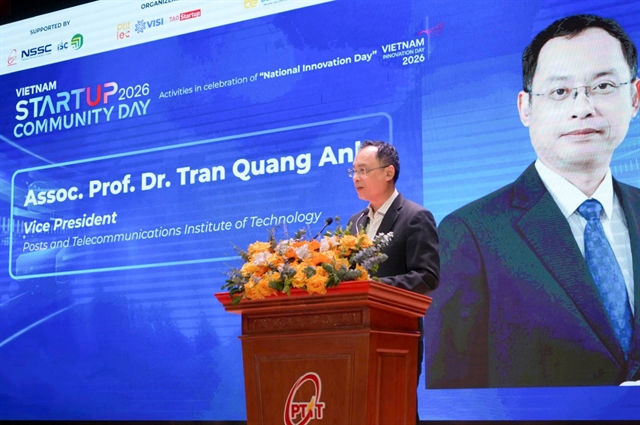 |
| Associate Professor Dr Trần Quang Anh, deputy director of the Posts and Telecommunications Institute of Technology, speaks at the recent conference 'Start-ups in a Global Context'. — Photo courtesy of Ministry of Science and Technology |
HÀ NỘI — Việt Nam’s start-up ecosystem is entering a new phase, with a growing focus on helping innovative businesses access markets, mobilise resources, commercialise technologies and compete internationally, rather than simply supporting the formation of new companies.
The country moved up five places to rank 50th globally in the 2026 Global Startup Ecosystem Index released by StartupBlink, its highest position since the ranking was launched.
On the index, Việt Nam’s start-up ecosystem rose 67.9 per cent, well above the global average growth of 17.5 per cent and the highest rate in Southeast Asia. Việt Nam ranked fifth in Southeast Asia and 10th in Asia.
These figures reflect a shift in the ecosystem from encouraging entrepreneurial ideas and helping projects get started to building stronger links between start-ups, investors, businesses, research institutions and markets.
Policy push
The shift comes as Việt Nam continues to strengthen its policy framework for science, technology, innovation and start-ups.
Politburo Resolution 57-NQ/TW, issued in 2024 and focused on breakthroughs in science, technology, innovation and national digital transformation, identifies people and businesses as the centre, key actors, resources and driving force of national development in these areas.
The resolution also calls for the removal of institutional barriers, the mobilisation of resources and better conditions for research, technology development and the application of innovation.
Politburo Resolution 68-NQ/TW on private-sector development, added momentum by highlighting the private sector’s role in science, technology, innovation and digital transformation.
The resolution sets a target of having two million active enterprises by 2030 and calls for a better business environment, greater access to resources, technology and markets, and stronger support for entrepreneurship.
It also calls for a controlled testing, or sandbox, framework for new technologies, products, services and business models, while encouraging businesses to invest in research and development, technological innovation, digital transformation and green transformation.
The policy direction was followed by Government Resolution 138/NQ-CP, issued shortly afterwards, which outlines an action plan to carry out Resolution 68.
National Assembly Resolution 198/2025/QH15, issued later that same month, provides special mechanisms and policies for private sector development, including direct incentives for innovative start-ups and other actors in the start-up ecosystem.
Support is also becoming broader and more inclusive.
A Government project approved under Decision 2415/QĐ-TTg on October 31, 2025 supports women starting businesses and start-ups through 2035, with a focus on innovation, digital transformation and green transformation. It gives priority to disadvantaged women and groups facing greater barriers to economic opportunities.
Together, the policies point to a broader approach to start-ups, covering not only training and business advice but also capital, technology, personnel, markets and management capacity.
Building markets
For innovative businesses, access to capital, skilled workers and technology infrastructure is only the starting point. Their long-term prospects depend on whether they can test products, establish viable business models, reach their first customers and scale up.
This makes stronger links between start-ups and established businesses, research institutes, universities, investment funds and international organisations increasingly important.
Support mechanisms therefore need to go beyond helping start-ups develop products and focus on giving them opportunities to test, validate and commercialise those products in real-world conditions.
Speaking at the International Innovation Forum and Exhibition 2026, Deputy Minister of Science and Technology Hoàng Minh said the State would act as the 'first customer' for Vietnamese technology products.
If businesses are the main actors in innovation, the State’s role is to create an environment in which they can research, test, apply and commercialise technologies more easily, he said.
The Ministry of Science and Technology is now working to improve institutions and implementation across the entire value chain, rather than stopping at research results. The aim is to support businesses until technologies are mastered and products are commercialised and accepted by the market.
The 'State as the first customer' approach is also being promoted through mechanisms for public procurement and State-ordered products and technologies developed domestically.
Public resources can serve as seed capital and help share risks at early stages, while an initial order can provide more than immediate revenue. It can give a start-up an opportunity to test its product, improve production processes and gain a foothold in the market.
This approach places the State in a broader role within the start-up ecosystem — not simply as a provider of support, but as a market maker, connector and risk-sharing partner.
For Việt Nam’s start-ups, the challenge ahead is therefore not only to generate more ideas or increase the number of new businesses. It is to turn ideas and research results into products and services that can survive in the market, grow in scale and compete internationally. — VNS
Society
 Society
 Society
 Society
 Society
 Society
 Society
 Society
 Society
 Society
 Society
 Society
 Society
 Society
 Society