 Society
NA President sets June 2027 deadline for APEC projects, rules out delays, quality cuts and violations
1.
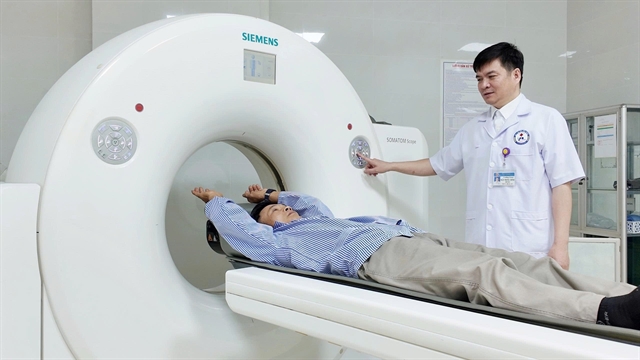 |
| A patient undergoes a CT scan at the Yên Lạc Regional Medical Centre in the northern province of Phú Thọ. — VNA/VNS Photo Nguyễn Thảo |
PHÚ THỌ — The medical sector in the northern province of Phú Thọ is focusing on developing specialised medical techniques while strengthening grassroots healthcare capacity to improve the quality of diagnosis and treatment.
Facilities across the province are investing in modern equipment, training medical staff and receiving technology transfers from central-level hospitals.
The Tam Dương Regional Medical Centre has successfully performed a total hip replacement on a 30-year-old patient.
The surgery was carried out following the transfer of the technique from Việt Nam – Germany Friendship Hospital.
Thanks to the use of a minimally invasive technique, the patient recovered quickly, experienced effective pain relief and was able to return to normal activities at an early stage.
The centre also sends dozens of doctors and nurses each year to central-level hospitals for training on advanced medical techniques and update their professional expertise.
A number of specialised techniques in surgery, urology and andrology have now been performed routinely, including percutaneous nephrolithotomy (PCNL), laser ureteral lithotripsy, laser treatment for varicose veins, radiofrequency ablation for thyroid tumours, and various surgical procedures for andrological conditions.
The centre has also effectively performed a range of modern laparoscopic procedures, including laparoscopic treatment of appendicitis, gastric perforation repair, retroperitoneal ureteral stone removal, inguinal hernia repair and surgery for benign prostatic hyperplasia.
It is also accelerating digital transformation through the use of electronic medical records and citizen ID cards and VNeID accounts for patient registration, helping shorten administrative procedures and improve the quality of services.
Đỗ Trọng Cán, Director of the centre, said developing high-quality surgery, anaesthesia and intensive care, and emergency medicine is one of the centre's key priorities.
The centre has also developed its haemodialysis services, with 10 dialysis machines, including a modern online haemodiafiltration (HDF) machine, which meets the regular treatment needs of around 60 patients a day.
The centre prioritises resources for staff training, equipment investment and the adoption of new techniques in order to bring more advanced medical services to grassroots facilities, enabling local residents to access high-quality healthcare without travelling far from home.
Yên Lạc Regional Medical Centre is another facility that has placed strong emphasis on developing specialised techniques alongside strengthening grassroots healthcare capacity.
In August 2025, the centre put into operation a five-storey outpatient and technical services building and a seven-storey inpatient treatment building equipped with modern equipment, including magnetic resonance imaging (MRI) and computed tomography (CT) scanners and an automated biochemistry testing system.
It now receives nearly 500 outpatients and treats nearly 400 inpatients on an average day.
It routinely performs a range of specialised procedures, including transoral endoscopic thyroid surgery, percutaneous kidney stone removal, laser ureteral lithotripsy, laparoscopic appendectomy, obstetric and gynaecological surgery, and various other surgical procedures.
Alongside investment in equipment and human resources, the centre regularly works with central-level hospitals and invites specialists to provide professional support, gradually improving the diagnostic and treatment capacity of its medical staff.
Nguyễn Hoàng Phương, Director of the centre, said investment in modern facilities and equipment, together with training and technology transfers, had significantly improved the quality of healthcare at the centre.
Many procedures previously requiring referrals to central-level hospitals can now be performed locally, reducing patients’ travel time and expenses.
The centre will continue to prioritise specialised medical services, expand cooperation with central-level hospitals to adopt new techniques, and provide advanced training for doctors and nurses to strengthen its capacity for diagnosis, treatment and patient care.
Under the 2026-30 medium-term public investment plan, the local healthcare sector has a total capital requirement of over VNĐ19.8 trillion (US$771 million), including more than VNĐ14.9 trillion ($587 million) from the central budget and over VNĐ4.8 trillion ($184 million) from the provincial budget.
The funding is expected to prioritise investment in regional hospitals, regional medical centres, projects funded by official development assistance (ODA), national target programmes and other key healthcare facilities.
Investment in healthcare infrastructure and facilities aims to gradually modernise the public healthcare system and increase the number of hospital beds from 16,410 to 20,635, ensuring a minimum of 50 beds per 10,000 people by 2030.
The healthcare sector will also continue investing in modern medical equipment, developing information technology infrastructure, accelerating digital transformation, building a shared healthcare database and gradually establishing a smart hospital model.
The province has 47 hospital beds per 10,000 people, exceeding the target of 44.3 beds, while the number of doctors has reached 14 per 10,000 people, surpassing the target of 13.9. — VNS
Society
 Society
 Society
 Society
 Society
 Society
 Society
 Society
 Society
 Society
 Society
.jpg) Society
Society
 Society
 Society
 Society