 Society

Cushman & Wakefield Takes Best Deal of the Year and Valuation Team of the Year Winner Awards at RICS Hong Kong Awards 2026
1.
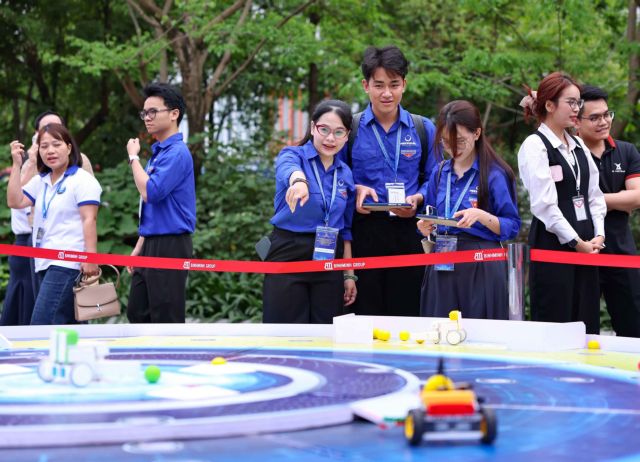 |
| Students at a scientific research competition, organised by the Ministry of Education in Hà Nội. —VNA/VNS Photo Thanh Tùng |
HÀ NỘI — Full scholarships will be provided for 1,500 people to study and conduct research abroad by 2035, helping develop a high-quality workforce in strategic technology fields.
It is expected to support 100 undergraduate students, 400 master's students, 500 PhD candidates and 500 postdoctoral researchers.
The target is set out in the scheme entitled 'Full scholarship programme for young scientists and outstanding students to study at leading world universities in strategic technologies', recently approved by Deputy Prime Minister Lê Tiến Châu.
The scheme aims to develop a high-quality workforce to directly support breakthroughs in science and technology, innovation and national digital transformation as well as areas contributing to a new development model for the country.
Full scholarships will be awarded to outstanding students and young scientists to study and conduct research at leading universities and higher education institutions worldwide.
The number of people sent abroad at each level may be adjusted depending on actual training needs and the State budget's capacity.
The selection and dispatch of scholarship recipients for overseas study and research will take place from 2027 to 2035, following the completion of scholarship mechanisms, eligibility criteria and selection procedures, a list of eligible training institutions, post-training employment arrangements, regulations on recipients' obligations to contribute to the country, reimbursement mechanisms and funding arrangements.
Eligible institutions will include overseas higher education institutions with strengths in the relevant fields and ranked among the world's top 500 by subject or field in reputable international rankings at the time of selection.
Their training programmes must have been accredited or recognised under the regulations of the host country and provide suitable conditions for research, technology access and technology transfer.
The selection process will be competitive, transparent and conducted nationwide. Selection criteria, quotas and results will be made public.
Specialist councils will be established for each field to assess candidates' capabilities, the need for training in specific disciplines, the quality of the training institution and supervisor, study and research plans, and candidates' potential contribution after completing their studies or research.
The authorities will also arrange overseas study and research placements, manage and disburse scholarship funding in accordance with current regulations.
They will monitor and assess recipients' academic and research performance, their fulfilment of post-training commitments and the extent of their contributions after completing their programmes.
Eligible candidates
Eligible candidates are Vietnamese citizens with strong academic or research capabilities and high potential for development, who meet the entry requirements of the relevant study or research programme at leading higher education institutions worldwide covered by the scheme.
They will be selected for study and research in fields serving the development of strategic technologies.
In term of undergraduate training, candidates will be nominated by ministries, sectors, local authorities and State-owned enterprises, with priority given to their recruitment after graduation.
They include high school students and first-year university students who have won first, second or third prizes in provincial-level excellent-student competitions organised by provincial Departments of Education and Training, national excellent-student competitions, national science and engineering competitions organised by the Ministry of Education and Training, or international competitions in which they participated at the ministry's nomination, provided their achievements are relevant to strategic technology fields.
First-year university students at educational institutions under the armed forces, including the police and military, with academic and conduct results rated good or above may also apply if nominated by the Ministry of Public Security or the Ministry of National Defence.
For master's training, candidates may be working at State agencies, State-owned enterprises or higher education institutions, or be nominated by ministries, sectors, local authorities and State-owned enterprises, with priority given to recruitment after graduation. They must hold a bachelor's degree in a relevant field serving strategic technology development, with a grade of good or above, or its equivalent.
For doctoral training, candidates may be working at State agencies, State-owned enterprises or higher education institutions, or be nominated by ministries, sectors, local authorities and State-owned enterprises, with priority given to recruitment after graduation.
They must hold a master's degree in a relevant field serving strategic technology development, with an academic score of at least 8.0 out of 10 or its equivalent.
For postdoctoral training and research, candidates must be working at higher education institutions, research institutes, science and technology organisations or State-owned enterprises.
They must demonstrate research capacity through scientific publications in reputable international journals, patents or applied science and technology products, as well as professional experience and development potential.
Selected candidates will undertake in-depth research to strengthen their capacity to lead research, develop and transfer technologies in fields serving strategic technology development.
Funding for the scheme will come from the State budget in accordance with regulations on State budget management, current budget decentralisation and annual budgetary capacity.
Additional funding may come from support, sponsorships and scholarships provided by domestic and foreign organisations and individuals as well as other lawful sources. — VNS
Society
 Society
 Society
 Society
 Society
 Society
 Society
 Society
.jpg) Society
Society
 Society
 Society
 Society
 Society
 Society
 Society