 Society

SBV to curb property price inflation, enforce lending rate rules
1.
 |
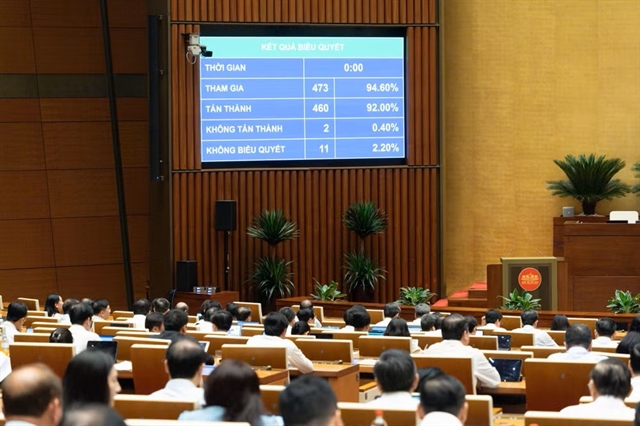
| The digital architecture framework is developed to meet the requirements of the synchronous deployment process for the two-tier local government model. VNA/VNS Photo |
HÀ NỘI — The Hà Nội People's Committee has issued the Hà Nội City Digital Architecture Framework (Version 1.0), laying the foundation for a governance model built around data and artificial intelligence (AI) as it pursues digital transformation across government, the economy and society.
The framework has been developed to meet the requirements of the two-tier local government model, accelerate comprehensive digital transformation and advance the development of science, technology and innovation in line with resolutions issued by the Party Central Committee and the city.
A defining feature of the framework is its adoption of a new-generation digital architecture model (Gen 4), which places data at the centre of all operations.
Data is no longer treated as a by-product of software applications. It is positioned as a "strategic asset" at the core of every operational process. Data drawn from national and specialised databases, IoT devices and surveillance cameras will be consolidated and standardised in a centralised City Data Lakehouse.
Rather than relying primarily on reports and experience, leadership and operational activities will be progressively supported by data that is collected, standardised, shared and analysed in real time.
Through decentralisation and delegation of authority in the digital environment, combined with real-time monitoring, the city aims to grant maximum autonomy and flexibility to commune and ward-level authorities.
The city retains shared platforms and monitors outcomes. Whichever level manages the relevant entities in practice is responsible for cleansing and updating data in the digital environment.
Data from national databases, specialised databases, sensor systems, IoT devices and digital platforms will be connected and integrated into a unified data source serving state management, enabling authorities at all levels to make decisions more quickly, more accurately and on the basis of concrete evidence.
To support the new governance model, the city's technological architecture is designed in a synchronised four-layer structure: the Shared Digital Infrastructure and Cybersecurity Layer; the Data and Core Platform Layer; the Shared Applications and Operations Layer; and the Interaction Channels and Performance Measurement Layer.
One of the framework's notable new elements is the "AI First" principle, which prioritises the integration of AI from the system design stage.
Under this approach, AI does not merely support data processing. It also performs analysis, forecasts trends, simulates scenarios and proposes solutions to urban management problems.
Together with the centralised data platform, AI will help strengthen forecasting capacity and support decision-making across fields including transport, healthcare, education, the environment, urban management and the provision of public services.
The framework also sets out requirements for transparent AI governance, clear accountability, safety and responsible operation. State management decisions carrying a high level of risk must still be reviewed and ultimately decided upon by competent authorities.
AI is also expected to reduce the burden of routine work. By eliminating manual processes and applying the "AI First" strategy, repetitive administrative tasks will be automated, allowing officials and civil servants to focus on analytical work, policy-making and serving citizens and businesses.
Beyond technology, the framework emphasises improving the quality of services provided to citizens and businesses.
Shared digital platforms will be built to promote interconnection and synchronisation, reducing fragmentation. The iHanoi application and VNeID are identified as key channels of interaction between authorities, citizens and businesses, helping to provide access to public services in a convenient, transparent and consistent manner.
The city also identifies information security, cybersecurity and personal data protection as requirements that run throughout the entire process of designing, building and operating digital systems. Open data will be promoted to strengthen transparency and accountability, and support research, innovation and the development of new digital products and services.
The issuance of the framework establishes a unified basis for the city's digital transformation and reflects a commitment to renewing the governance model in a modern direction grounded in data and digital technology. It is regarded as an important foundation for Hà Nội to build a synchronised digital ecosystem as it works towards the goal of becoming a "Developed Digital City" by 2045, with a government that operates intelligently, transparently and efficiently. — VNS
Society
 Society
 Society
 Society
 Society
 Society
 Society
 Society
 Society
 Society
 Society
 Society
 Society
 Society
 Society