 Society

SBV to curb property price inflation, enforce lending rate rules
1.
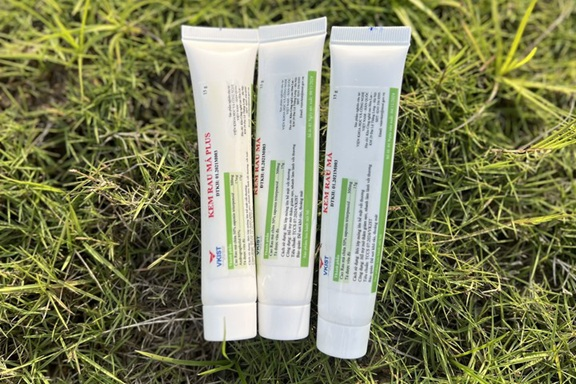 |
| "Kem rau má Plus" contains two key active ingredients extracted from centella asiatica and andrographis paniculata plants. Photo courtesy of MOST |
HÀ NỘI — Scientists at the Việt Nam-Korea Institute of Science and Technology (VKIST) have successfully formulated a burn treatment preparation called Kem rau má Plus (Pennywort Cream Plus), derived from standardised pennywort extract and andrographolide isolated from andrographis plants.
Both plants are common medicinal species in Việt Nam, containing active compounds with anti-inflammatory properties that support wound healing and promote tissue regeneration.
Kem rau má Plus was developed as part of a Ministry of Science and Technology-level research project, code 01/2021/M003. The product currently meets the institutional standard 10:2004/VKIST, opening up the possibility of developing burn care preparations from domestic raw materials.
The preparation contains triterpenoid saponins extracted from pennywort, including asiaticoside, madecassoside, asiatic acid and madecassic acid. These active compounds are capable of stimulating collagen synthesis, regulating fibroblast activity and supporting the regeneration of skin tissue.
The preparation also contains andrographolide, isolated from the andrographis plant. This compound is known for its anti-inflammatory, antibacterial and anti-irritant properties, while also supporting fibroblast proliferation and the formation of new blood vessels at the site of injury.
The two active components are combined at a ratio of one per cent triterpenoid saponins and 0.1 per cent andrographolide, together with an excipient base, to create a cream applied directly to the affected skin area.
To assess the preparation's capacity to support burn wound recovery, VKIST scientists applied it directly to white rats with thermal burns at two dosage levels – 0.02 g/cm² (grams per square centimetre) and 0.04 g/cm² – twice daily for 21 days.
Results showed that after 14 days, the burn wound area in groups using the preparation had decreased markedly compared with the untreated model group. The reduction in burn wound area at the two tested doses reached 26.1 per cent and 22.45 per cent, respectively.
After 21 days, the recovery effect was more pronounced. The burn wound area in the group using the 0.02 g/cm² dose decreased by 71.89 per cent, while the group using the 0.04 g/cm² dose saw a reduction of 78.43 per cent compared with the model group. This efficacy was assessed as comparable to the control group using a cream containing one per cent silver sulfadiazine, an active compound commonly used in burn care.
Analysis of skin samples after three weeks also recorded a significant increase in hydroxyproline concentration at the wound site in groups using the preparation. The increase in hydroxyproline levels indicates greater collagen synthesis, corresponding to enhanced wound closure and restoration of skin structure.
Hydroxyproline concentrations reached 29.74 mg/g (milligrams per gram) in the low-dose group and 31.07 mg/g in the high-dose group, representing increases of 38.6 per cent and 44.8 per cent respectively compared with the model group. Histological results also showed that the skin structure at the affected area improved following use of the preparation.
Beyond its effects in supporting burn recovery, the research team also assessed the systemic effects of the preparation in the experimental model. After 21 days of use, the product caused no significant adverse effects on the general condition, body weight or haematological indices of the experimental animals.
Indices evaluating liver and kidney function also showed no marked difference from the control group. Gross and histological observations revealed no abnormal lesions in the liver or kidneys.
According to the research team, these results provide a scientific basis demonstrating that the combination of saponin compounds from pennywort and andrographolide holds potential for application in the development of preparations to support burn wound care and recovery. The product showed good efficacy, safety and low toxicity, indicating its potential for use in basic healthcare settings across many localities. — VNS
Society
 Society
 Society
 Society
 Society
 Society
 Society
 Society
 Society
 Society
 Society
 Society
 Society
 Society
 Society