 Society
Panamanian President wraps up official visit to Việt Nam
1.
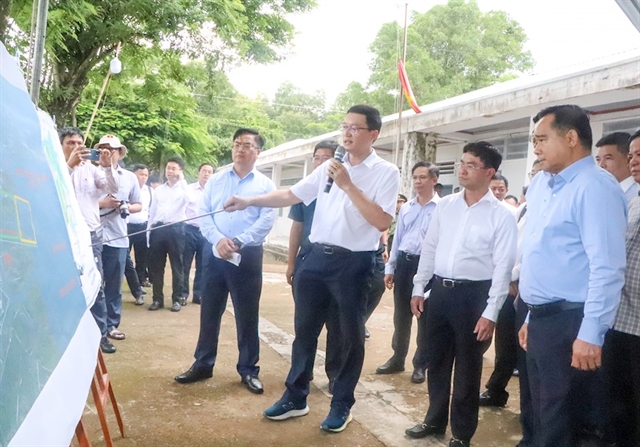 |
| HCM City People's Committee Chairman Nguyễn Văn Được (first, right) listens to a consultant briefing him on the Long Sơn LNG Power Plant project during an inspection tour of key infrastructure sites in the city's Eastern sector on August 22. — Photo www.hcmcpv.org.vn |
HCM CITY — HCM City is stepping up efforts to remove land acquisition and administrative obstacles to fast-track key transport, energy, urban, and tourism projects, reinforcing its broader strategy to boost public investment disbursement and drive sustainable regional growth.
On Saturday (August 22), HCM City People's Committee Chairman Nguyễn Văn Được led an inspection delegation to survey major infrastructure developments across the city's eastern zone.
The field checks covered a range of strategic initiatives, including the 1,500MW Long Sơn LNG Power Plant, the Gò Găng Urban Area, Thùy Vân Square Park, Nghinh Phong Cape, the proposed Vũng Tàu International Passenger Port, the expansion of Coastal Road ĐT994, and the VNĐ14 trillion (US$535.7 million) connecting routes to the Biên Hòa-Vũng Tàu Expressway.
During the visit, Được asked project owners, contractors, and local authorities to strengthen on-site coordination and adopt flexible construction tactics to maintain momentum.
"I request contractors and local authorities to closely monitor field operations, eliminate land clearance and procedural bottlenecks, and proactively implement rolling construction methods to guarantee on-time completion," he said.
Prominent among the energy initiatives under review is the Long Sơn LNG Power Plant.
Covering 42.6ha with an initial capacity of 1,500MW, it serves as a critical energy transition project for the Eastern zone and the broader region.
Transport connectivity also featured heavily during the inspection.
Coastal Road ĐT994, a vital six-lane artery linking coastal urban and tourism hubs, has seen land acquisition for its 5.6km section in Hồ Tràm largely resolved following the Prime Minister's approval for forest land conversion, targeting completion by late 2026.
Meanwhile, the Biên Hòa-Vũng Tàu Expressway connecting routes project spans 16.4km across three sub-projects, featuring elevated bridges and a 10-lane section scheduled for full completion by Q2 2027.
Maritime tourism infrastructure is also advancing through the proposed Vũng Tàu International Passenger Port, planned across 73.2ha with a 420m berth capable of receiving cruise ships up to 225,000 GT and a marina accommodating 280 yachts.
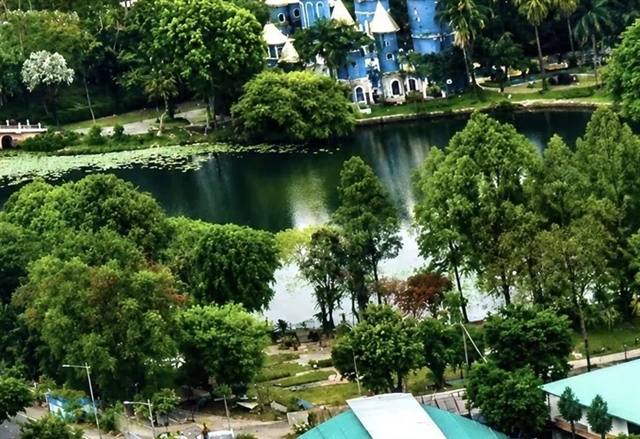 |
| The site for the 220kV Đầm Sen Substation project has yet to be handed over and remains under the management of Phú Thọ Tourist. — Photo www.sggp.org.vn |
The field visit highlights a broader, city-wide push to unclog site handover issues, which remain the primary barrier to project execution.
Prominent inner-city projects facing similar challenges include the An Phú Intersection, Ring Road 2, and key power grid developments such as the 220kV Đầm Sen Substation and the 220kV-110kV Cầu Bông-Bình Tân transmission line.
At an agency review meeting on August 21, Trần Anh Hào, head of Energy Management under the city's Department of Industry and Trade, stressed the urgency of resolving power grid delays.
"If progress stalls, we will lack sufficient power to serve socio-economic development and transmission to other areas," Hào said, adding that city authorities will collaborate directly with investors and local districts to resolve even minor bottlenecks to keep work on schedule.
Assigned a record VNĐ147.6 trillion ($5.7 billion) in public investment capital for 2026, the city achieved a 43.2 per cent disbursement rate by late July.
City authorities aim to pass 70 per cent in Q3 and hit 100 per cent by year-end by shifting toward outcome-based management, reallocating funds from sluggish projects, and securing a steady supply of construction materials. — VNS
Society
 Society
 Society
 Society
 Society
 Society
 Society
 Society
 Society
 Society
 Society
 Society
 Society
 Society
 Society