 Society

ZOOD Real Estate launches Élevée, a $667 million project in north Riyadh
1.
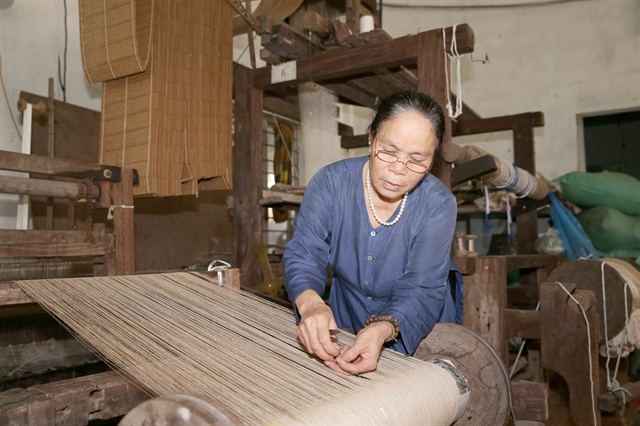 |
| Born into a family with a traditional silk-weaving craft, Meritorious Artisan Phan Thị Thuận has always been driven to create new and distinctive silk products that blend the essence of tradition with modern creativity. — Photos courtesy of the Hà Nội Office for Coordination of the New Rural Development Programme |
HÀ NỘI — From soft silk threads to delicate lotus silk, Meritorious Artisan Phan Thị Thuận has spent years researching and innovating to elevate the traditional silk-making craft of Phùng Xá Village.
Two products made by Mỹ Đức Silk and Sericulture Co., Ltd. – silk scarves and lotus silk scarves – were recently recognised by the Ministry of Agriculture and Environment as national-level OCOP 5-star products in the second round of 2025, showcasing the cultural heritage, craftsmanship and creativity of Vietnamese artisans.
In early autumn, Phùng Xá Village in Hồng Sơn Commune, Hà Nội, retains the familiar charm of a traditional craft village whose history has been intertwined with mulberry growing, silkworm raising and silk weaving for hundreds of years.
Along the rivers, green mulberry fields stretch into the distance. Inside village homes, trays of silkworms are carefully tended day by day. Fed on nothing more than humble mulberry leaves, the silkworms produce lustrous silk threads – the raw material for products that have long been part of Việt Nam’s cultural heritage.
Yet in Phùng Xá, tradition is not preserved simply by repeating the past. Local artisans are finding new ways to give silk a new journey, where the value of a product lies not only in its material but also in its cultural story, creativity and potential to reach international markets.
At the heart of this journey is Meritorious Artisan Phan Thị Thuận, director of Mỹ Đức Silk and Sericulture Co., Ltd.
Born into a family with generations of experience in the craft, Thuận has mastered every stage of traditional silk production, from growing mulberries and raising silkworms to reeling, spinning and weaving silk. This wealth of traditional knowledge has provided the foundation for her pursuit of new ideas and techniques.
Giving traditional silk a new expression
For Phan Thị Thuận, innovation does not mean moving away from tradition. It means finding new ways to unlock the value already inherent in the craft.
In the early 2010s, while observing silkworms spinning silk and forming their cocoons, she began asking herself: if a silkworm can produce a long, continuous and untangled silk thread on its own, why not let it contribute directly to making a finished product?
“The product is the result of years of dedication, experimentation and trial and error. In the early 2010s, while observing silkworms spinning silk and weaving their cocoons, I began thinking about letting them weave silk blankets themselves instead of simply forming cocoons in the traditional way,” Thuận said.
After years of experimentation, the idea eventually became a method for making self-woven silk blankets. Tens of thousands of silkworms spin their silk across a flat surface, creating seamless sheets of flat cocoon silk. Each silkworm contributes only a small amount, but together they form a complete product.
The story of the “self-weaving” silkworm reflects a distinctive approach to traditional craftsmanship: rather than intervening more deeply in a natural material, artisans can allow nature itself to reveal and preserve its full potential.
Inspired by this philosophy, Mỹ Đức Silk and Sericulture Co., Ltd. has developed a range of silk and lotus silk products, most notably its silk scarves and lotus silk scarves.
Silk scarves are known for the softness, sheen and elegance of traditional silk, while lotus silk scarves stand out for their unusual material, made from the fine fibers extracted from lotus stems – a plant deeply associated with Việt Nam’s natural landscape and cultural identity.
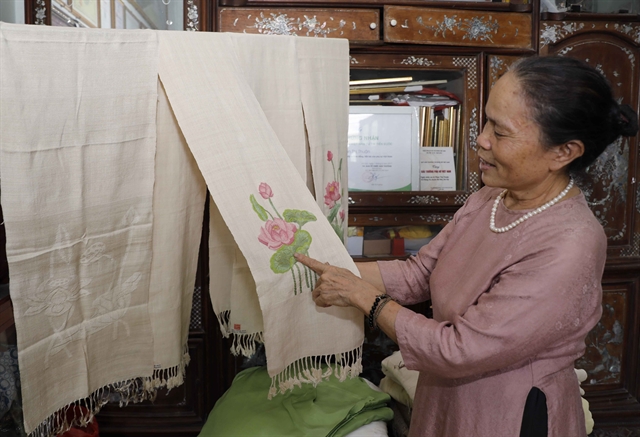 |
| Meritorious Artisan Phan Thị Thuận with silk scarves made from lotus silk. |
Producing lotus silk requires numerous painstaking manual steps. Fine fibers are carefully drawn from lotus stems and joined continuously by hand. This labor-intensive process gives each lotus silk scarf a distinctive beauty while carrying a story of nature, craftsmanship and local culture.
Of particular note, both the silk scarves and lotus silk scarves produced by Mỹ Đức Silk and Sericulture Co., Ltd. have been awarded national-level OCOP 5-star certification, the highest rating under Việt Nam’s One Commune One Product (OCOP) Programme.
For Thuận, OCOP is about much more than a title.
“All our products entering the market meet standards ranging from four to five stars; we have no three-star products. This achievement has been made possible by the close support, encouragement and guidance of the Hà Nội Office for Coordination of the New Rural Development Programme,” she said.
In her view, developing OCOP products is also a process of continuous improvement, requiring businesses to standardise everything from raw materials and production conditions to product quality and market development.
Most importantly, national-level OCOP 5-star certification gives products rooted in a traditional craft village greater opportunities to reach wider markets.
From Phùng Xá to the world
The silk and lotus silk scarves are not limited to the domestic market. Through exports and visits by international delegations, products from Mỹ Đức Silk and Sericulture Co., Ltd. have reached markets including the United States, France, Germany, Japan and the Netherlands, among others.
For international customers, the value of these products lies not only in their material or practical use. Each scarf also tells a story about Việt Nam’s lotus flowers and silkworms, its traditional craft villages and the skilled hands of its artisans.
This is also a distinctive advantage of Vietnamese handicrafts as the country integrates more deeply into the global economy. As consumers increasingly value products made from natural materials, environmentally friendly production and distinctive cultural identities, the heritage of traditional craft villages can become a powerful competitive advantage.
A silk scarf, once simply an everyday item, can thus become a cultural ambassador. Every product presented as a gift or sold in a new market offers another opportunity to tell the story of Vietnamese silk, Vietnamese people and values passed down through generations.
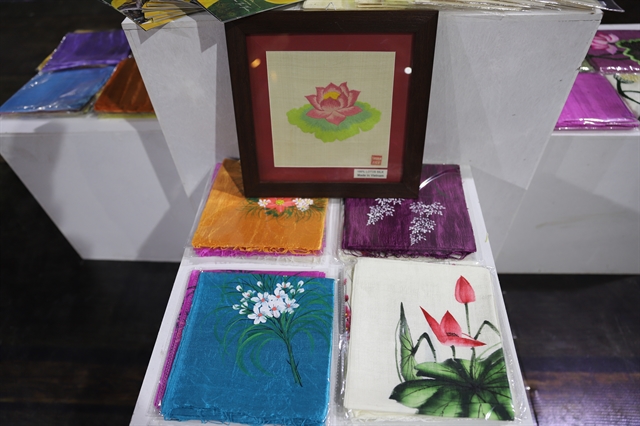 |
| Silk and lotus-silk scarves made by Mỹ Đức Sericulture Company Limited have recently been recognised as five-star OCOP products at the national level in 2025 (second batch) by the Ministry of Agriculture and Environment. |
Behind the OCOP 5-star products is also the livelihood of rural workers. Mỹ Đức Silk and Sericulture Co., Ltd. currently provides regular employment for around 20 workers, with an average monthly income of VNĐ8-10 million (US$307-384). Highly skilled workers can earn around VNĐ15 million per month ($576).
During peak production periods and school holidays, the workshop takes on an additional 50-70 workers, many of them local students. This provides not only an opportunity to earn an income but also a chance for younger generations to experience and learn about a traditional craft firsthand.
Thuận places particular importance on passing the craft on to young people. For a traditional profession to remain vibrant in modern society, she believes, younger generations need to see it not merely as a legacy of their ancestors but also as a source of new opportunities.
From mulberry trees, silkworms, lotus stems and the hands of skilled artisans, a new value chain is taking shape. The company plans to expand its raw-material areas, increase mulberry and lotus cultivation to secure clean supplies, and continue improving product designs and styles to better meet demand at home and abroad.
“The OCOP Programme has given us greater confidence and hope. With the solid foundation we have built, I believe that young people and businesses will continue to grow more strongly, taking Vietnamese OCOP products further onto the world map,” said Meritorious Artisan Phan Thị Thuận.
In Phùng Xá today, mulberry trees remain green, silkworms continue to spin their silk, and lotus flowers still bloom across Việt Nam'S countryside. What has changed is the way local artisans look at these familiar resources.
From tiny silk fibers, they create high-value products; from an age-old craft, they find new pathways forward; and from a traditional village, products carrying a distinctly Vietnamese identity are gradually making their way into the world.
The national-level OCOP 5-star silk scarves and lotus silk scarves are therefore more than a source of pride for Phùng Xá. They demonstrate the enduring vitality of Việt Nam’s traditional crafts when heritage is strengthened by creativity, quality and the ambition to reach the world. — VNS
*In collaboration with the Hà Nội Office for Coordination of the New Rural Development Programme
Society
 Society
 Society
 Society
 Society
 Society
 Society
 Society
 Society
 Society
 Society
 Society
 Society
 Society
 Society