 Society

Philippines and Việt Nam mark 50 years of bilateral relations
1.
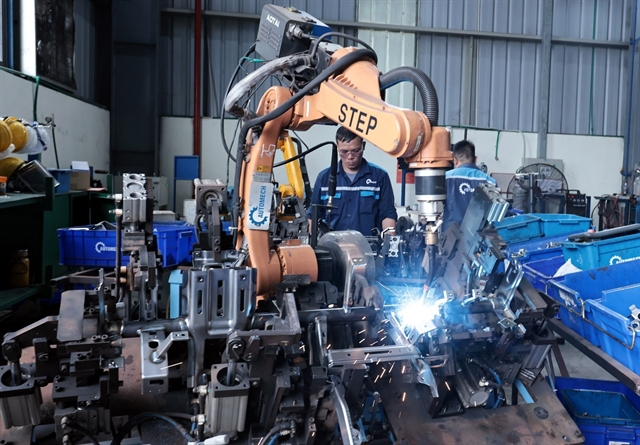 |
| A production line at the Automech Mechanical Equipment and Solutions JSC at Đình Trám Industrial Park in northern Bắc Ninh Province. Experts said Việt Nam must transform its development model towards focusing on productivity, labour quality and technology. — VNA/VNS Photo Trần Việt |
Khánh Dương
HÀ NỘI — After 40 years of Đổi Mới (Renewal), Việt Nam has risen to become an upper-middle-income country.
To realise its high-income status goal by 2045, as mentioned in the Politburo's Resolution 19 on renewing the country's development model, Việt Nam must overcome numerous challenges.
If the country continues with its existing growth model, it will struggle to achieve the status, experts have said.
But the country could become a high-income country around 2045-2047 if it pursues sweeping reforms, effectively implements Party resolutions and focuses on addressing key bottlenecks, they said.
Professor Ngô Thắng Lợi, senior lecturer at the National Economics University, said that before Đổi Mới, Việt Nam pursued the development model that highlighted equality. Since 2001, Việt Nam has switched to a mixed growth model that places the economy at the core.
From 2030 until the years when Việt Nam will become a high-income country, the mixed growth model should place society at the center, he said.
Looking back on the development over the past decades, Việt Nam has achieved significant results that have laid the foundation for a new phase of development, including being among the economies with the fastest growth rates in the world and significant improvements in per capita income.
“It took Việt Nam just 17 years to move into the upper-middle-income group," Lợi said.
"By comparison, Thailand took 23 years, while the Philippines and Indonesia took around 30-31 years to make the same transition.”
To achieve the high-income status, there remain bottlenecks with weakening growth momentum.
“If the current growth model is maintained, Việt Nam will find it difficult to achieve its goals of rapid and sustainable growth in the future,” Lợi added.
He pointed out traditional drivers that Việt Nam still relies on, including Foreign Direct Investment (FDI).
The FDI sector makes a major contribution to exports and domestic Gross Domestic Product (GDP) growth. However, linkages between foreign-invested enterprises and domestic firms remain weak, with only about 13 per cent of FDI enterprises having linkages with domestic businesses. Only around 2.3 per cent of FDI enterprises engage in research and development, he said.
Although identified as an important growth driver, the private sector still faces major limitations, he said, citing that micro-enterprises account for as much as 85 per cent of businesses, small enterprises 10 per cent, while medium-sized and large enterprises make up only around 5 per cent.
The professor recommended a shift from simply seeking to attract foreign investment to actively promoting and nurturing FDI. The focus should no longer be on quantity, but on supporting existing FDI projects, identifying strategic investors and retaining them, encouraging domestic investors to join the supply chains of foreign-invested companies and promoting technology transfer.
Professor Nguyễn Trọng Hoài, senior lecturer at the University of Economics HCM City, pointed out other bottlenecks that hinder Việt Nam from achieving high-income status.
Việt Nam's Total Factor Productivity growth remains low compared with other developing countries and emerging economies. Capital, technology and growth rates remain relatively low compared with other developing and emerging economies, while the quality of the labour force is also limited, he said.
This requires the country to transform its development model, with a stronger focus on productivity, labour quality and technology, he said.
He added that Việt Nam will struggle to become a high-income country if productivity remains low and there is no fundamental change in its production function.
Next-generation FDI attraction must be linked to technology transfer and create conditions for domestic small and medium-sized enterprises to participate more deeply in global value chains, he said.
He proposed shifting from a 1i model, which relies primarily on investment, to a 3i model comprising Investment, Infusion and Innovation.
Associate Professor Nguyễn Ngọc Sơn, vice rector of the College of Economics and Public Management at the National Economics University, said that looking back at Việt Nam's 40-year development and comparing it with East and Northeast Asian economies, including Japan, the Republic of Korea, Taiwan and Singapore, it is clear that these economies took no more than around 40 years to become advanced economies.
Some achieved the transition in around 30 years, while others took about 28 years.
“This is an issue that Việt Nam should reflect on," he said.
"These economies took around 25-30 years, or at most 40 years, to become advanced, high-income economies with their current levels of development.”
To achieve high growth from now until 2045, Việt Nam's growth model must undergo a profound transformation, shifting from extensive growth to intensive growth based on science, technology and innovation, he said.
Citing that economies such as the Republic of Korea, Taiwan, Singapore and Hong Kong have built strong corporations and brands, particularly in high-tech industries, Sơn said: “Lessons learned for Việt Nam are to create distinctive values and products of its own." — VNS
Society
 Society
 Society
 Society
 Society
 Society
 Society
 Society
 Society
 Society
 Society
.jpg) Society
Society
 Society
 Society
 Society
.jpg)