 Society
Hưng Yên outlines three economic zones, two development corridors
1.
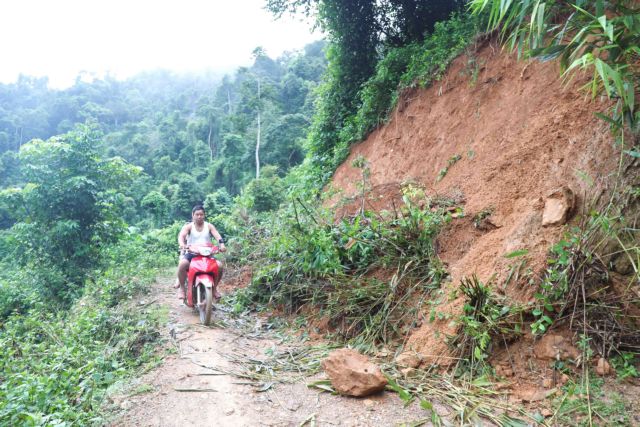 |
| A villager rides his motorbike on the single road leading to the village. — VNA/VNS Photos Xuân Tiến |
NGHỆ AN — The road to Na Ngân Village disappears into the dense forest of Pù Huống Nature Reserve, its once-passable surface now covered with mud, rocks and fallen trees.
In places, only a narrow track remains, forcing motorcyclists to inch along the mountainside with a steep drop toward the raging Nậm Ngân Stream below.
After days of torrential rain, dozens of landslides and sinkholes have made the only road into Na Ngân Village in Nga My Commune, Nghệ An Province, virtually impassable, leaving the village isolated since the afternoon of August 19.
Home to more than 150 households with nearly 740 people, all from the Thai ethnic community, Na Ngân lies more than 20km from the commune centre and National Highway 48C.
The village is connected to the outside world by a single road winding through the forest along hillsides and mountains.
A perilous journey
Equipped with flashlights, drinking water, dry food and other essentials, Vietnam News Agency correspondents in Nghệ An Province set out to reach Na Ngân Village.
The journey was relatively easy for the first several kilometres of concrete road. But it soon turned into a difficult and dangerous trek as the road gave way to slippery stretches of mud and rocks, steep slopes and areas where loose rocks threatened to fall from the mountainside.
From Xốp Kho Village onward, the road became increasingly difficult.
The deeper the correspondents travelled into the heart of Pù Huống, the more frequent the landslides became.
Earth and rocks had poured down the mountainside and covered the road. In many places, only a narrow path wide enough for a motorcycle remained.
Fallen trees, bamboo, tall grass and debris blocked the way, while large rocks that had rolled down from the cliffs made the already narrow road even more treacherous.
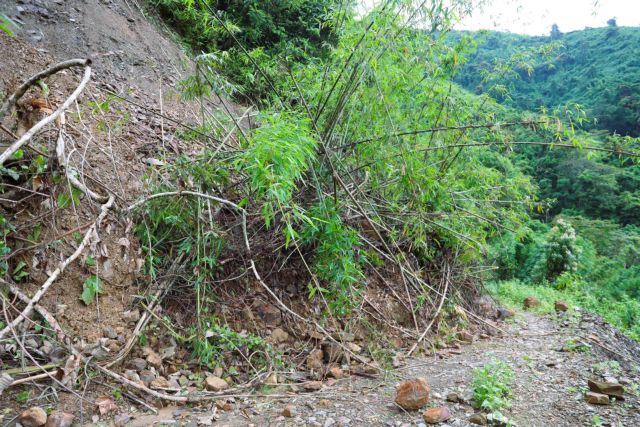 |
| Rocks, soil and tree branches continue to fall onto the road. |
After more than five hours of travel, crossing dozens of landslides and stretches of road cut by floodwater, they finally reached the isolated village as another spell of heavy rain began.
Heavy rain continued through Sunday night and early Monday morning, causing several landslides and sinkholes to worsen.
Water levels at Đền stream continued to rise, keeping alive the risk that Na Ngân Village could remain isolated.
For village residents, four days of isolation have brought numerous difficulties.
Villager Lương Văn Nghiệp said he recently had an important matter that required him to leave the village and catch a bus to the lowlands.
After struggling through the damaged road, he managed to cover only about half the journey.
At the landslide on Co Ngóa slope, his motorcycle could not go any further. He had to call for help and wait for people from Canh village to come and help carry and drag the motorcycle across the landslide.
“If you are travelling alone, there is simply no way to get through this landslide,” Nghiệp said.
Kha Văn Luân, another Na Ngân villager, said landslides, soil subsidence, falling rocks and fallen trees frequently occur along the steep, rugged road during the rainy season.
The situation makes travel dangerous and seriously affects the transportation of goods, food and other necessities, as well as the village's economic and cultural development. The road blockage could also affect children's schooling as the new academic year approaches, he said.
Lô Khăm Kha, chairman of the Nga My Commune People's Committee, said heavy rain since August 19 had damaged roads leading to several villages, with Na Ngân suffering the most severe damage.
It was not until Sunday at noon that a working delegation from the commune reached Na Ngân.
A survey found 12 landslides and subsidence points (cave-ins or sinkholes) along the road, including five major sites requiring specialised machinery and manpower to clear debris, level the ground and restore the road surface.
Local residents cannot repair the major damaged sections by hand alone, Kha said.
“This is the only road into the village, so residents are facing tremendous difficulties in travelling, especially as students are preparing to start the new school year. Trade and economic activities are also being severely affected, increasing transportation costs for local people,” he said.
In the immediate term, the commune plans to mobilise vehicles and machinery to clear the most serious landslide sites and make the road safe enough for motorcycles to pass. It will also facilitate students' travel so they can return to school as scheduled, Kha said.
According to Kha, the commune has instructed the local primary and preschool schools to send teachers directly to Na Ngân to clean school grounds, prepare facilities and ensure that the necessary conditions are in place for the start of the new school year.
Monday was scheduled as the first day for students to return to school.
However, the commune has told schools not to require Na Ngân students to attend on that day.
The locality aims to bring the children out of the village before September 5 so they can attend the opening ceremony for the new school year.
The commune had already worked with the Na Ngân village Party cell and management board earlier this year to encourage residents to stockpile rice and other food supplies, ensuring that there would be no shortage for 10 to 15 days in case the village became isolated.
In the longer term, the local authorities hope higher-level agencies will provide funding to build a road from Xốp Kho to Na Ngân that can remain accessible during the rainy season, helping residents stabilise their livelihoods and develop the local economy.
After four days of isolation, Na Ngân's residents continue to cope with the disaster on their own. But every heavy downpour brings the threat that the village's only lifeline could once again be severed.
For now, clearing the landslides is an urgent priority to ensure residents' safety.
In the longer term, an all-weather road could help Na Ngân escape the cycle of isolation, improve trade and economic opportunities, and ensure that children can get to school safely. — VNS
Society
 Society
 Society
 Society
 Society
 Society
 Society
 Society
 Society
 Society
 Society
 Society
 Society
 Society
 Society