 Society

NA President sets June 2027 deadline for APEC projects, rules out delays, quality cuts and violations
1.
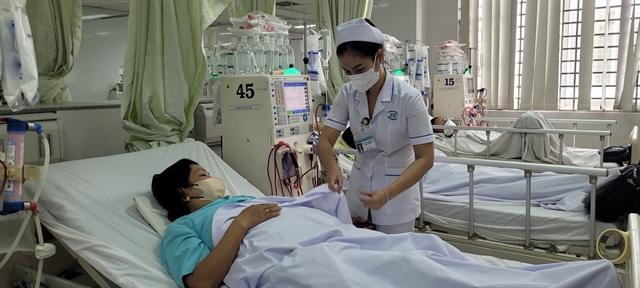 |
| A patient undergoing haemodialysis at Bà Rịa General Hospital in HCM City. VNA/VNS Photo Hoàng Nhị |
HCM CITY — When most people are settling into sleep, Trần Thị Ngọc Giàu’s struggle to stay alive is just beginning.
At 11pm, the 31-year-old resident of Long Trường Ward in HCM City takes a motorbike taxi to Lê Văn Thịnh Hospital for her fifth dialysis session. After four hours of blood filtration, she catches a few hours of sleep at the hospital before returning home early in the morning to take her children to school and then go to work.
With her health severely weakened, Giàu can only take on casual jobs at eateries or hourly domestic work, earning a meagre income.
“Every month, on top of travel expenses, I still have to pay VNĐ3-4 million ($115-153) in co-payments and other costs. Over the years, I have also had to undergo emergency surgery several times. With my finances stretched and my spirits wearing down, I don't know how much longer I can keep going, while my two children are still so young,” Giàu said.
Lê Văn Thịnh Hospital has struggled with an overload of dialysis patients for years. Dr Nguyễn Thị Hồng Quyên of the hospital’s Artificial Kidney Department said the department is currently treating around 230 patients with chronic kidney failure.
Nearly 15 per cent of the hospital’s dialysis patients are under 40, including a significant number under 30. The figures highlight a worrying trend: chronic kidney disease is no longer a condition associated primarily with older people, and is increasingly affecting younger patients.
Dr Nguyễn Minh Tuấn, head of the Artificial Kidney Department at Chợ Rẫy Hospital, said the number of patients with chronic kidney failure requiring regular dialysis has been rising each year — and many of them are young people.
The youngest patient ever treated at the hospital was just 16, and has since undergone more than 30 years of dialysis.
The hospital’s Artificial Kidney Department currently has 74 dialysis machines serving 427 patients requiring regular blood filtration. On average, the department performs about 220 regular dialysis sessions a day, in addition to 50-75 emergency dialysis procedures.
“Dialysis machines in the department are operating at almost full capacity. Each machine performs around four dialysis sessions a day. Some machines reserved for emergency cases are used for up to five sessions a day. That means some patients have to undergo dialysis in the fourth or even fifth shift,” Tuấn said.
According to HCM City’s Department of Health, around 9,000 patients currently undergo haemodialysis at medical facilities across the city. Healthcare facilities have a total of 766 dialysis machines, which are operating at near-full capacity. On average, each machine runs three shifts a day, while at some overloaded facilities, patients have to undergo dialysis in even later shifts.
For many patients, that means undergoing life-sustaining treatment late at night.
Hope from new policy
For 61-year-old Vũ Ngọc Sơn, nighttime dialysis is the only option, because during the day he has to take his older grandchild to school and look after a younger one.
Sitting through another late-night dialysis session, the resident of Cát Lái Ward described the arduous task of staying alive.
“I’ve been sick for years. I’m no longer healthy enough to work and earn money, so all I can do is help my children look after the grandchildren. Even though I have no income, every month I still have to pay for some medicines and medical supplies not covered by health insurance. It is a burden on both me and my children,” Sơn said.
According to Dr Quyên, health insurance covers 80 per cent of haemodialysis costs, leaving patients responsible for the remaining 20 per cent. On average, patients still have to pay around VNĐ3 million ($115) a month out of pocket.
Some patients also have to be hospitalised for other illnesses because of their weakened health, while additional expenses include nutritional supplements and medicines to stimulate red blood cell production. These costs place a heavy financial burden on patients and their families.
Doctors have seen some patients who have stopped treatment midway or reduced the frequency of their dialysis sessions to save money, which can ultimately cost them their lives.
HCM City’s Department of Health considers end-stage chronic kidney failure a particularly serious condition requiring lifelong renal replacement therapy. On average, haemodialysis patients need 12 sessions a month, while those receiving peritoneal dialysis undergo treatment 30 times a month.
Although the national health insurance fund covers a large proportion of treatment costs, patients still have to make frequent co-payments over long periods, placing considerable pressure on household finances. The department estimates that the annual amount needed to cover patients’ co-payments is around VNĐ165.9 billion ($6.3 million).
Against this backdrop, the department has sought public input and submitted a proposal to the municipal People’s Committee to develop a financial support scheme for patients with end-stage chronic kidney disease receiving regular haemodialysis or peritoneal dialysis.
Under the proposal, the city budget would cover 100 per cent of patients’ remaining co-payments after the national health insurance fund has paid its share for two services: regular haemodialysis and periodic peritoneal dialysis.
The department also proposes expanding eligibility to all end-stage chronic kidney disease patients with health insurance who receive treatment at medical facilities in the city and have maintained permanent or temporary residence in HCM City for at least 12 consecutive months.
Support would be provided by directly deducting the eligible amount from patients’ medical bills at medical facilities. Patients would not have to go through complicated procedures to receive the money — instead, hospitals would compile the relevant data and settle the payments directly with the city budget.
“If the city could cover the costs completely, that would be wonderful. Life would be less suffocating and we would have fewer worries,” said Sơn, a long-term dialysis patient in Cát Lái Ward.
For thousands of people living with chronic kidney failure, the proposed policy would do more than remove a financial barrier. It could offer a much-needed lifeline, restoring their hope and giving them a better chance to keep living. — VNS
Society
 Society
 Society
 Society
 Society
 Society
 Society
 Society
 Society
 Society
 Society
 Society
 Society
 Society
 Society