 Society

Việt Nam, EU and Belgium seek deeper, practical cooperation
1.
|
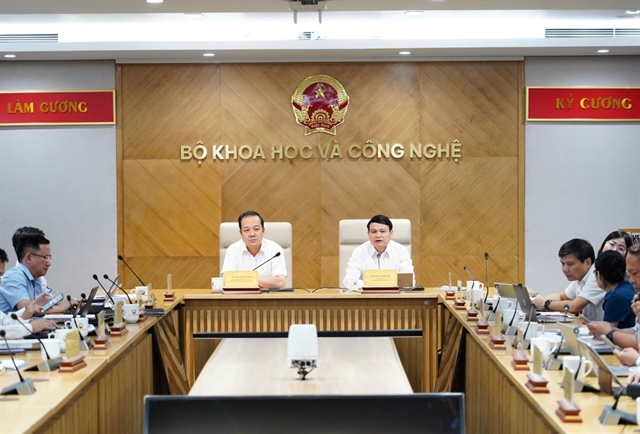
| Deputy Minister of Science and Technology Phạm Đức Long (left) speaks at the meeting with Sơn La Province's People's Committee to review telecommunications infrastructure. Photos courtesy of the Ministry of Science and Technology |
SƠN LA — The Ministry of Science and Technology, Sơn La Province and Viettel Group are working to eliminate areas without mobile coverage and improve connectivity in weak-signal areas across the mountainous province by the end of 2026.
One solution under consideration is using low-Earth-orbit (LEO) satellite technology to provide temporary Wi-Fi connectivity in areas where mobile base transceiver stations (BTS) cannot be deployed immediately. The approach is expected to extend connectivity to remote communities, helping build the infrastructure needed for digital government and narrow the digital divide.
Focusing on villages without mobile coverage
On August 25, Deputy Minister of Science and Technology Phạm Đức Long chaired a meeting with Sơn La Province's People's Committee to review telecommunications infrastructure and agree on measures to address areas without mobile coverage or with weak signals.
Participants compared and verified data on uncovered areas and locations where network quality remains below required standards, and agreed on a roadmap tailored to different areas.
According to the Authority of Telecommunications, from 2021 to 2025, Sơn La worked with telecom operators to provide mobile coverage to 534 villages and hamlets, accounting for about 16.5 per cent of all villages and hamlets covered nationwide during the period.
However, the province's mountainous terrain, dispersed population and remote communities mean that coverage gaps and weak-signal areas remain. Data on areas requiring further action has also been updated as new assessment criteria are applied.
At the meeting, participants agreed on the need to distinguish between areas with no mobile coverage at all and those where coverage exists but network quality is inadequate. This distinction will help determine appropriate investment solutions and prevent areas that already have coverage from being mistakenly classified as coverage ‘dead zones’ requiring new infrastructure.
After reviewing the data, the ministry found that 35 of the 77 villages and hamlets previously reported by Sơn La Province were completely without mobile coverage. Additional areas with inadequate network quality were identified during the latest review. These locations will be classified separately so that operators can focus on upgrading existing networks rather than treating them as new coverage gaps.
Deputy Minister Long said the immediate priority was to eliminate all areas without mobile coverage while gradually improving service quality in locations where infrastructure is already available but signal strength remains poor.
Under the agreed plan, Viettel aims to provide coverage to another 17 villages and hamlets in September and the remaining 38 in the fourth quarter of 2026.
Satellite connectivity for hard-to-reach areas
A notable solution discussed at the meeting was the temporary use of LEO satellite equipment to provide Wi-Fi in areas where BTS infrastructure cannot yet be deployed.
|
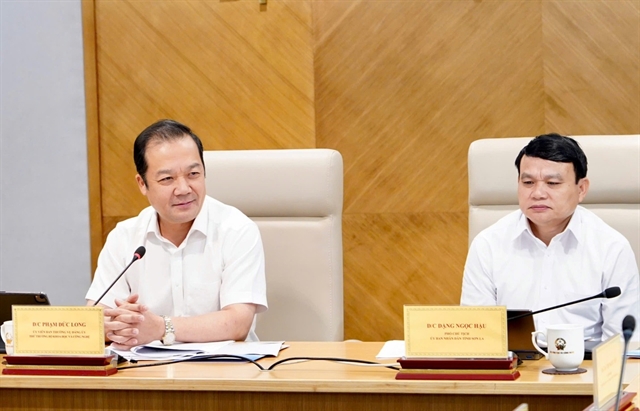
| Deputy Minister of Science and Technology Phạm Đức Long said the immediate priority was to eliminate all areas without mobile coverage. |
The ministry plans to provide one or two satellite equipment sets for each uncovered village, prioritising community cultural houses or other central locations to establish an initial connectivity zone for local residents.
The solution is intended to meet immediate connectivity needs while telecom operators complete permanent infrastructure. Once BTSs are installed and stable mobile coverage is established, the satellite equipment can be retrieved and redeployed to other remote communities.
This approach could provide faster connectivity while making more efficient use of infrastructure and equipment, particularly in mountainous areas where populations are small and scattered and conventional infrastructure can be costly to deploy.
For fixed broadband, the ministry agreed to continue extending fibre-optic networks to key locations such as cultural houses, schools and health facilities. Households that need connections can then extend fibre from these access points to their homes.
Beyond eliminating coverage gaps
The challenge in Sơn La Province is no longer simply whether a village has mobile coverage. Ensuring reliable and consistent connectivity is becoming equally important.
Having a BTS in a village does not mean all residents receive the same quality of service. Mountains, deep valleys, distance between residential clusters and dispersed settlements can create shadowed areas where signal quality deteriorates.
Deputy Minister Long called for accurate mapping of coverage gaps, stressing that areas with no service should not be confused with those where service is available but weak. For locations where infrastructure has already been installed but service quality remains inadequate, telecom operators should optimise and upgrade their networks.
The Authority of Telecommunications also said that digital maps should be used to accurately identify weak-signal areas, including their locations, number of households and houses, and the area requiring coverage. Telecom operators should work with local authorities to conduct field measurements, verify conditions and propose solutions.
This is particularly important in mountainous areas, where discrepancies between data collected by local authorities and telecom operators can make it difficult to accurately determine coverage needs.
Vice Chairman of the Provincial People's Committee Đặng Ngọc Hậu said improved connectivity, particularly in remote villages and hamlets, should go hand in hand with digital transformation at the grassroots level.
He called for continued efforts to resolve obstacles related to mechanisms, funding and equipment so that communes can effectively carry out digital transformation tasks.
One proposal is to develop a village-level digital transformation model, using grassroots service points as connectivity hubs before gradually expanding services to individual households. This approach could make better use of infrastructure, equipment and investment resources, particularly in areas far from commune centres where terrain is difficult and demand for digital services is growing.
The proposal is part of efforts to narrow the digital divide between urban centres and remote areas. Telecommunications infrastructure is considered essential for enabling residents to access online public services, education, healthcare and other digital services, Hậu said.
Under the approach agreed at the meeting, Hậu said, mobile connectivity will be the immediate priority given limited resources. Fixed broadband and fibre-optic infrastructure will continue to be deployed where conditions and demand warrant.
For sparsely populated communities where BTS construction is technically difficult or costly, solutions such as LEO satellite-based Wi-Fi could be considered based on factors including the number of households, required coverage and investment costs.
For Sơn La, eliminating coverage gaps and improving weak-signal areas is particularly important as the province accelerates digital transformation and operates under the two-tier local administration model. Reliable connectivity will enable people in remote areas to access digital services, online public services and other essential services of the digital society. — VNS
Society
 Society
 Society
 Society
 Society
 Society
 Society
 Society
 Society
 Society
 Society
 Society
 Society
 Society
 Society