 Society
Việt Nam, Poland establish Strategic Partnership
1.
|
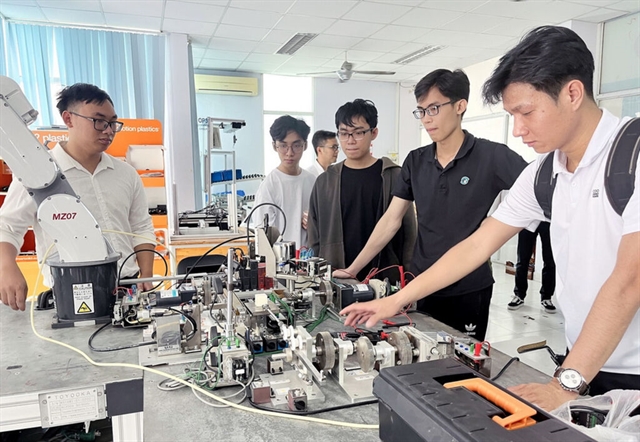
| Students conduct practical research at the HCM City High-Tech Park Training Centre.Việt Nam aims to have at least 100 AI start-ups valued over US$10 million by 2030. — VNA/VNS Photo Thanh Vũ |
HÀ NỘI — Việt Nam is standing at a turning point in the development of artificial intelligence (AI), shifting from exploiting existing technologies to proactively building AI capabilities.
To build that capability, Việt Nam must simultaneously solve the problems of models, computing infrastructure, data, human resources and enterprises, forming an ecosystem capable of creating technologies, products and value bearing the country’s identity.
At a recent working session with Minister of Science and Technology Vũ Hải Quân, Vikram Rao, Vice-President and ASEAN Regional Director of Nvidia, proposed future cooperation with Việt Nam to build a large language model (LLM) mastered by Việt Nam, suited to domestic data, language and needs, based on open-source models and tools developed by Nvidia.
Clearly stating the proposal to connect Việt Nam’s AI ecosystem with the global ecosystem, Nvidia’s representative said that this direction of cooperation would allow products, enterprises, and AI capabilities to participate more deeply in the ASEAN market then expand internationally.
The cooperation proposals are assessed as suitable to Việt Nam’s strategy and orientation for developing science, technology, innovation, and digital transformation.
At the same time, they show that the requirement for AI development is being set at a broader level, not merely introducing technology into each product or service.
For AI to become a technological capability of the nation, there must be the capacity to research, develop, adjust, evaluate and operate models suited to Việt Nam’s data and language. This orientation is clearly reflected in the draft National AI Transformation Strategy to 2030, with a vision to 2045.
According to Trần Anh Tú, deputy director of the Department of Digital Technology and Artificial Intelligence, Ministry of Science and Technology (MoST), the first guiding viewpoint of the strategy that Việt Nam is developing is 'comprehensive transformation through AI'.
Instead of introducing AI into each product, service or individual process, this technology is oriented to become a core capability from the stage of problem identification, system design, to operation.
In the public sector, the draft sets the target that by 2030, all online public services and administrative procedure files will be AI-supported. All ministries, sectors, and localities will issue AI transformation plans.
Sixty per cent of directive and managerial decisions by State agencies will have the support of data and artificial intelligence. In the private sector, AI technology will support a minimum of 500,000 small and medium-sized enterprises, business households, and cooperatives.
Việt Nam will have at least 100 AI start-ups valued at over US$10 million.
The draft proposes building a national computing-capacity coordination platform, a Vietnamese language model evaluation platform, at least five shared AI platforms and eight Vietnamese language models.
The strategy sets the general target that artificial intelligence will contribute about six per cent of GDP and Việt Nam will be among the top three in Southeast Asia for AI research and development.
With a vision to 2045, Việt Nam will belong to the group of 10 leading countries in Asia for AI capability, artificial intelligence becoming the principal operational foundation of the State, the economy, and society.
Master technology
Alongside models, computing infrastructure and data, AI human resources must also be linked to the actual needs of the market.
Recently, the MoST established the Global Vietnamese AI Expert Network to connect experts, scientists and Vietnamese entrepreneurs at home and abroad, creating a pilot model to attract, gather and leverage high-quality resources in the field of AI.
Prime Minister Lê Minh Hưng has issued Decision No. 1528/QĐ-TTg approving the National Programme on AI Human Resources Development to 2030, with a vision to 2035.
The objective is to develop an AI workforce of scale, structure, and quality meeting the requirements for developing strategic technology sectors, enhancing national technological self-reliance capacity, promoting innovation, digital transformation, developing the digital economy and digital society.
The programme sets specific targets: to newly train, retrain, and upskill a minimum of 50,000 human resources at university level or above, with the capacity to apply AI in key sectors and fields.
At the same time, to train and upskill at least 10,000 high-level AI human resources, including researchers, engineers, and experts with the capacity to research, develop, master, deploy, operate, and manage advanced AI systems.
Among these, there will be at least 1,500 experts capable of researching, developing, mastering core technologies, and leading key AI tasks.
Việt Nam sets the target of joining the group of three leading countries in Southeast Asia for AI research, development, and application; developing a minimum of six AI systems based on Vietnamese data serving essential fields such as justice, finance, agriculture and environment, culture, education, and healthcare.
This is an important step to move AI out of the pilot scope, progressing towards creating products and markets. — VNS
Society
 Society
 Society
 Society
 Society
 Society
 Society
 Society
 Society
 Society
 Society
 Society
 Society
 Society
 Society




