 Society

Xsolla Mall Brings Six Indie PC Games Together in One Limited-Time Bundle
1.
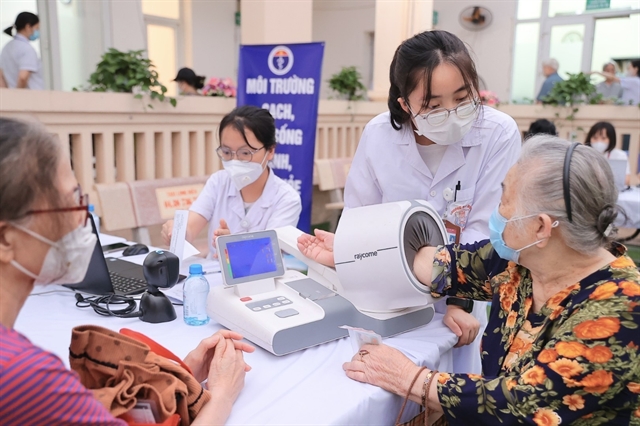 |
| Older people receive a free health examination in Việt Hưng Ward, Hà Nội. The capital city strives for about 95 per cent of older people to access at least one appropriate healthcare, social care or rehabilitation service. — VNA/VNS Photo Minh Quyết |
HÀ NỘI — Population ageing is placing increasingly heavy pressure on Hà Nội in terms of healthcare, social welfare and long-term care, but with nearly 1.4 million older people, including hundreds of thousands who remain healthy, knowledgeable and eager to contribute, the capital also possesses a special development resource.
New mechanisms enacted through the Law on the Capital 2026 are paving the way for the formation of a silver economy ecosystem, which both meets the needs of older people and harnesses their experience and intellect to create additional growth momentum.
The core of the silver economy is a change in how older people are perceived. They are not only beneficiaries of social welfare policies, but also consumers, workers, owners of production and business establishments, investors, experts, artisans and transmitters of knowledge.
Hà Nội is rapidly entering the population ageing stage. According to the National Population Database cited in the policy development dossier, the city currently has nearly 1.4 million older people, accounting for more than 16 per cent of the population. Forecasts predict that the number of older people could rise to around 1.71 million by 2030.
The system supplying products and services for older people in the city has not kept pace with demand.
The number of care facilities is limited and unevenly distributed, community-based care and day care models are still in their early stages and social investment in this field is not commensurate with its potential. High investment costs, long capital recovery periods and difficulties in accessing land are barriers that make enterprises cautious.
Conversely, a large proportion of older people in the capital remain healthy, have income and have increasingly diverse needs in learning, travel, sport, culture, entertainment and high-quality healthcare.
This is a group with considerable purchasing power, but it has not been fully recognised as a market for specialised products.
According to Nguyễn Thế Toàn, chairman of the Hà Nội Association for the Elderly, the city has more than 290,000 older people who are retired public employees. Around 70,000–100,000 of these are intellectuals, scientists, teachers, artists, successful entrepreneurs and village artisans.
This is a source of intellectual knowledge, a particularly valuable asset for the capital. After retirement, many can still conduct research, provide consultancy, train, pass on skills, participate in corporate governance or work part-time.
If appropriate connection mechanisms are in place, this knowledge base can support young enterprises, universities, research institutes, craft villages and the start-up ecosystem.
In practice, older people are already quite deeply embedded in Hà Nội’s economic life.
A 2023 review of the movement 'Older people doing well in the economy' showed that the city has more than 158,000 older people directly participating in economic activities. Around 15,000 have earned achievements in production, business and green transformation movements. Nearly 10,000 older people own enterprises, cooperatives or business households, creating jobs for nearly 80,000 workers.
Silver economy ecosystem
Lê Trung Hiếu, deputy director of the Hà Nội Department of Finance, said that the silver economy is not newly emerging. This field is only just beginning to be recognised as both a market and a development resource, however. The Law on the Capital 2026 opened an institutional door for this perspective to be translated into policy, Hiếu said.
The city’s policies are designed along two lines: the first is to develop products and services for older people, while the second is to create conditions for older people to continue participating in labour, start-ups, production, business and the provision of knowledge to society.
For the public sector, the city prioritises allocating land funds, investing in facilities, equipment, technology and digital transformation, and training workers in geriatric nursing, rehabilitation and community-based elderly care.
Mechanisms for ordering, assigning tasks or bidding for the provision of public services are used to enhance the responsiveness of the care system.
For non-public facilities, policies aim to remove bottlenecks related to land, capital, technology and personnel.
Eligible facilities may be considered for investment incentives under city regulations, and given access to preferential capital, surplus land funds and public offices, or support to apply AI, the Internet of Things and digital technology in health management and remote safety warnings.
Hà Nội aims by 2030 to develop around 70 additional non-public care facilities, raising the total number of elderly care facilities in the city to 126, and to establish around 126 community-based day healthcare centres.
The city strives for about 95 per cent of older people to be able to access at least one appropriate healthcare, social care or rehabilitation service.
Population ageing is an irreversible trend. With advantages in institutions, market size, science and technology, and a large intellectual workforce, Hà Nội is well placed to take the lead in developing the silver economy.
When care policies are linked with employment, start-up and innovation policies, advanced age no longer means exiting economic life. — VNS
Society
 Society
 Society
 Society
 Society
 Society
 Society
 Society
 Society
 Society
 Society
 Society
 Society
 Society
 Society