 Society
National conference maps out comprehensive diplomacy at new height
1.
|
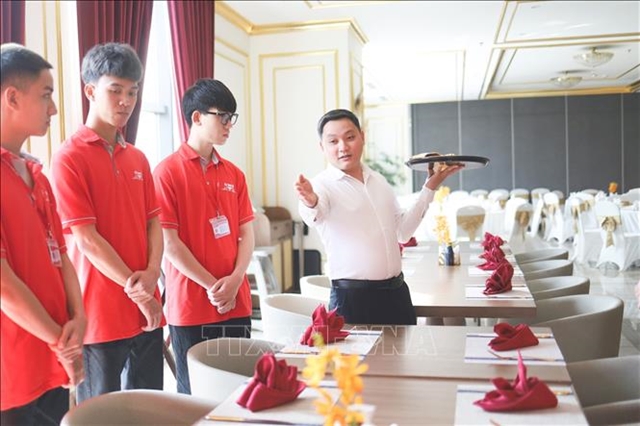
| A lecturer from the Hotel Management Faculty at the Việt Mỹ College teaches table-setting techniques in hotels to trainees. Pupils, students, and lecturers will be supported to study in developed countries. — VNA/VNS Photo Diệu Thuý |
HÀ NỘI — Pupils, students, and lecturers will be encouraged and supported in undertaking study, research, visiting lectureships, and academic exchanges in developed countries, countries with traditional relations with Việt Nam, and those with strengths in key sectors and fields.
It is regulated in a draft decree, which has been compiled by the Ministry of Education and Training (MoET).
According to the draft, learners eligible for these policies are Vietnamese citizens sent to pursue undergraduate, master's, or doctoral degrees under approved projects and scholarship programmes utilising state budget resources.
The field of study at the foreign educational institution must belong to the top 500 disciplines worldwide according to reputable international rankings at the time the competent authority approves the list of successful candidates or the decision to send the learner abroad.
The draft proposes that learners be supported with two economy-class return air tickets during their study period; passport and visa fees; transport costs from the airport to the place of study and vice versa; health insurance; and tuition fees.
Monthly living allowances are proposed at 1.5 times the highest living allowance currently applied to undergraduate students, and twice that amount for master's and doctoral students.
Master's and doctoral students who are public employees or workers in state agencies, state-owned enterprises, or educational institutions will retain their salaries and allowances. Those without an employing agency will be given priority in recruitment as public employees in accordance with current regulations.
The draft also proposes support policies for lecturers from higher education and vocational education institutions holding doctoral degrees, who are sent by competent authorities to deliver visiting lectures and conduct academic exchanges with foreign educational institutions under bilateral cooperation programmes or academic exchange programmes within the framework of international treaties or agreements to which Việt Nam is a member or signatory.
The content of visiting lectures and academic exchanges must fall within key sectors and fields and meet prescribed conditions.
Under the draft, lecturers will retain their salaries and allowances during their period of visiting lectureships, scientific research, or academic exchanges abroad.
They will be supported with one economy-class return air ticket, passport and visa fees, transport costs from the airport to their accommodation and vice versa, health insurance, and a monthly living allowance.
The living allowance is expected to be equivalent to the highest living allowance currently applied to Vietnamese citizens studying abroad under projects and training programmes of the Government of Việt Nam.
Where lecturers receive partial financial support from foreign educational institutions or other organisations or individuals, the state budget will cover only the shortfall relative to the entitled allowance level.
The MoET will prescribe conditions and commitments regarding output products for lecturers undertaking visiting lectureships and academic exchanges.
The specific list of countries will be issued by the MoET after obtaining written agreement from the Ministry of Foreign Affairs. The list of key sectors and fields, as well as the list of reputable international rankings, will be prescribed by the MoET.
The MoET expects to finalise the dossier and submit it to the Government for consideration in November this year, with implementation from next year onwards. — VNS
Society
 Society
 Society
 Society
 Society
 Society
 Society
 Society
 Society
 Society
 Society
 Society
 Society
 Society
 Society