 Society

Việt Nam national youth ice skating championships attract record 112 athletes
1.
by Lê Hương
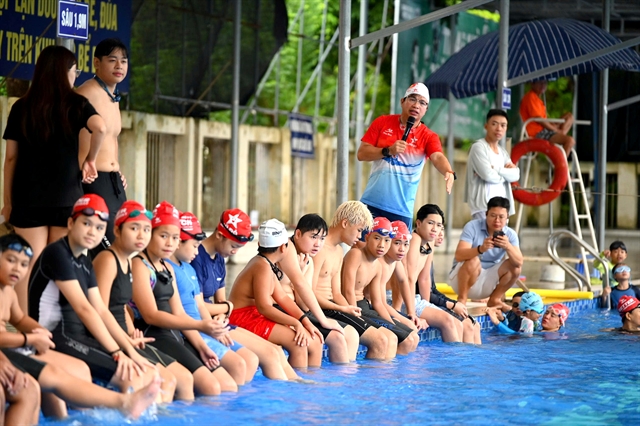 |
| Nguyễn Văn Thủy (with microphone) instructs his students. VNS Photo Lê Minh |
“Alright, keep going! Come on, faster! Keep it up... Minh Nhật, there's still one more lap to go. You've only done six laps. Come on, let's go!...”
For the past 15 years, this has been part of Nguyễn Văn Thủy’s daily routine.
Every morning, the founder of the Red Caps Swimming Club in Hà Nội puts children through physical conditioning before they enter the pool. But swimming is not the only part of what he wants them to learn.
Children are taught how to float, breathe, stay calm if they unexpectedly fall into the water and, ultimately, survive.
“First, we teach survival breathing skills," Thủy told Việt Nam News.
"Children learn how to stay afloat and survive in the water for at least 30 minutes, tread water continuously for five to seven minutes, and if they accidentally fall into the water, they are taught to remain calm and do nothing for the first five seconds.”
What began as one man’s effort to teach children how to swim has grown into a community of hundreds. Some former students have even gone on to help rescue people from drowning.
The philosophy behind the Red Caps Club is now reflected in a much broader effort: Việt Nam’s national programme to prevent child drowning.
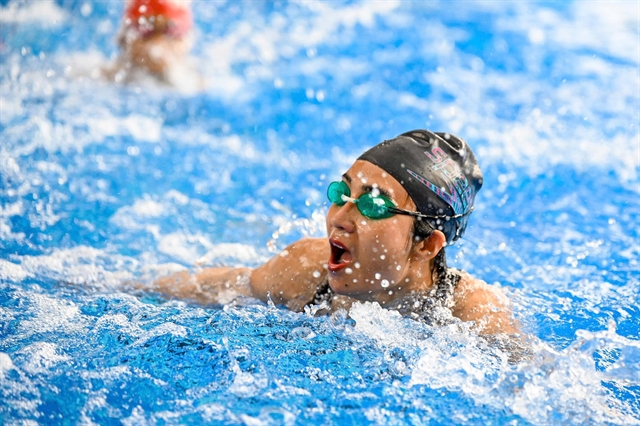 |
| Survival swimming is the most important skill that teacher Thủy teaches his students. VNS Photo Lê Minh |
When swimming becomes a survival skill
For many parents, swimming is a summer activity. For Thủy and the Red Caps team, it is something more fundamental.
The club’s lessons are free. Children learn conventional swimming techniques, but survival swimming is given particular importance.
Lương Thanh Hòai, a parent who has brought his children to the club for four years, said: “Vietnamese children are given many opportunities to learn swimming, but swimming does not always become a daily or survival skill. When children practise regularly, they gradually develop swimming as an essential survival skill."
Another parent, Vũ Thị Thu Thảo, believes the most important lesson is what a child does in the first few seconds after falling into water.
“Survival swimming means that if children accidentally fall into the water, they do not panic in those crucial first three to five seconds," she said.
"Instead, they instinctively hold their breath and float on the surface.”
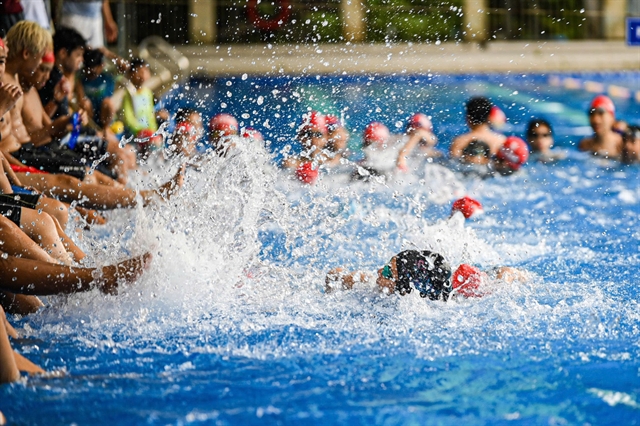 |
| Swimming lessons become more fun with water games. VNS Photo Lê Minh |
The need for such skills is particularly urgent in Việt Nam. Thủy's effort is among those to curb the death rate of child drowning in the country.
Around 1,800 children die from drowning every year, making drowning the leading cause of accidental injury deaths among children under one year old.
"Through this swimming class, I've learned how to swim, float, and handle situations in the water,” said Nguyễn Ngọc An Nhiên, a 13-year-old student who joined the national programme in Huế City.
“I want to tell my friends that when they go swimming, they should always go with their parents or other family members, not just with their friends or by themselves. Even if you know how to swim, drowning can still happen.”
That message is particularly relevant in a country where children may encounter rivers, ponds, lakes, canals, flooded areas and the sea in their daily lives.
In Huế, where heavy rain and flooding are common, parent Nguyễn Văn Tài sees swimming lessons as more than recreation.
“It’s very good that students are being given free swimming lessons like this. In Huế, flooding is quite frequent, and there are many rivers and lakes, so children often swim on their own. Equipping them with swimming skills and water-safety knowledge like this is very important.”
From grassroots lessons to a national programme
Việt Nam’s response to child drowning has been developing for more than a decade, but the programme expanded significantly from 2018 with support from Bloomberg Philanthropies and technical assistance from international partners.
 |
| Children in Đà Nẵng play with Bobo, the mascot of the national child drowning prevention programme. VNS Photo Lê Minh |
Since 2018, survival swimming programmes have been introduced in ten cities and provinces, reaching thousands of children with water safety skills.
The wider programme has now reached more than 400,000 children with safe swimming lessons and more than 52,000 children with water safety skills. In localities where interventions were implemented, drowning mortality has fallen by 16 per cent, according to programme data.
For Caroline Lukaszyk, Technical Officer for Unintentional Injury Prevention at WHO Headquarters, Việt Nam’s experience offers lessons beyond its borders.
“The World Health Organization refers to Việt Nam's efforts in child drowning prevention as a best practice case study for a number of other countries around the world who are also hoping to make progress in drowning prevention,” she said.
“We now see a very impressive national programme, particularly around teaching children swimming and water safety skills, that has seen a legitimate reduction in drowning deaths."
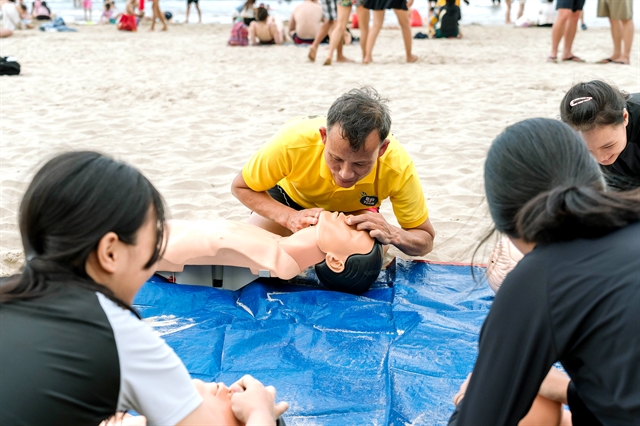 |
| A teacher and children in Đà Nẵng attend a first-aid lesson. VNS Photo Lê Minh |
Making the programme fit local needs
One reason the programme has worked, according to Phạm Việt Cường of the Hà Nội University of Public Health, is that Việt Nam did not simply copy international models.
Instead, proven interventions were adapted to local circumstances.
Cường said: “In developing this programme, we drew on internationally proven interventions that have been scientifically shown to effectively reduce drowning deaths. We then adapted and implemented them in Việt Nam.
"Our approach went beyond adapting them for the country as a whole; we also took into account the unique characteristics of each locality.”
Mountainous communities, lowland areas and riverine regions face different risks and have different resources.
Cường added: "We also considered the reality that resources are often limited, designing the programme to be practical, sustainable, and achievable. This approach has delivered very positive results over the past few years.”
Affordability is also important. Sixteen swimming lessons cost only around VNĐ750,000 (US$30), while children from disadvantaged families can receive free swimming classes.
Local action, measurable results
Some of the clearest evidence of what can happen when drowning prevention becomes a local priority comes from Đồng Tháp.
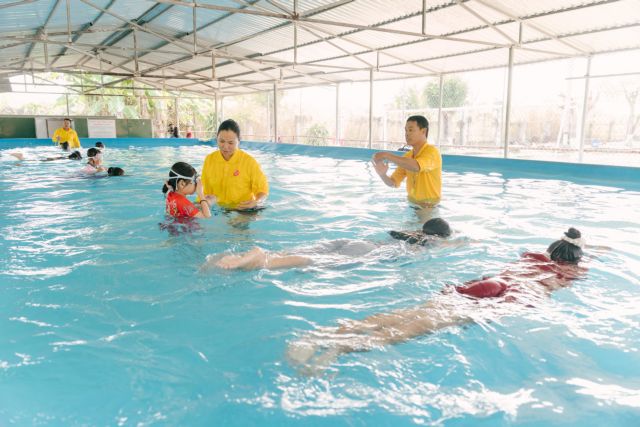 |
| A swimming lesson in southern province of Đồng Tháp. VNS Photo Lê Minh |
The Mekong Delta province began with only around 20 per cent of children able to swim. After five to six years of the programme, the proportion had risen to around 50–60 per cent.
More significantly, the number of children dying from drowning in the 2020–25 period was half that of the previous five years, according to Cường.
He attributes part of the success to making swimming and drowning prevention part of the province’s economic, cultural and social plans.
Quảng Trị offers another lesson.
Where public schools did not have enough swimming pools, local authorities worked with private facilities to provide access. More than 90 per cent of participating children achieved safe swimming skills.
Together, these examples show that there is no single infrastructure solution to drowning. Where there are pools, they can be used. Where there are not enough pools, mobile pools or public-private partnerships can help.
What matters is that swimming and water safety become part of the regular system rather than a short-term campaign.
From projects to a lasting system
But perhaps the biggest challenge now is not proving that drowning prevention works, but making sure the work continues.
For years, many activities have depended heavily on international funding and technical support. Cường believes Việt Nam needs to move from short-term projects towards a sustainable national system.
“The activities are still heavily dependent on foreign funding," he said.
"To make the programme sustainable and effective in the long term, I think this is the time when we need to institutionalise the programme and make it a sustainable and continuous programme, incorporating these activities into the economic, cultural and social plans of provinces.”
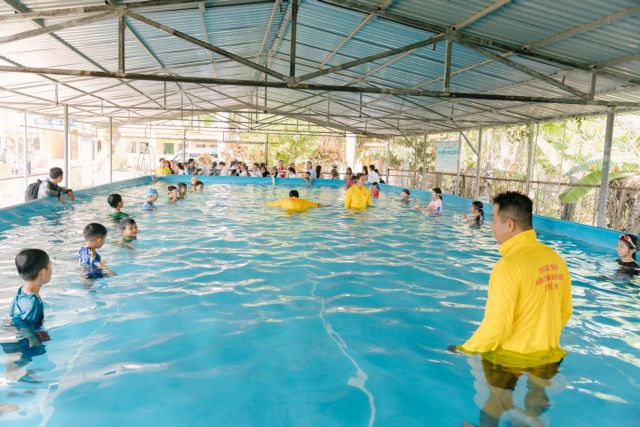 |
| Đồng Tháp has significantly reduced its child drowning rate thanks to prevention programmes.VNS Photo Lê Minh |
Cường says sustainability should be measured not simply by whether a programme exists, but by whether local governments allocate money and people to it, whether schools and families participate, and whether children actually complete the required training.
“We have swimming pools, programmes and swimming classes, but very few children take part, and the number of children who are able to meet basic water-safety swimming standards remains low. So I don’t think that can be considered a sustainable approach.”
More than learning to swim
The objective of the national prevention programme is not merely to teach children to swim but also to ensure they can stay calm, recognise danger, protect themselves and help others.
For a country where water is woven into everyday life, from rivers and canals to beaches and floodwaters, those are skills that can remain valuable long after a swimming lesson ends. VNS
Society
 Society
 Society
 Society
 Society
 Society
 Society
 Society
 Society
 Society
 Society
 Society
 Society
 Society
 Society